
Ministry of Education and UNESCO Encourage Youth to Become Solutions in Addressing Environmental Conservation Challenges
The future of food security, marine conservation, and the quality of life for Indonesians depends heavily on the younger generation’s ability to understand and protect the environment. Therefore, education must provide learning experiences that are close to real life, enabling students to become part of the solution to various challenges.
This principle underpinned the Ministry of Basic and Secondary Education’s (Kemendikdasmen) participation in the National Forum on Education for Sustainable Development (ESD), organised by UNESCO and the Indonesian National Commission for UNESCO (KNIU) in Jakarta on Monday (15/6). The forum, themed ‘Biosphere Reserves and Oceans as Learning Spaces for People and the Planet’, brought together national and international stakeholders from government institutions, academia, civil society, the private sector, and development partners to discuss sustainable education policies and strengthen cross-sector collaboration.
In his opening remarks, Minister of Basic and Secondary Education Abdul Mu’ti asserted that education must develop the whole Indonesian person, in line with the direction of national development. He added that future challenges demand a generation that balances intellectual, emotional, and spiritual intelligence with environmental awareness, in accordance with the vision of President Prabowo Subianto. ‘Education must bring students closer to the nature around them. We must ensure that education not only produces people who can live in the world, but also people who can protect the world,’ he stated.
He explained that the ministry continues to promote the Deep Learning approach, which allows students to learn reflectively, contextually, and meaningfully. Within this approach, nature is viewed not merely as an object of study but as a learning space that provides real experiences for students. Strengthening education for sustainable development also aligns with efforts to build students’ character, fostering social awareness, critical thinking skills, and a spirit of mutual cooperation in facing various global issues.
Meanwhile, Maki Katsuno-Hayashikawa, Director of the UNESCO Regional Office in Jakarta, stated that global challenges such as climate change, biodiversity loss, and ecosystem degradation require a transformation in education. ‘ESD is not just about teaching sustainability topics. It is about transforming the way we learn, the way we teach, and the way we interact with the world around us,’ she emphasised.
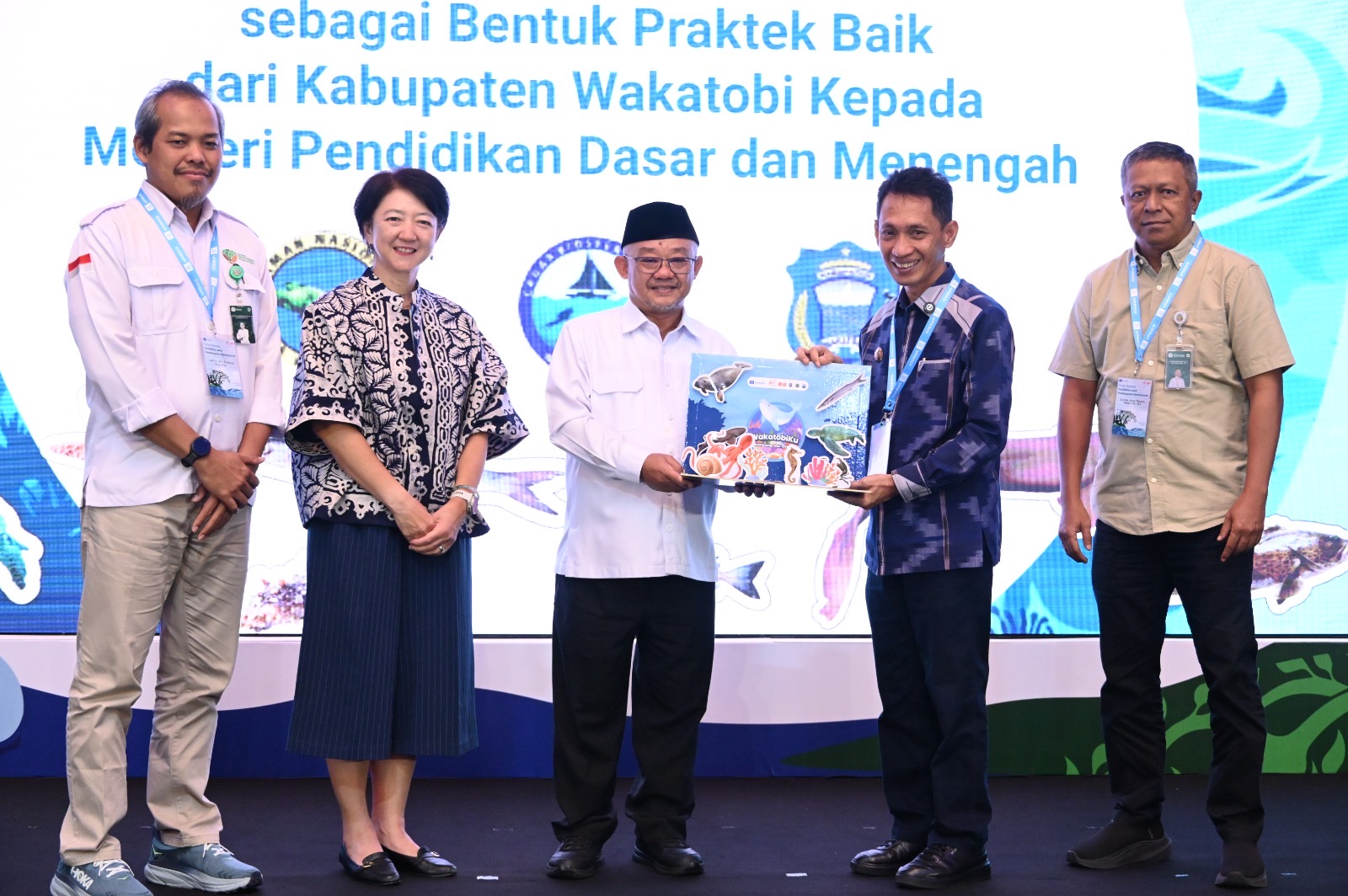
Through the Sustaining Our Oceans (SOO) project, supported by Fast Retailing (UNIQLO), UNESCO and its partners continue to strengthen the capacity of educators and communities to become agents of change in protecting marine ecosystems. The programme has been implemented in Wakatobi through the development of learning materials that connect modern science with local ecological knowledge, making it more relevant to students’ lives. The forum also featured the symbolic handover of the ‘Wakatobiku’ learning package to Minister Abdul Mu’ti, representing collaboration between the government, international organisations, local governments, and various development partners in strengthening sustainable education in Indonesia.