
Ministry of Culture Designates Muna's Liangkabori Cave as National Heritage Site
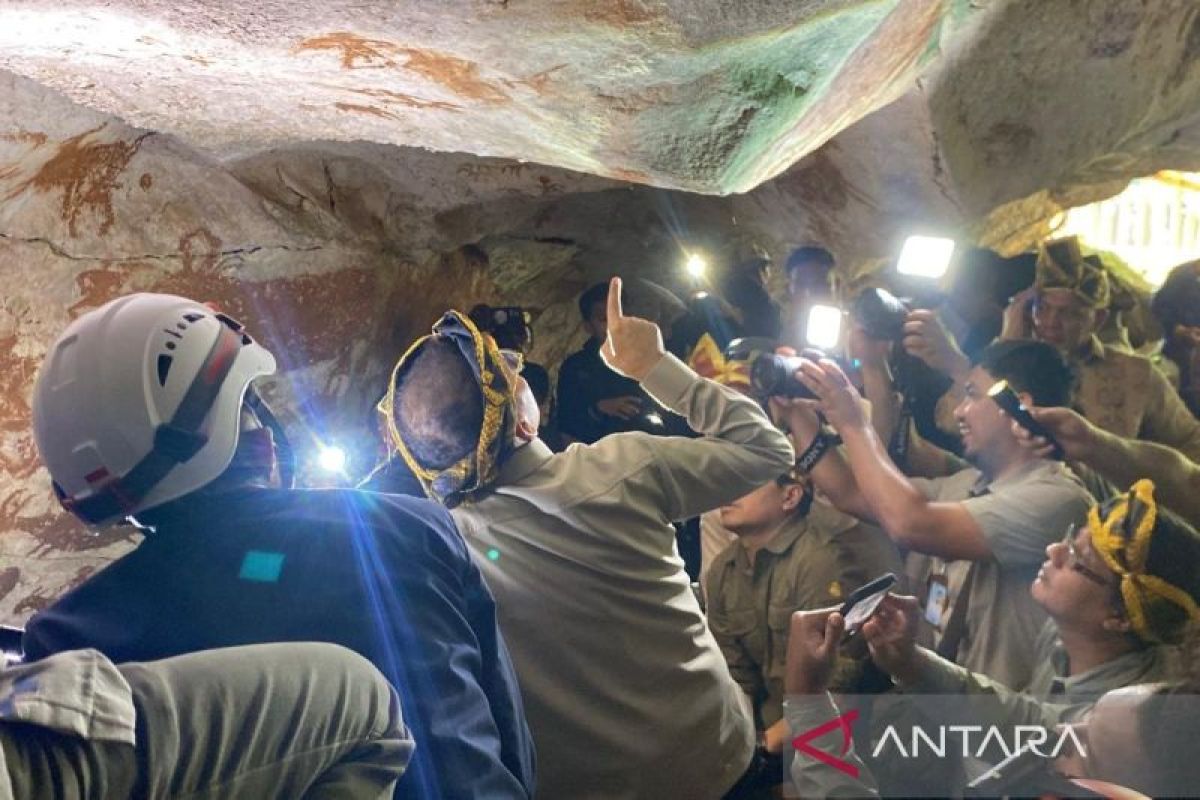
Muna (ANTARA) - The Ministry of Culture of the Republic of Indonesia has designated the prehistoric Liangkabori and Liang Metanduno cave areas in Muna Regency, Southeast Sulawesi (Sultra), as National-Ranked Cultural Heritage Sites.
Minister of Culture Fadli Zon, contacted in Muna on Sunday, said that all stages of the designation hearing by the National Cultural Heritage Expert Team had been completed last week.
“The designation hearing was completed last week. Now it just needs to be announced, God willing, in early August as a national cultural heritage site,” said Fadli Zon.
Through this festival and the designation of status, Fadli believes Indonesia is once again opening a crucial chapter in the history of humankind, given that the site holds some of the oldest evidence of civilisation in the world.
Fadli Zon revealed that the Liang Metanduno site came under the global archaeological spotlight following the publication on 22 January 2026 of research conducted jointly by domestic and foreign universities, together with Griffith University in Australia and the Cultural Preservation Office.
“The results of that research were officially recorded in the Guinness Book of Records 2026 as the world’s oldest non-figurative cave painting,” he said.
He explained that scientific testing using the laser ablation uranium-series method proved that the ancient visual pigment panel, measuring 14 cm by 10 cm, in the cave is at least 67,800 years old.
The finding breaks the previous world record held by Leang Karampuang in Maros Pangkep, South Sulawesi, which is 51,200 years old. Moreover, the Muna discovery is recorded as being 1,100 years older than the minimum age of the ancient hand stencil at Maltravieso in Spain, associated with Neanderthals, and far exceeds the age of the legendary cave wall paintings in France, such as Chauvet Cave (30,000-32,000 years) and Lascaux (17,000 years).
Fadli considers the archaeological evidence of modern humans (Homo sapiens) in Muna, spanning more than 2,700 generations, to have great potential to challenge the dominance of the single Out of Africa migration theory in return.
“Science has long been influenced by colonialism, which always viewed us as relatively younger, with the centre over there in Europe. With this very strong archaeological evidence, we must dare to challenge those old theories. The narrative of human migration could well be two-way or multiple traffic, including the potential for Out of Nusantara or Out of Sulawesi,” he said.
To optimise protection against the threat of physical degradation due to climate change, the Ministry of Culture is committed to building a Prehistoric Painting Information Centre in the Muna Islands through its office in Southeast Sulawesi.
In addition, the Ministry has instructed that all prehistoric rock paintings in the Muna region, Maros Pangkep, Kalimantan, and Raja Ampat be documented in a comprehensive book, and that high-scale visual replicas be displayed at the Southeast Sulawesi Provincial Museum as a showcase for public education.
Source: jawawa.id (https://jawawa.id/newsitem/ministry-of-culture-designates-munas-liangkabori-cave-as-national-heritage-site-1783853588)
Originally published by Antara (Indonesian) (https://www.antaranews.com/berita/5646268/kemenbud-ri-tetapkan-kawasan-gua-liangkabori-cagar-budaya-nasional), translated from Indonesian