
Ministry of Creative Economy partners with media to drive creative IP as source of foreign exchange
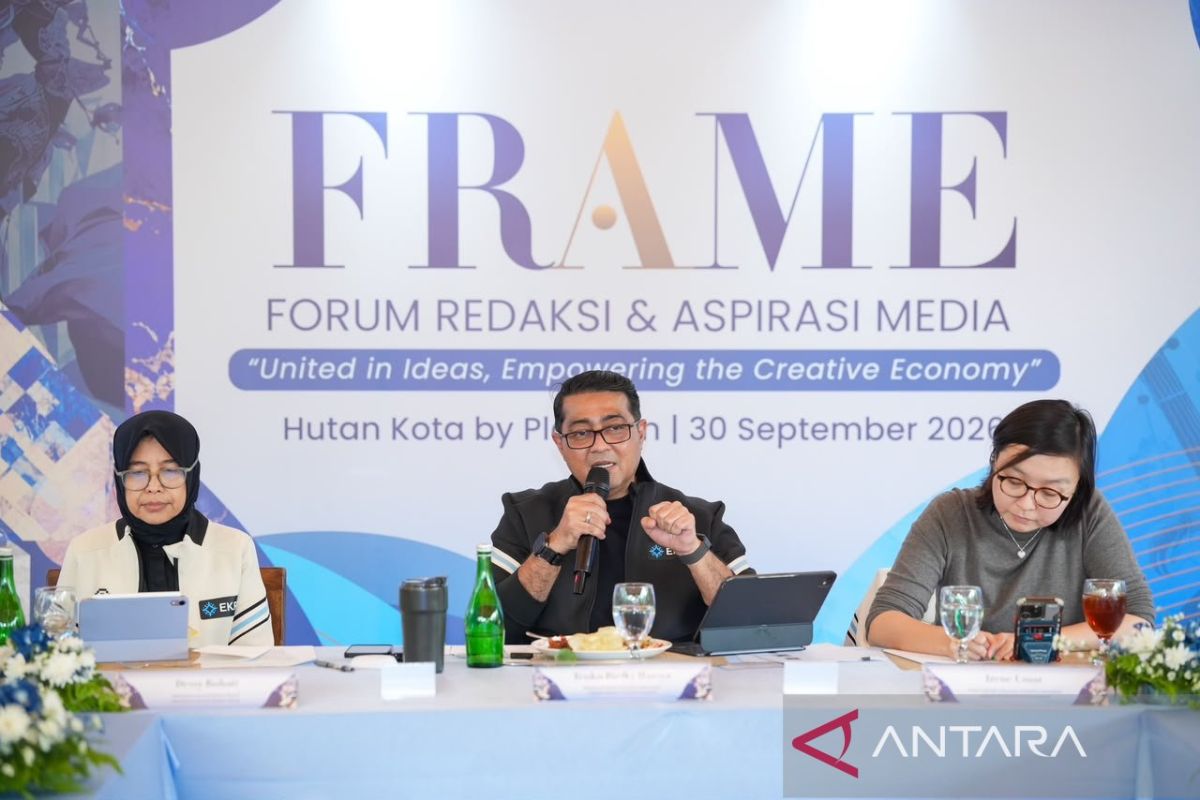
Not only should we export our arts and culture, but we must also export the Intellectual Property (IP) of our creative economy to provide economic value that increases national foreign exchange.
he Ministry of Creative Economy is synergising with the media to encourage the Intellectual Property (IP) of Indonesian creative economy products to become a new source of economic value and national foreign exchange.During the Editorial Forum & Creative Economy Media Aspirations (FRAME), the Minister of Creative Economy, Teuku Riefky Harsya, invited leaders of national media to demonstrate the role of strengthening IP as a creative economy sector that contributes to the national economy.
“Not only should we export our arts and culture, but we must also export the IP of our creative economy so that it provides economic value that increases national foreign exchange,” Riefky stated in a release received in Jakarta on Friday.
Under the theme ‘United in Ideas, Empowering The Creative Economy’, the FRAME forum, attended by 30 national media leaders, discussed how the creative economy sector continues to prove its vital role in the national economy.
Based on data from the Central Bureau of Statistics (BPS) cited by the Ministry of Creative Economy, the Gross Domestic Product (GDP) of the creative economy reached IDR 1,757.87 trillion, with a growth rate of 6.86 per cent. This growth stands above the national economic growth rate of 5.11 per cent.
According to Riefky, the creative economy also plays a role in job creation, particularly for the younger generation. The same data shows that the creative economy workforce is dominated by Millennials at 36.63 per cent and Gen Z at 26.40 per cent.
The strengthening of IP will be driven through Indonesia’s role as the host of The 5th World Conference on Creative Economy (WCCE) 2026. The forum is targeted to produce the ‘Jakarta Vision on Creative Economy’ and strengthen the creative economy agenda within global development.
Riefky stated that the WCCE serves as a momentum to strengthen Indonesia’s creative economy position on the international stage through diplomacy and collaboration.
Deputy Minister of Creative Economy, Irene Umar, noted that WCCE 2026 will bring together various stakeholders, ranging from the government to business actors, including through government-to-government (G2G) meetings.
“WCCE is intended to bring this resolution to the United Nations; furthermore, it serves as a platform where stakeholders will gather, from government to business. Moreover, WCCE will feature not only plenary meetings but also G2G meetings,” explained the Deputy Minister.
Support for this strategic move was also voiced by media leaders. The Deputy Editor-in-Chief of TV One, Wahyu Kustyanto, assessed that the creative economy possesses limitless potential and deserves to become a main pillar of national economic growth.
“This Ministry of Creative Economy is very important. It can become a pillar for Indonesia’s future economic growth. Because creativity is inexhaustible, whereas natural resources will eventually run out. Therefore, the state and the government must be truly serious in developing this creative economy,” said Wahyu.
The implementation of FRAME is expected to unite ideas and strengthen media understanding of government priorities and policy directions for strengthening the global market through IP to support Indonesia’s new economic growth.
Source: jawawa.id (https://jawawa.id/newsitem/ministry-of-creative-economy-partners-with-media-to-drive-creative-ip-as-source-of-foreign-exchange-1790909840)
Originally published by Antara (Indonesian) (https://www.antaranews.com/berita/5767829/menekraf-sinergi-dengan-media-dorong-ip-ekraf-jadi-sumber-devisa), translated from Indonesian