
Ministry of Creative Economy partners with BINUS to strengthen national creative ecosystem
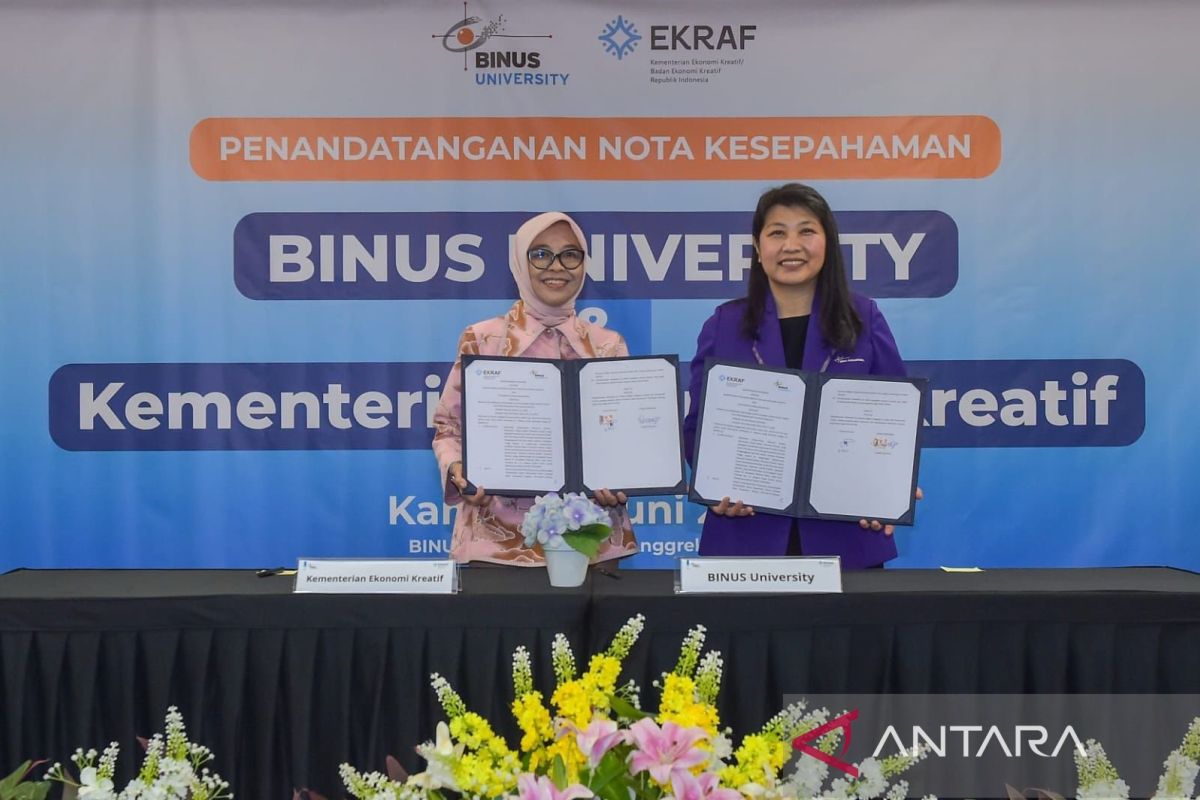
Jakarta (ANTARA) - The Ministry of Creative Economy/Creative Economy Agency (Ekraf) has partnered with BINUS University in an effort to strengthen synergy in the development of the national creative economy through the signing of a Memorandum of Understanding (MoU) regarding the Synergy of Implementing the Catur Dharma of Higher Education and Creative Economy Development.
“Through this cooperation with BINUS University, we hope to introduce various programmes capable of strengthening the creative economy ecosystem and increasing the competitiveness of Indonesian creative economy talents and actors,” stated the Secretary of the Ministry of Creative and the Executive Secretary of the Creative Economy Agency, Dessy Ruhati, in a statement received on Friday.
The scope of the cooperation includes the implementation of education, research, community service, technology transfer, and personal development aligned with the evolving needs of the creative industry.
This partnership serves as a strategic step in enhancing the national creative economy ecosystem through the strengthening of human resources, research, innovation, and collaborative programmes that provide tangible benefits to society.
Dessy noted that in developing the creative economy, the government cannot work alone but requires cross-sector collaboration involving the government, academia, the business world, communities, media, and financial institutions.
“Through this collaboration, the Ministry of Creative Economy is committed to building an ecosystem that transforms creativity into economic value, creates jobs, strengthens intellectual property, and brings the nation’s works to the global market,” said Dessy.
In addition to the signing of the MoU, a discussion forum was held between the Ministry of Creative Economy and BINUS University to identify various collaboration opportunities that can be pursued in the future.
The Rector of BINUS University, Dr Nelly, S.Kom., M.M., stated that the creative economy is currently growing rapidly alongside technological advancements and the increasing role of young talent. This momentum underpins the importance of synergy between education and the government, leading to the signing of this Memorandum of Understanding.
“We hope for broader collaboration opportunities for student programmes or the development of startups based on the creative economy, as well as the organisation of scientific activities and workshops relevant to current creative industry needs,” said Nelly.
The agreement is expected to serve as a firmer foundation between the academic world and the government to produce creative talents capable of meeting industry demands while strengthening the competitiveness of Indonesia’s creative economy.