
Ministry of Cooperatives and Agrinas Palma Sign MoU to Build Cooperative-Based Palm Oil Ecosystem
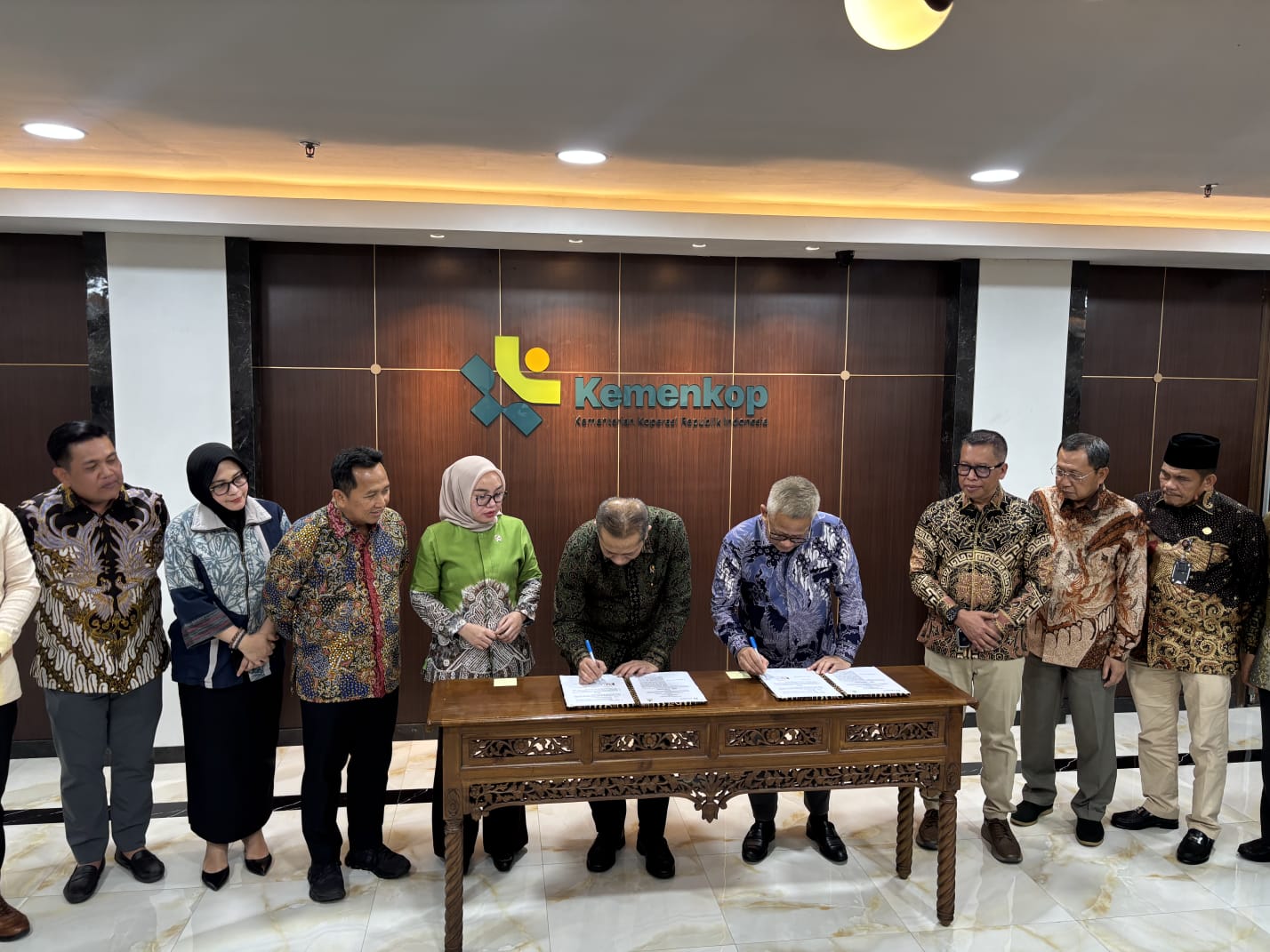
The Minister of Cooperatives, Ferry Juliantoyno, has partnered with PT Agrinas Palma Nusantara (Persero) in an effort to build a cooperative-based palm oil plantation ecosystem in Indonesia. This collaboration was marked by the signing of a Memorandum of Understanding (MoU) at the Ministry of Cooperatives office in Jakarta on Thursday (2/7).
Ferry emphasised that this step is a direct mandate from the President to strengthen the bargaining position of farmers through cooperatives, spanning both the upstream and downstream sectors. Currently, there are 1,135 existing cooperatives operating in the palm oil sector that will be integrated into this new ecosystem.
“We want to build a model where PT Agrinas serves as the core, and palm oil cooperatives are developed as plasma partners. At least 20% of the productive land will be managed by cooperatives,” said Ferry.
Furthermore, he explained that through this cooperation, cooperatives are encouraged not only to possess plantations but also to operate their own processing plants. “It is an irony if farmers have palm oil, yet they have to queue for cooking oil. Cooperatives are the instrument to make palm oil trade fairer. We will provide assistance to ensure they become professional and independent,” he asserted.
As a concrete step, the Ministry of Cooperatives will inaugurate a cooperative-owned Crude Palm Oil (CPO) factory in Musi Bwoasin in late July or early August. Ferry is optimistic that the involvement of cooperatives in large-scale industry will significantly increase farmer welfare. He emphasised that cooperatives currently possess sufficient financial capacity and experience.
“Cooperatives are now entering the production process, owning their own CPO factories, and producing derivatives such as cooking oil or red cooking oil, which will later be resold in village cooperatives. This is a form of economic sovereignty for the community,” he stated.
On the same occasion, the President Director of PT Agrinas Palma Nusantara (Persero), Muhammad Abdul Ghani, explained that his company is currently tasked with managing 850,000 hectares of forest land previously reclaimed by the PKH Task Force, with plans to expand to 1.25 million hectares.
“From the total land area, at least 250,000 hectares will be allocated for plasma managed by approximately 250 cooperatives. We have also identified over 120,000 hectares of smallholder palm oil that lacks clear formal ties, which will be gathered into cooperatives,” Ghani explained.
Beyond palm oil, this cooperation also includes the development of other strategic agricultural commodities to support national food and energy self-sufficiency. Ghani detailed that Agrinas will plant 400,000 hectares of soybeans, 250,000 hectares of maize, and 300,000 hectares of cassava as raw materials for renewable energy (ethanol).
“This means that across all aspects of Agrinas’ business, we will partner with cooperatives. In North Sumatra alone, we will begin a 1,500-hectare pilot planting project with cooperatives this year,” he added.
Source: jawawa.id (https://jawawa.id/newsitem/ministry-of-cooperatives-and-agrinas-palma-sign-mou-to-build-cooperative-based-palm-oil-ecosystem-1783007463)
Originally published by Media Indonesia (https://mediaindonesia.com/ekonomi/906918/sinergi-bangun-ekosistem-sawit-berbasis-koperasi-kemenkop-teken-mou-dengan-agrinas-palma), translated from Indonesian