
Ministry of Basic and Secondary Education Strengthens Inclusive Education, Trains Certified Special Companion Teachers
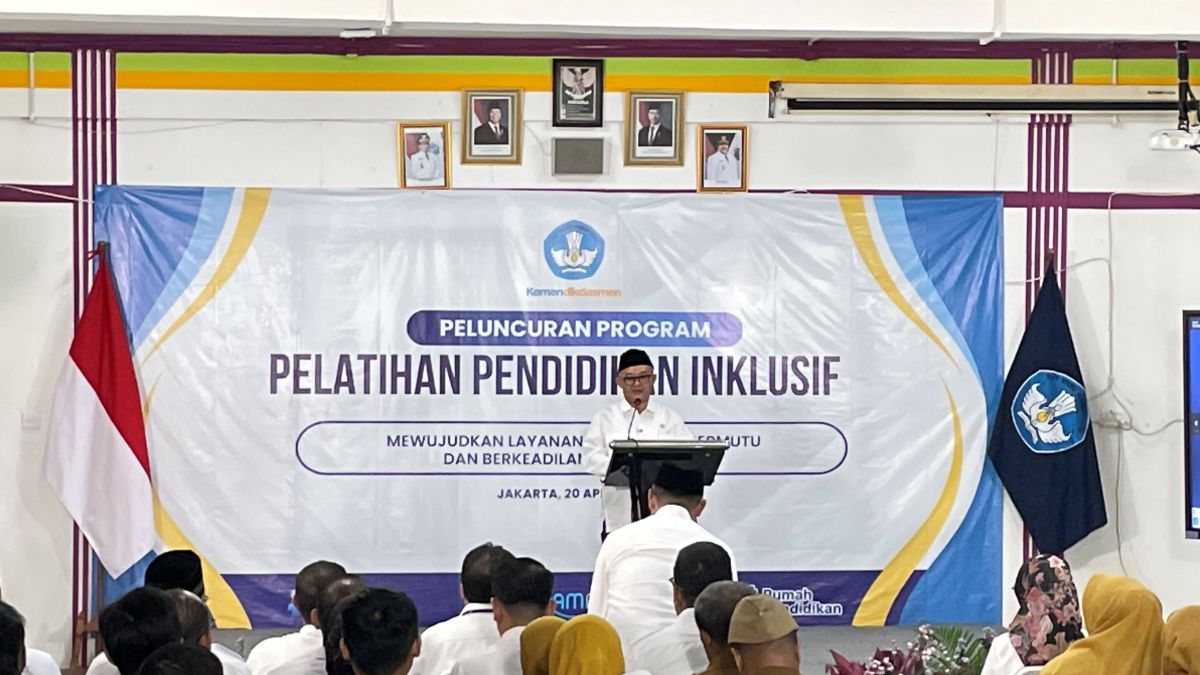
The Ministry of Basic and Secondary Education (Kemendikdasmen) continues to strengthen the implementation of inclusive education through the launch of the advanced Inclusive Education Training Programme. This programme focuses on enhancing teachers’ capacity to professionally and structuredly assist students with special needs.
Minister of Basic and Secondary Education (Mendikdasmen) Abdul Mu’ti stressed that inclusive education is part of the constitutional mandate that must be realised concretely and sustainably.
“This programme is very important in our collective effort to fulfil the constitutional mandate, provide quality education services for all, and deliver special services for children with special needs,” said Abdul Mu’ti in Jakarta on Monday (20/4).
He stated that every child has potential that must be facilitated, regardless of their physical condition or background.
“We all realise that every human being is created by God as a perfect being. Whatever their physical condition, they have potential, talents, and abilities that we must support,” he said.
Mendikdasmen emphasised that inclusive education must be built on four main pillars: intellectual, physical, economic, and social-religious inclusivity.
Through policies such as the New Student Admission System (SPMB), the government also opens affirmative pathways to ensure educational access for children with special needs and from underprivileged families.
He called on all stakeholders to jointly support inclusive education as part of Indonesia’s human resource development.
“InsyaAllah, all our children will have the opportunity to receive quality education, and they are the great children of Indonesia who will continue our struggle,” he said.
On the same occasion, the Director General of Teachers and Education Personnel (GTK) of Kemendikdasmen, Nunuk Suryani, explained that this programme is a follow-up to the previous basic-level training.
“So this is a continuation of the previous programme, so the participants are those who have already attended the basic-level training. After completing this training, they will receive certificates as GPK or special education teachers,” she clarified.
The graduates will serve as Special Education Teachers (GPK) and be placed to support services in Disability Service Units (ULD) in schools.
Kemendikdasmen has also prepared a support ratio scheme to ensure effective services.
In addition, the GPKs will be equipped with additional skills according to students’ needs, including communication abilities such as sign language and special support techniques.
“In the advanced training, they will be equipped with those competencies so they can support children inclusively in mainstream schools,” she added.
This training programme is open and emphasises voluntary participation from teachers who have completed the basic training. “For this year, the quota is over 1,500, and currently about 60 percent has been filled. We continue to open training for batch 2,” she revealed.
After completing the training, participants will undergo 10 days of field practice as part of competency strengthening.
This programme is expected to be a concrete step in addressing the shortage of educators while ensuring no Indonesian child is left behind in obtaining decent and quality education rights.