
Ministry of Basic and Secondary Education Announces 2026 TKA Results, Advocates for Data-Driven and Precise Learning Evaluation
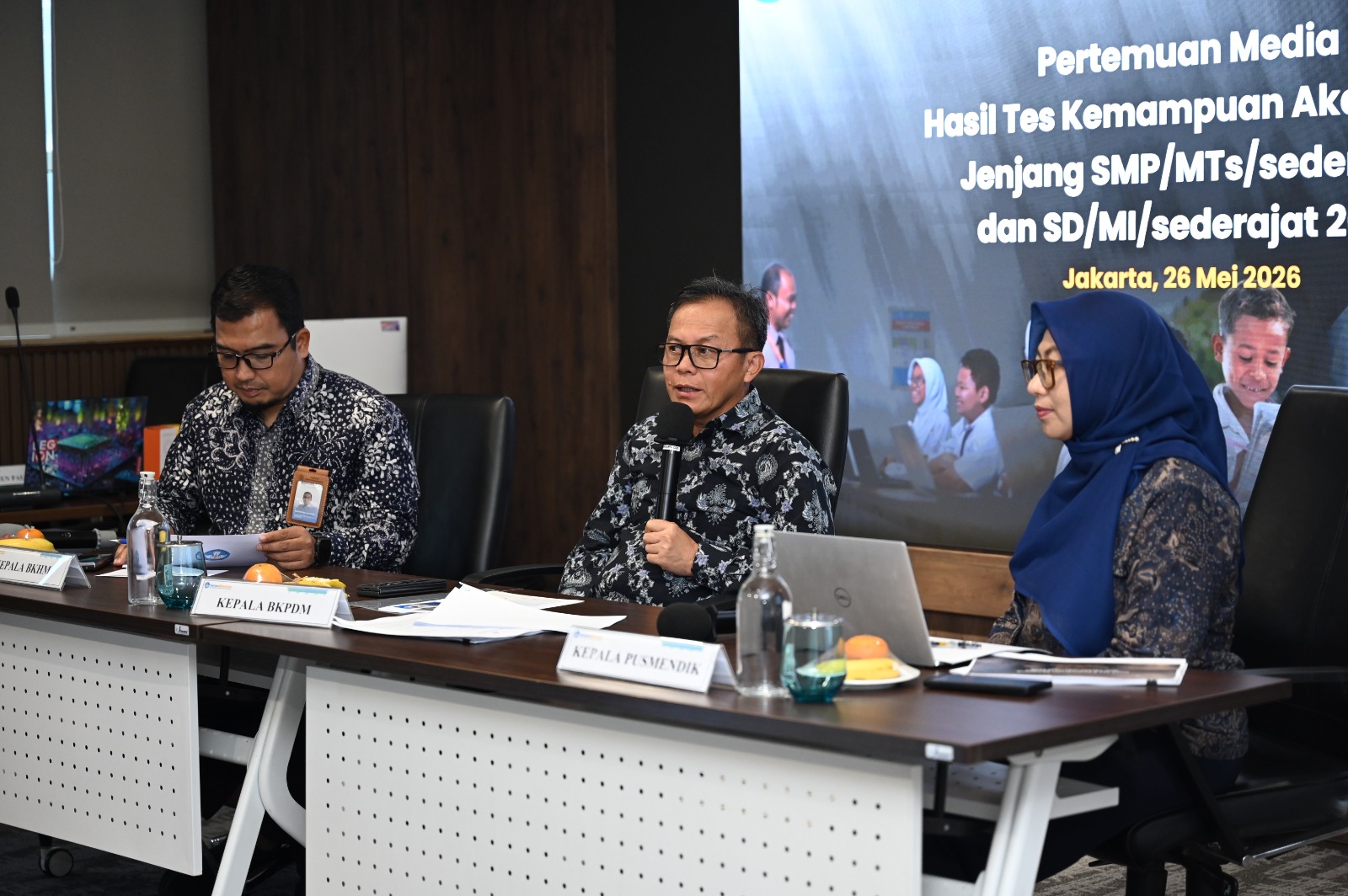
The Ministry of Basic and Secondary Education (Kemendikdasmen) announced the results of the 2026 Academic Ability Test (TKA) for primary (SD/MI) and junior secondary (SMP/MTS) levels at its Jakarta headquarters on Monday (26/5). The TKA this year recorded a high national participation rate, with 98.12% of students taking the assessment on the main schedule. Prof. Toni Toharudin, Head of the Basic and Secondary Education Policy Agency (BKPDM) at Kemendikdasmen, stated that the TKA has generated rich, strategic national education big data mapped down to provincial, district/city, school, and even student competency levels. ‘This quality mapping forms the basis for more precise, data-driven education policies, identifies areas needing improvement, and ensures policies are built on real-world needs,’ said Toni. According to BKPDM data, out of 8,875,362 students registered for the main schedule, 8,708,891 took the TKA as scheduled. Meanwhile, 463,533 students from a total of 490,551 registered for the rescheduled session. Head of the Education Assessment Centre (Kapusmendik), Rahmawati, added that these figures indicate growing awareness among schools, parents, and students about the importance of assessments for improving education quality. The TKA uses a classical scoring system on a 0-100 scale. Before results were released, all question packages underwent statistical verification and validation to ensure fairness for all students. In addition to numerical results, the TKA provides achievement categories and descriptions of student abilities. This approach ensures the TKA goes beyond mere numbers, becoming a learning reflection tool for students, teachers, and parents. ‘If a child falls into the adequate category, parents and teachers can see which skills they’ve mastered and which need strengthening. Thus, the TKA helps all parties understand the most suitable learning strategies for the student,’ Rahmawati explained. Nationally, Indonesian Language scores were higher than Mathematics across both levels. At primary school level, the average Indonesian score was 60.14 versus 43.41 in Mathematics. At junior secondary level, the averages were 60.83 for Indonesian and 40.34 for Mathematics. On the same occasion, Toni emphasised that the TKA is not a tool for labelling regions, schools, or students. He also noted the results highlight the need to strengthen reasoning and problem-solving skills, particularly in Mathematics. ‘This is a collective concern that logical thinking, mathematical reasoning, and problem-solving skills must be consistently reinforced in daily learning,’ Toni said. TKA results were released in phases starting 26 May 2026 at 13:00 WIB. Education offices and regional authorities received collective result lists first, followed by schools verifying participant data and printing Student TKA Certificates (SHTKA) for distribution. Kemendikdasmen also ensured integration of TKA results with the Academic Excellence Admission System (SPMB) via API and web services, eliminating the need for manual uploads by students. Kemendikdasmen’s Communication and Public Relations Bureau Chief, Yudhistira Nugraha, stated that TKA results would be a component in the Academic Excellence admission track, alongside report card grades and other achievements. ‘The use of TKA in SPMB is expected to make the selection process more objective, fair, transparent, and comprehensive in assessing students’ academic abilities,’ Yudhistira added. (H-2)