
Ministry of Agriculture Uses AWD Method to Save 20% Water in Facing Godzilla El Niño
Jakarta (ANTARA) - The Ministry of Agriculture is applying the Alternate Wetting and Drying (AWD) method to save up to 20% of irrigation water usage in facing the threat of the extreme El Niño phenomenon or “Godzilla El Niño”, which has the potential to trigger prolonged droughts.
“The AWD method is capable of reducing irrigation water usage by up to 20% without lowering rice productivity. Efforts to improve water efficiency are key to facing the increasingly unpredictable dry season,” said Minister of Agriculture Andi Amran Sulaiman in a statement in Jakarta on Sunday.
He explained that the technology is part of the climate change adaptation and mitigation strategy, with a focus on the efficiency of using increasingly limited water resources.
Through AWD, farmers can regulate water application more precisely so that crops still grow optimally even in conditions of water limitation.
The Minister emphasised that water management is a determining factor in maintaining the sustainability of agricultural production, especially amid drought threats.
“Water management is a crucial factor in the success of agricultural production. Planned and efficient water availability is very important in suppressing drought risks and maintaining productivity,” said the Minister.
Meanwhile, the Head of the Agricultural Assembly and Modernisation Agency (BRMP) of the Ministry of Agriculture, Fadjry Djufry, stated that the AWD method is an innovation designed to address real challenges in the field, especially during the dry season.
He explained that AWD technology is an adaptive solution in facing water limitations. With measured water regulation, farmers can maintain optimal crop conditions while reducing dependence on continuous flooding.
“So that they are more prepared to face drought risks,” said Fadjry.
He added that AWD is a technology developed by the International Rice Research Institute in 2009, and has been adapted in Indonesia by the Ministry of Agriculture since 2013.
“Based on testing results over six planting seasons, through the AWD technique, water scarcity in paddy fields can be suppressed, even avoided. This technology can save 17-20% of irrigation water usage,” he said.
He noted that various studies show that the application of AWD can significantly reduce irrigation water usage without lowering rice productivity.
In certain conditions, this efficiency even opens opportunities to expand irrigation services to other lands.
“In addition, this method also has positive environmental impacts through improved soil conditions and reduced greenhouse gas emissions from paddy fields,” said Fadjry.
Meanwhile, an analyst from the BRMP Agricultural Environment of the Ministry of Agriculture, Ali Pramono, explained that AWD application is carried out by regulating irrigation cycles based on soil moisture conditions, so that the fields are not always flooded.
“After the initial flooding phase, the water is allowed to recede to a certain level before being irrigated again,” said Ali.
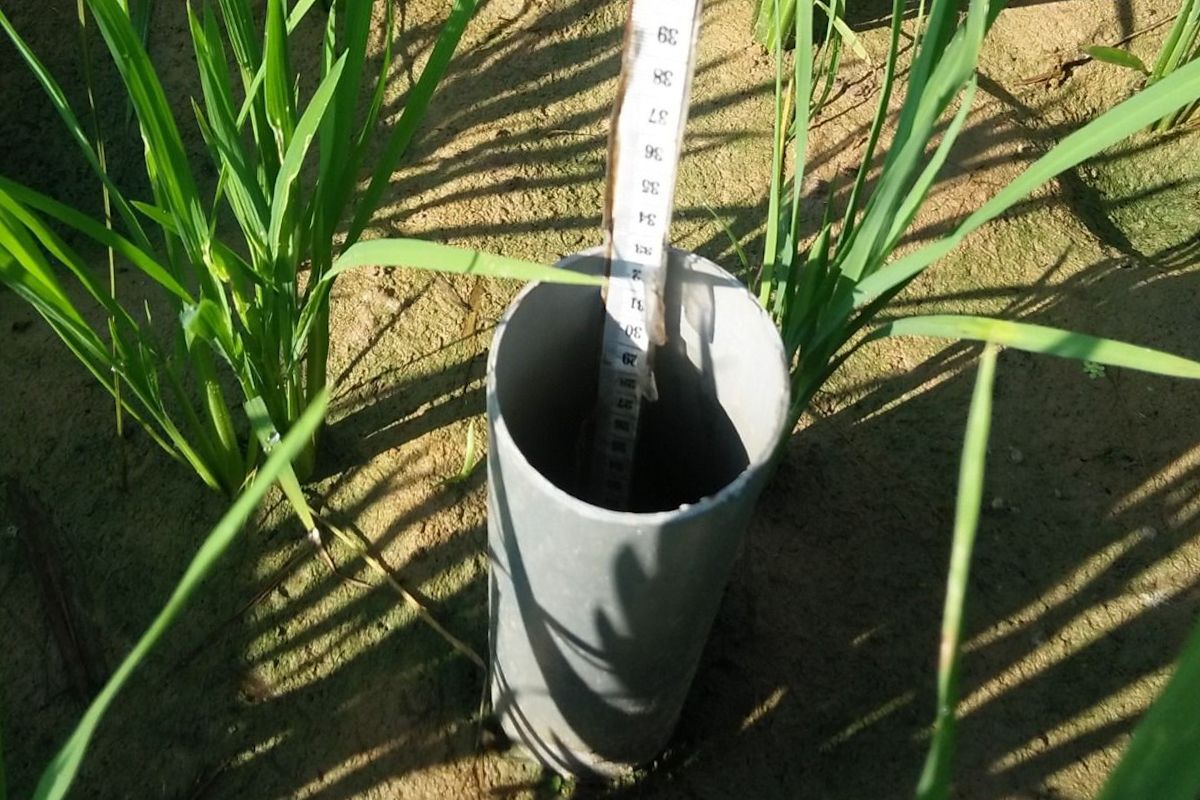
Observation of water conditions is done using a simple tool in the form of a PVC pipe with a diameter of 10-15 cm and length of 30-100 cm, which is perforated on all sides and wrapped in gauze, then buried until 10-20 cm remains above the soil surface. This pipe works on the principle of a simple piezometer (a device to measure fluid pressure - red).
The pipe is placed in an easily accessible area, near the bund, to facilitate monitoring of water depth that represents the average field conditions.
“Re-irrigation is generally carried out when the water level in the pipe has dropped to around 10-15 cm below the soil surface, then water is given again in a limited amount until the water level is 3-5 cm to maintain soil moisture,” added Ali.
This cycle is repeated, with adjustments to field conditions and weather, while still ensuring water availability in critical phases such as fertilisation, weeding, up to the heading-flowering phase.
According to Ali, the application of AWD not only increases water use efficiency but also improves root conditions and soil structure so that plants are more resistant to drought stress and have the potential to increase yields.
“AWD is not just an irrigation technique, but also part of a mitigation strategy that strengthens the resilience of the rice production system,” said Ali.
He added that the application of AWD is part of the climate smart agriculture strategy that emphasises efficiency and sustainability, while maintaining rice productivity amid water limitations during the dry season.