
Ministry of Agriculture invites universities to strengthen national livestock downstreaming
Jakarta (ANTARA) - The Ministry of Agriculture (Kementan) is inviting universities to strengthen the downstreaming of the national livestock industry to increase competitiveness and the welfare of smallholder farmers.
“Downstreaming must provide real benefits. Production must become more efficient, markets must expand, and the resulting added value must be felt by farmers,” said the Director General of Livestock and Animal Health of the Ministry of Agriculture, Agung Suganda, in a statement confirmed in Jakarta on Tuesday.
The Ministry of Agriculture is inviting universities, alumni, and the business world to strengthen collaboration to accelerate national livestock downstreaming. This synergy is required so that research and innovation can be applied as technology, value-added products, job creation, and an improvement in farmer welfare.
Agung stated that livestock development is a vital part of efforts to strengthen food security and the quality of Indonesia’s human resources. Food security, according to him, does not only concern carbohydrates but also the adequacy of animal protein from meat, milk, and eggs.
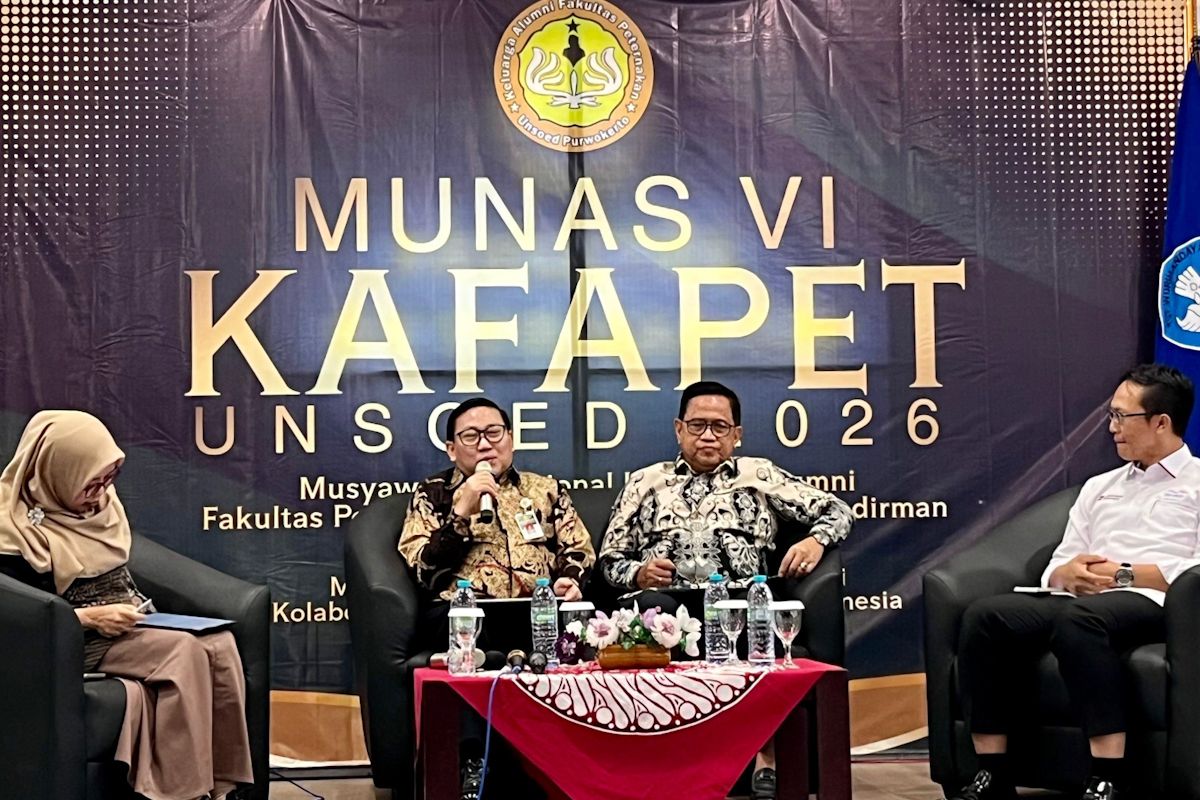
“Meat, milk, and eggs play an important role in meeting nutritional needs and developing a healthy, strong, and intelligent Indonesian generation. Therefore, livestock development holds a strategic position in national development,” said Agung while speaking at a national seminar titled “Contribution of Unsoed Faculty of Animal Science Alumni to the Success of the Downstreaming Programme” during the VI National Consultative Meeting of the Unsoed Faculty of Animal Science Alumni Family in Purwokerto, Central Java.
To strengthen this contribution, the Ministry of Agriculture continues to encourage increased production and livestock competitiveness through the strengthening of breeding, reproduction, feed, animal health, investment, and partnerships with smallholder farmers.
Agung emphasised that downstreaming should not be interpreted merely as building processing facilities. Downstreaming must form an ecosystem that connects production, technology, processing, distribution, and markets.
“The even distribution of production capacity is also a priority for the government,” he asserted.
The development of the livestock industry in various regions is necessary to bring production centres closer to consumers, increase distribution efficiency, strengthen the availability of animal protein across regions, and open new economic growth centres.
In this effort, universities hold an important position as producers of human resources, research, and innovation. Therefore, Agung encouraged that research should not stop at academic reports but should be translated into technology and business models capable of meeting the needs of farmers and industry.
Agung added that one important contribution from alumni is to assist smallholder farmers so they are not only strong in cultivation but also capable of managing businesses, developing products, and expanding market access.
“Many of our farmers are already very strong in cultivation. The challenge is to assist them in upgrading to business actors who are capable of managing production, accessing markets, and obtaining better added value,” explained Agung.
According to him, alumni networks spread across the government, universities, SOEs, private companies, and various business sectors can serve as a link between the needs of farmers, research results, technology, investment, and markets.
Acting Rector of Unsoed, Prof. Ali Rokhman, assessed that downstreaming requires an increasingly strong relationship between higher education and the industrial world, with alumni serving as one of the drivers.
“There must be a link and match between the world of higher education and the industrial world. Alumni possess networks and experience that can serve as a bridge between campuses, government, industry, and society,” said Ali.
He added that universities are now required to not only produce knowledge but also deliver a real impact on society.
Meanwhile, the General Chairperson of Kafapet Unsoed, Teguh Sudaryatno, stated that the livestock subsector is required to be increasingly adaptive, efficient, and innovative in facing global changes and challenges. Therefore, alumni active in government, business, education, and research need to strengthen synergy with campuses and society.
“This national seminar is not merely an academic forum, but a strategic platform for academics, practitioners, and alumni to formulate real solutions for the progress of national livestock,” said Teguh.
He hoped that the forum could produce new ideas, applied research, and policy recommendations relevant to the needs of farmers and supporting the strengthening of national food security.
The VI National Consultative Meeting of Kafapet Unsoed is part of the spirit of the 190th Anniversary of Livestock and Animal Health Service Month in 2026.
Collaboration between the government, universities, alumni, farmers, and the business world is expected to drive downstreaming that increases competitiveness while delivering greater economic benefits for farmers.
Source: jawawa.id (https://jawawa.id/newsitem/ministry-of-agriculture-invites-universities-to-strengthen-national-livestock-downstreaming-1788886782)
Originally published by Antara (Indonesian) (https://www.antaranews.com/berita/5732173/kementan-ajak-perguruan-tinggi-perkuat-hilirisasi-peternakan-nasional), translated from Indonesian