
Ministry of Agriculture and BRIN Collaborate on Food Sector, Here Are the Key Points
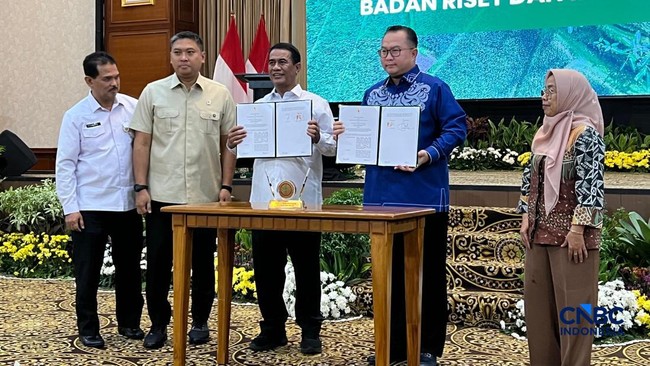
Minister of Agriculture Amran Sulaiman has officially partnered with the National Research and Innovation Agency (BRIN) to accelerate the achievement of food self-sufficiency and strengthen national food security. The collaboration was marked by the signing of a memorandum of understanding (MoU) allowing BRIN researchers to utilise the Ministry of Agriculture’s research facilities across Indonesia.
Amran described the cooperation as an important milestone in agricultural sector development. According to him, research is one of the main keys to significantly and sustainably increasing agricultural productivity.
“Thank you to the Head of BRIN. This is a historic milestone, today we sign the MoU, we collaborate. Firstly, all the Ministry of Agriculture’s laboratories in every province, 38 provinces, are freely available for use by BRIN researchers from all over Indonesia,” Amran said during a press conference at his office.
He explained that the shared use of these research facilities is expected to accelerate the birth of new innovations, whether in the form of superior varieties or cultivation methods that can increase farmers’ production yields.
“Because we can produce something exponentially or achieve a significant productivity increase if our research succeeds, finding new varieties, new methods, and so on. Once again, we thank you,” he stated.
According to Amran, this step aligns with President Prabowo Subianto’s directive to realise sustainable food self-sufficiency. Furthermore, the government wants to encourage downstream processing so that every region can become independent in meeting its needs for food, energy, and protein.
“Our dream in the field is in line with the President’s grand idea, we must have sustainable food self-sufficiency, then downstream processing, so that eventually all islands become self-sufficient in food, energy, protein, and so on, so that inflation is well maintained,” he said.
To achieve this target, the Ministry of Agriculture plans to build clusters for flagship commodities supported directly by researchers and experts in their respective fields.
“An example of our priority programme, plantations with high demand: cocoa, coffee, cashew, sugarcane. These have high global demand. We are making clusters for them. Then sugarcane experts, cocoa experts, horticulture garlic experts we place there. The budget is there,” Amran explained.
He confirmed that the programme receives adequate budget support. In fact, the implementation of research results will not be conducted on a small scale but will be applied directly on large tracts of land with intensive assistance.
“We have the budget. Our total budget at the Ministry of Agriculture is approximately Rp40 trillion, it is very large. This will also involve coaching farmers. So, it is not a trial of one or two hectares, this is 10,000, 5,000 we will supervise together, 2,000 hectares like that,” he said.
He stressed that the cooperation is purely a form of collaboration, not a transfer of BRIN researchers to the Ministry of Agriculture.
“They are not being transferred, it is a collaboration. They remain, so they just have an office at the ministry, in Cimanggu, Bogor, all over Indonesia, wherever they are. Our labs, our offices are big, very big,” he added.
Meanwhile, Head of BRIN Arif Satria welcomed the collaboration. He assessed that cooperation with the Ministry of Agriculture will strengthen the contribution of research in supporting the targets for national food self-sufficiency and security.
“Today, this is a very historic meeting, because the Minister of Agriculture, the Deputy Minister, and BRIN have agreed to strengthen collaboration and synergy, especially in research and the downstream commercialisation of agricultural product research results,” Arif said on the same occasion.
Arif stated that BRIN researchers will be encouraged to be more actively involved in developing the agricultural sector, including supporting the achievement of production targets for various strategic commodities.
“Therefore, through this agreement, God willing, we will push and encourage BRIN researchers to provide their contributions to agricultural development, achieving self-sufficiency, and food security more concretely,” he noted.
Arif added that BRIN is ready to deploy all its research capacities, ranging from the development of climate-resilient varieties to artificial intelligence (AI) technology, genomics, robotics, and smart farming to support national agricultural development.
He is also optimistic that the target of increasing the productivity of strategic commodities can be achieved through strengthened research. For garlic, for example, the government is targeting a productivity level of 35 tonnes per hectare.
“We are targeted to produce garlic at 35 tonnes per hectare. This is a fantastic figure, we want to surpass other countries that can already produce 35 tonnes per hectare,” he said. “Our research will be very strong, we will strengthen it to support the achievement of that target.”
For soybeans, BRIN already has an innovation capable of producing up to 4.6 tonnes per hectare. “Now there is already an innovation that reaches 4.6 tonnes per hectare. We just need to develop it. I am confident under his leadership, I am very confident,” he concluded.