
Ministerial Reshuffles in the Prabowo Era: What are the Effects on the Indonesian Economy?
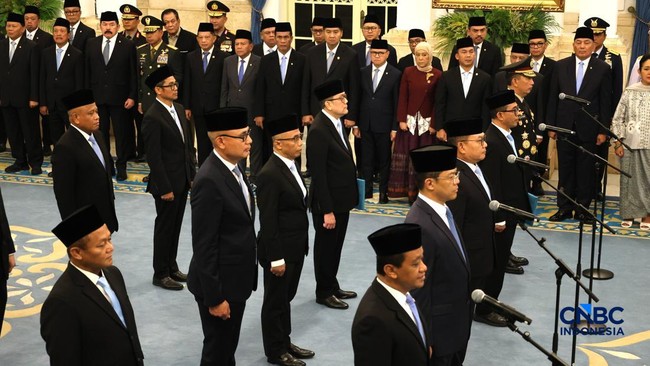
President Prabowo Subianto has conducted yet another reshuffle of the Red and White Cabinet. Ministerial changes have occurred seven times within two years, a move intended to ensure campaign promises can be fulfilled by the end of his term.
Senior economist and Rector of Paramadina University, Didik J. Rachbini, noted that new officials face numerous significant tasks, particularly regarding industrial reform. Didik observed that the industrial sector has been in decline over the last two years, with growth rates dropping from 5.48% in Q2-202<0xA0>25 to just 4.5% in Q2-2026.
Furthermore, Didik stated that the 2027 State Budget (APBN) fails to provide any specific signals to boost the industrial sector, which serves as the economy’s largest pillar. “Consequently, it is difficult to expect the economy to grow by 6 percent, let alone towards 7 percent,” he said in a written statement.
The 2025-2029 National Medium-Term Development Plan (RPJMN) aims to increase manufacturing’s contribution to Gross Domestic Product (GDP) from a baseline of 18.67% to 21.9% by 2029. According to Didik, no policies have been implemented in the last two years to drive towards this target.
“This target is certainly impossible to achieve if economic and industrial policies do not change, or rather, if they continue to operate ‘as usual’,” he explained.
Didik continued that the Indonesian government has missed many moments and opportunities, noting concerning data where the Manufacturing PMI has repeatedly fallen below the 50 level.
“What strategy and policy should be implemented moving forward with the refreshment of the new Minister of Industry? The answer is absolutely not to continue with ‘business as usual’ as seen over the past two years. Current policies have instead resulted in a weakening industrial sector that cannot support economic growth,” remarked Didik.
Didik also assessed that the State Budget (APBN) will struggle to contribute significantly to future growth. Of the total expenditure of Rp4,106.3 trillion, a large portion is allocated to operational costs, debt servicing, and instalments.
“If there is no policy change in this sector, then do not expect the economy to grow by 7-8%. Forget the government’s ambition, promised to the people, to drive economic growth to 7-8 percent,” he concluded.