
Minister Yusril: Legal Frameworks Alone Cannot Eradicate Corruption Without Ethical Awareness
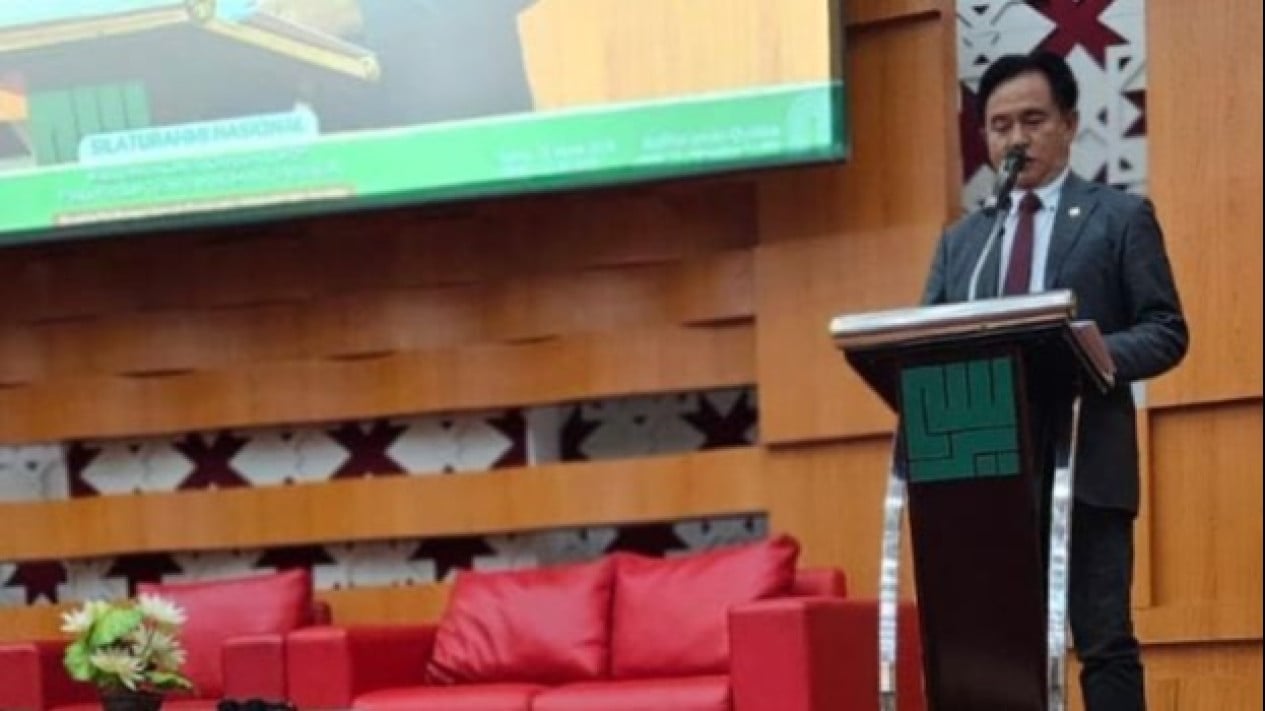
Jakarta, VIVA – Coordinating Minister for Legal Affairs, Human Rights, Immigration and Corrections (Menko Kumham Imipas) Yusril Ihza Mahendra believes that eradicating corruption in Indonesia will not succeed if it relies only on legal rules and law enforcement agencies, without being accompanied by the development of ethical and moral awareness in society.
According to Yusril, Indonesia already has adequate legal instruments, ranging from legislation and law enforcement apparatus to specialised institutions such as the Corruption Eradication Commission (KPK) and the Corruption Crime Court. Yet corrupt practices continue to occur.
“I believe the problem is not the absence of legal norms, nor the absence of law enforcement institutions. What is missing is ethical awareness, moral awareness,” Yusril said while delivering a speech at the inauguration of the Cetiya Tian Shi Hua Guan Di Jing Se temple in Pantai Indah Kapuk (PIK), North Jakarta, on Sunday.
Yusril said his long experience as a minister in the legal field, involved in drafting various laws and regulations, made him realise that law enforcement alone is insufficient to eradicate corruption.
“I have drafted hundreds of laws. I helped create various institutions, expanded investigative powers, formed the KPK, established the corruption court. But why, to this day, have we still not managed to eradicate corruption? It has in fact grown worse,” he said.
He stressed that moral awareness cannot be built merely through the constitution or legislation, but must rest on ethical values derived from religious teachings.
“For decades I studied constitutional law, from an ordinary lecturer to a professor. But I know that the Constitution, laws, government regulations — whatever we create — mean nothing if the state is not built upon an ethical foundation, which must be constructed based on the religious beliefs that live and flourish in our homeland,” Yusril said.
For that reason, Yusril takes the view that ethics education needs to be instilled from an early age, so that a generation emerges that obeys the law not merely out of fear of sanctions, but driven by conscience.
“If you ask me now whether we can build a state with legal certainty and justice, free of corruption, manipulation and bribery, can it be resolved in a short time? I am pessimistic. I would say it may take one or two generations to instil this,” he said.