
Minister Yandri Recommends Village-Based Solutions for Agrarian Conflicts in Forest Areas
Villages and Development of Disadvantaged Regions Minister Yandri Susanto has recommended a number of solutions to address agrarian conflicts occurring in villages, particularly those located within or directly bordering forest areas.
Based on coordinated data from the Ministry of Forestry, the Geospatial Information Agency, and the Ministry of Home Affairs, there are 35,974 forest area zones and 34,323 villages located within or directly bordering these areas. This data represents an initial mapping and does not directly determine the legal status of each plot of land.
“This distribution shows the scale of the problem that we must manage together. There are 34,323 villages and around 72.28 million residents recorded as being within or directly intersecting with forest areas, with very large variation between regions,” said Minister Yandri in a written statement on Tuesday (11/8/2026).
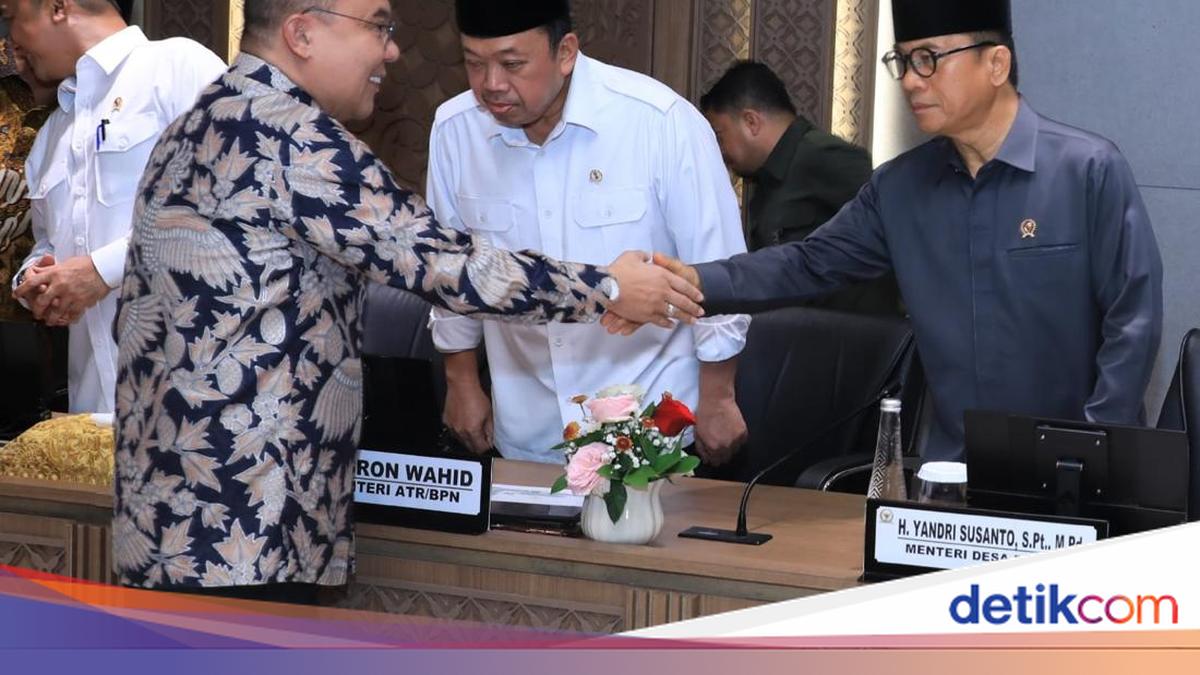
The recommendation was delivered by Yandri while attending an invitation from House of Representatives leaders at a coordination meeting discussing agrarian conflicts at the Parliamentary Complex in Senayan, Jakarta, today. In the activity, Yandri was accompanied by Deputy Villages and Development of Disadvantaged Regions Minister Ahmad Riza Patria.
Yandri explained that based on various existing cases, agrarian conflicts in villages can be grouped into seven main forms. First, villages facing forest areas. Second, communities facing holders of plantation cultivation rights. Third, problems with plasma schemes or partnerships that are not functioning.
Fourth, communities facing holders of sectoral permits. Fifth, indigenous communities facing the state or corporations. Sixth, village land or assets facing projects, the Land Bank, or state property. Seventh, horizontal conflicts within villages or between villages regarding boundaries, customary land, and natural resources.
According to Yandri, this typology is needed to identify the parties, objects, and authorities that differ in each case. Conflict resolution also needs to involve ministries or institutions that have authority over land status, areas, permits, and assets.
Meanwhile, the Ministry of Villages ensures that the impact of conflicts on village governance, basic services, livelihoods, and the social life of communities is also restored.
“Agrarian conflict resolution is more effective when each ministry moves according to its authority, but is connected to the same goal,” he said.
In this division of authority, Agrarian Affairs and Spatial Planning Minister/National Land Agency Head Nusron Wahid handles certainty of land rights, cultivation rights, management rights, agrarian reform, and asset arrangement. Meanwhile, the Forestry Minister handles certainty of forest area status and boundaries, including release mechanisms, boundary changes, and social forestry.
“The Ministry of Villages holds the impact on village governance, services, livelihoods, economic recovery, and prevention of social conflict. The coordination meeting needs to produce one case, one division of tasks, one target time, and one final result in the form of a recovered village,” he said.
Yandri emphasised that the final outcome of agrarian conflict resolution must ensure that villages and communities truly recover. Certainty and justice must be obtained, governance and services must resume functioning, sources of livelihood must recover, development can continue, and similar conflicts do not recur.
According to him, the success of conflict resolution can at least be measured through five things: clear land and area status, normal administration and services, restored resident incomes, social protection for vulnerable groups, and collaborative governance that prevents new conflicts.
“We need to establish priority cases based on the scale of the problem, the number of affected residents, social risk, and document readiness,” he said.
Yandri also recommended that during the resolution process, basic services and productive activities of the community remain protected. This is necessary so that administrative decisions do not actually increase community vulnerability.
Furthermore, every decision by the Agrarian Affairs and Spatial Planning Ministry/National Land Agency and the Ministry of Forestry needs to be directly linked to a measurable village recovery plan, including services, livelihoods, and outcome indicators.
Yandri also recommended the establishment of a joint follow-up mechanism involving the Agrarian Affairs and Spatial Planning Ministry/National Land Agency, the Ministry of Forestry, the Ministry of Villages, the House of Representatives, regional governments, and community representatives.
The meeting was chaired by Deputy Speaker of the House of Representatives Sufmi Dasco Ahmad, accompanied by Saan Mustopa and Cucun Ahmad. Also present were Forestry Minister Raja Juli Antoni, Agrarian Affairs and Spatial Planning Minister/National Land Agency Head Nusron Wahid, Deputy Forestry Minister Rohmat Marzuki, and Deputy Agrarian Affairs and Spatial Planning Minister/Deputy National Land Agency Head Ossy.