
Minister urges fathers to spend time interacting with children
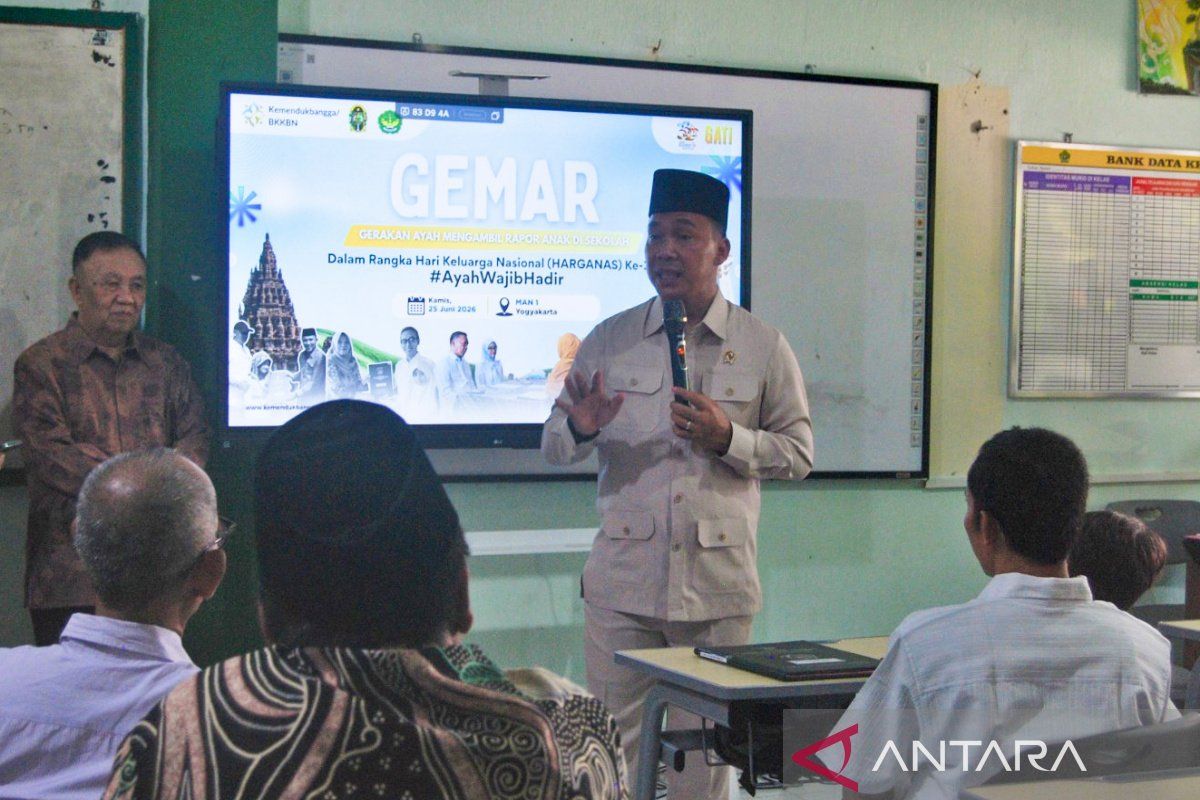
Yogyakarta (ANTARA) - The Minister of Population and Family Development/Head of BKKBN, Wihaji, has encouraged fathers to dedicate time to interacting with their children to strengthen the family’s role in supporting child development.
“Children do not only long for financial support, but also need psychological connection,” said Wihante while attending the ‘Gerakan Ayah Mengambil Rapor’ (Gemar) event at MAN 1 Yogyakarta on Thursday.
During the event, held as part of the 2026 National Family Day commemorations, Wihaji requested that fathers prioritise spending time with their children. The ‘Gemar’ programme is an initiative by the Ministry of Population and Family Development aimed at increasing paternal involvement in parenting and education as part of efforts to strengthen family resilience.
According to the Minister, Indonesia still faces the phenomenon of being ‘fatherless’, or the absence of a father figure. “Based on our data, approximately 25 per cent of children in Indonesia experience this condition,” he stated.
He noted that technological advancements also present a unique challenge for parents. Children today spend significant amounts of time using smartphones, making the family’s role essential in providing guidance and building intensive communication.
Wihaji assessed that schools serve not only as places for the transfer of knowledge but also for the transfer of values. Therefore, he urged parents, particularly fathers, to dedicate time to communicating and building closeness with their children.
“As educational units, schools are not just about the transfer of knowledge, but also the transfer of values. Therefore, I entrust that the students here are engaged in conversation. If they are not engaged in conversation, our children will end up communicating with their phones, creating what we might call a ‘new family’ that, if we are not careful, is influenced by a heartless device,” he said.
Agung Baskoro, a parent in attendance, noted that the ‘Gemar’ programme could encourage fathers to become more involved in their children’s lives and education. “The programme is excellent for ensuring we pay more attention to our children. A father’s presence in a child’s education is vital, as school matters are often left primarily to mothers,” he said.
Agung added that work commitments are a major factor preventing many fathers from being optimally involved in their children’s education. He suggested that paternal involvement could be realised through simple actions, such as escorting children to school or personally collecting report cards.
“I hope fathers can dedicate more time and attention to their children. Simple gestures, such as walking them to school or collecting their report cards, can serve as meaningful forms of support,” he concluded.