
Minister Urges Agrinas to Emulate Malaysia's Felda in Building Palm Oil Cooperatives
Felda can serve as one of the references in consolidating smallholder plantations and oil palm farmers through cooperatives, so that they have a stronger position in the palm oil industry chain.
Musi Banyuasin (ANTARA) - Cooperatives Minister Ferry Juliantono has encouraged PT Agrinas Palma Nusantara (Persero) to develop a palm oil ecosystem together with cooperatives and farmers, adopting one of the models implemented by Malaysia’s Federal Land Development Authority (Felda).
Speaking at the National Seminar on “Optimisation and Downstreaming of Cooperative-Based Palm Oil” in Musi Banyuasin Regency, South Sumatra, on Tuesday, the Minister said Felda could serve as one of the references in consolidating smallholder plantations and oil palm farmers through cooperatives, so that they have a stronger position in the palm oil industry chain.
Ferry compared the situation with Malaysia, which has a palm oil plantation area of around a quarter of Indonesia’s. According to him, despite having smaller land area, Malaysia’s production and exports of crude palm oil (CPO) are relatively close to Indonesia’s.
“This means there is indeed a difference in management,” he said.
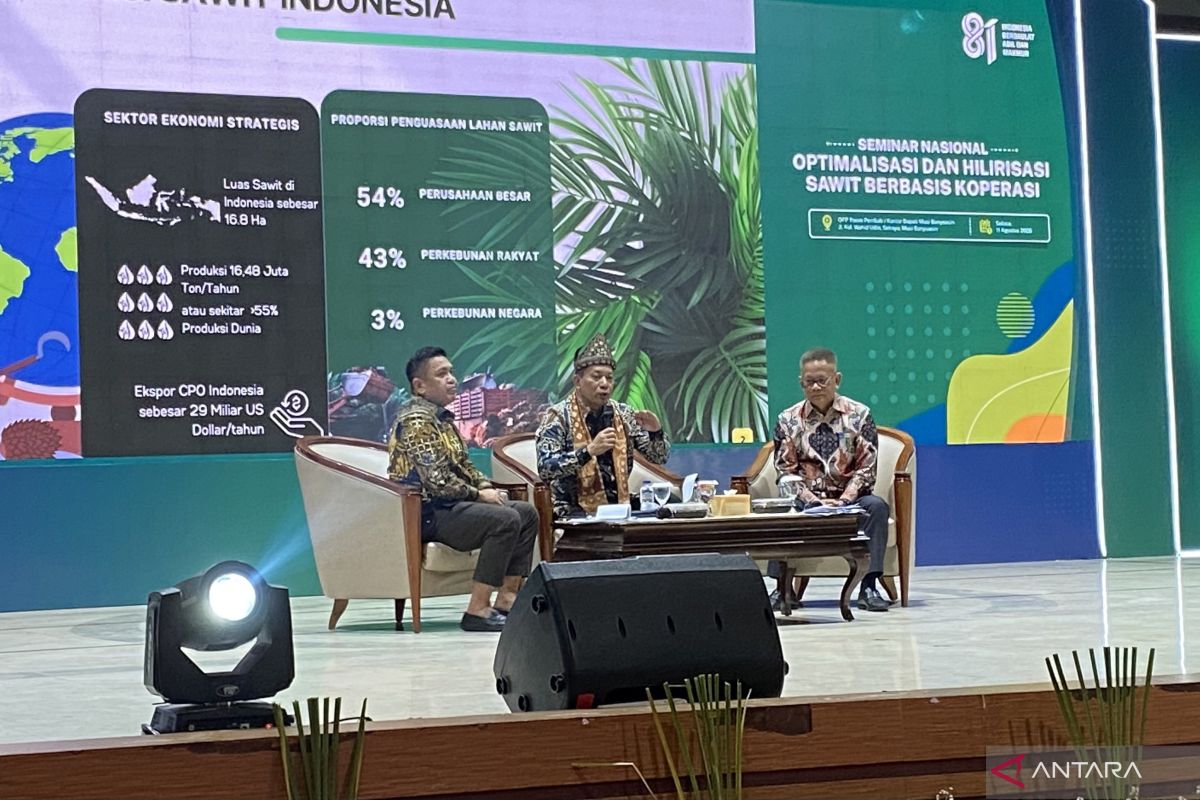
Ferry said the composition of Indonesia’s oil palm plantations consists of 54 percent large companies, 43 percent smallholder plantations, and 3 percent state plantations.
According to him, the large proportion of smallholder plantations needs to be accompanied by strengthening farmer institutions through cooperatives, so that they can play a greater role in the palm oil industry.
Ferry said Agrinas Palma is expected to build an ecosystem together with cooperatives directly, including by strengthening CPO sales in large volumes up to export markets.
He also encouraged the ecosystem to strengthen Indonesia’s CPO export capacity and develop downstream industries, including derivative products such as cooking oil.
“If necessary, we should also export, export our CPO abroad. That is what we actually want and we will build that ecosystem so that CPO sales occur in large volumes,” said Ferry.
According to Ferry, cooperatives need to be strengthened so that they not only serve as a platform for farmers, but also become part of the palm oil business chain from upstream to downstream. In this way, farmers are expected to obtain greater added value from their plantation produce.
President Director of PT Agrinas Palma Nusantara (Persero) Mohammad Abdul Ghani said Agrinas has received a special assignment through Presidential Regulation Number 5 of 2025 to manage oil palm plantations resulting from the enforcement action against illegally cleared forest areas.
He said there are around 4.1 million hectares of land from the enforcement action by the Forest Area Enforcement Task Force (PKH) that need to be directed in their management so that the benefits return to the community, particularly through cooperatives.
From the land entrusted to Agrinas, Abdul Ghani said, there is an obligation to allocate at least 20 percent as plasma for the people. To fulfil this requirement, Agrinas needs to engage cooperatives as partners in management.
“We will prioritise cooperatives around the land as vendors for plant maintenance, harvesting, and other activities. With the vast area we manage, cooperatives become the main partners in supporting palm oil downstreaming as well as food security,” he said.
Source: jawawa.id (https://jawawa.id/newsitem/minister-urges-agrinas-to-emulate-malaysias-felda-in-building-palm-oil-cooperatives-1786460013)
Originally published by Antara (Indonesian) (https://www.antaranews.com/berita/5689920/menkop-mendorong-agrinas-bangun-ekosistem-sawit-seperti-felda-malaysia), translated from Indonesian