
Minister Trenggono Reveals Mounting Problems Hindering Indonesia's Shrimp Industry, Including Weak Rupiah
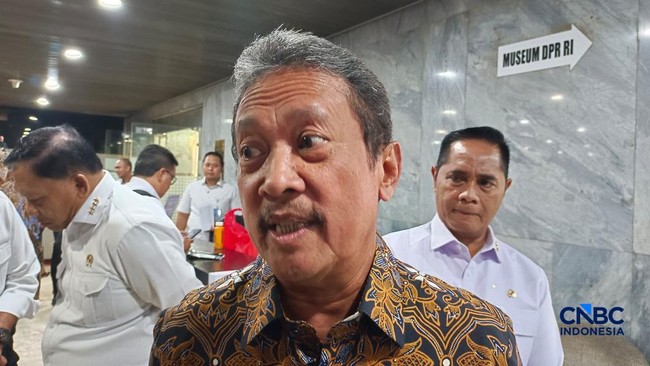
Maritime Affairs and Fisheries Minister Sakti Wahyu Trenggono has acknowledged that the national shrimp industry continues to face several fundamental issues, which prevent the sector from being optimally competitive. One consequence is that shrimp prices in a number of regions are still under pressure even though the rupiah exchange rate against the US dollar is at a high level.
Trenggono explained that Indonesia’s shrimp export performance is actually still quite good. In fact, after being temporarily disrupted by the Cesium-137 case, national shrimp exports have now returned to normal.
“Our shrimp exports are quite high, at US$6.7 billion. We were slightly stalled due to the Cesium-137 case, then thank God, through our negotiations and the assurance we provided to the market, we have finally been able to return to normal operations,” Trenggono said during a working meeting with Commission IV of the Indonesian House of Representatives at the parliamentary complex.
Nonetheless, he admitted there are still issues causing shrimp prices in several areas to decline. According to him, the problem is not occurring in all regions, but only in certain locations.
“So now, when the exchange rate is high, why then are our shrimp prices in certain places—not all, actually—experiencing a decline. It is true, we are still weak in all aspects, Sir,” he stated.
Trenggono revealed that one of the main weaknesses of the national shrimp industry lies in the hatchery sector. According to him, Indonesia still does not have an adequate hatchery industry to support the needs of national shrimp farming.
“In hatcheries, we do not yet have an adequate hatchery industry. This is what I have repeatedly conveyed informally to colleagues at universities, especially at IPB, Brawijaya University, and UNDIP, to try to carry out research. Also to BRIN. Hopefully BRIN will quickly grasp this, as the current head of BRIN is from IPB,” he said.
Besides seed stock, another issue in the spotlight is the feed industry. Trenggono said that shrimp feed raw materials are still heavily dependent on imports, especially for fishmeal, which is one of the main components.
“Well, the hatchery is also a problem. Then secondly, feed. It could be said, I can say 100 per cent of the feed’s raw materials are imported. The Ministry of Marine Affairs and Fisheries has been in existence for 26 years. But the substitution of raw materials, the raw material of fishmeal as a major component, has not been carried out properly to this day,” Trenggono stated.
To overcome these problems, the Ministry of Marine Affairs and Fisheries claims it is undertaking various transformation measures, including strengthening vocational education more closely aligned with industry needs.
“We are immediately moving to carry out transformation. We are shifting the polytechnic paradigm. Our polytechnics must not just keep learning theory; we will shift and transform them,” he concluded.