
Minister Trenggono Requests Additional Rp30 Trillion Budget for Fishermen's Villages
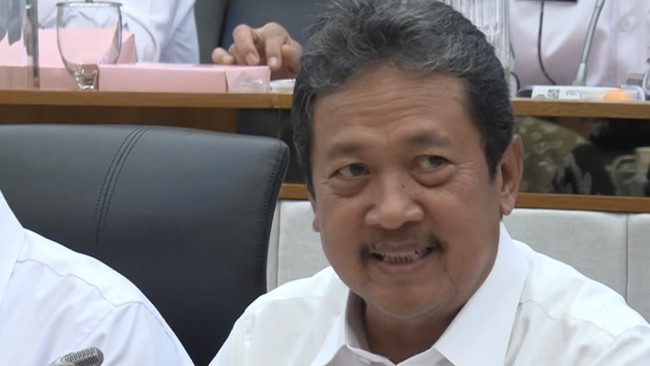
The Minister of Marine Affairs and Fisheries (MenKP), Sakti Wahyu Trenggono, has proposed an additional budget of Rp30 trillion for the 2027 Fiscal Year. This additional funding is required to accelerate several of the government’s priority programmes, ranging from the construction of ‘Merah Putting’ Fishing Villages and pond revitalisation to the empowerment of coastal communities.
Trenggono presented the proposal during a working meeting with Commission IV of the Indonesian House of Representatives (DPR RI) at the parliamentary complex in Jakarta on Thursday (11/06/2026).
According to Trenggono, the additional budget is necessary to support food self-sufficiency targets, improve the welfare of marine and fisheries communities, and drive national economic growth.
“In order to accelerate the realisation of food self-sufficiency, the improvement of the welfare of marine and fisheries communities, national economic growth, and to optimally accommodate all priority programme targets directed by President Prabowo Subianto, please allow the Ministry of Marine Affairs and Fisheries (KKP) to propose an additional expenditure budget for the 2027 fiscal year of Rp30 trillion at this working meeting,” said Trenggono.
Of the total proposed additional budget, the largest portion will be used for the construction of ‘Merah Putih’ Fishing Villages. The KKP has proposed an allocation of Rp9.45 trillion to develop 600 new locations in 2027.
“We will use the proposed additional budget first for the construction of ‘Merah Putih’ Fishing Villages in 600 locations amounting to Rp9.45 trillion, so that the target of one thousand locations by 2027 can be achieved,” he stated.
Additionally, the KKP has requested a budget of Rp5.4 trillion for the revitalisation of saline tilapia ponds. These funds are intended to support the construction of ponds covering 5,500 hectares next year.
Another priority programme is thematic inland fish farming. For this programme, the KKP has proposed a budget of Rp8.8 trillion to develop 9,000 farming locations.
“Thirdly, the thematic inland fish farming programme across 9,000 locations at Rp8.8 trillion, so that the target of 10,000 locations by 2027 can be realised,” he added.
In addition to these three main programmes, the additional budget will also be used for various other strategic activities. These include the certification of crew members and the operationalisation of fishing vessels amounting to Rp9 billion, the construction and operationalisation of salt industry centre areas covering 2,000 hectares valued at Rp965 billion, and the modelling and replication of integrated shrimp ponds covering 2,000 hectares at Rp1.3 trillion.
The KKP has also proposed a budget of Rp1.44 trillion for post-disaster reconstruction and rehabilitation in three provinces in Sumatra, while a programme for the empowerment of marine and fisheries communities to support poverty alleviation has been proposed for Rp1 trillion.
Furthermore, the supervision of marine and fisheries resources is proposed to receive an additional Rp857 billion, while the requirements for duties, functions, and the improvement of public services amount to Rp573 billion.
Trenggono noted that, based on a joint letter from the Minister of Finance and the Minister of National Development Planning (PPN)/Head of Bappenas dated 7 May 2026, the indicative budget ceiling for the KKP for 2027 has been set at Rp15.63 trillion.
Therefore, the additional budget is deemed essential to ensure that all government priority programmes in the marine and fisheries sector can run optimally.
“Through the implementation of these various priority programmes, the KKP is optimistic that we can strengthen national food security and sovereignty, increase productivity in the marine and fisheries sector, and drive inclusive and sustainable economic growth for coastal communities, fishermen, fish farmers, and fisheries entrepreneurs throughout Indonesia,” said Trenggono.