
Minister Trenggono confident Fishermen's Villages will become engines of economic growth
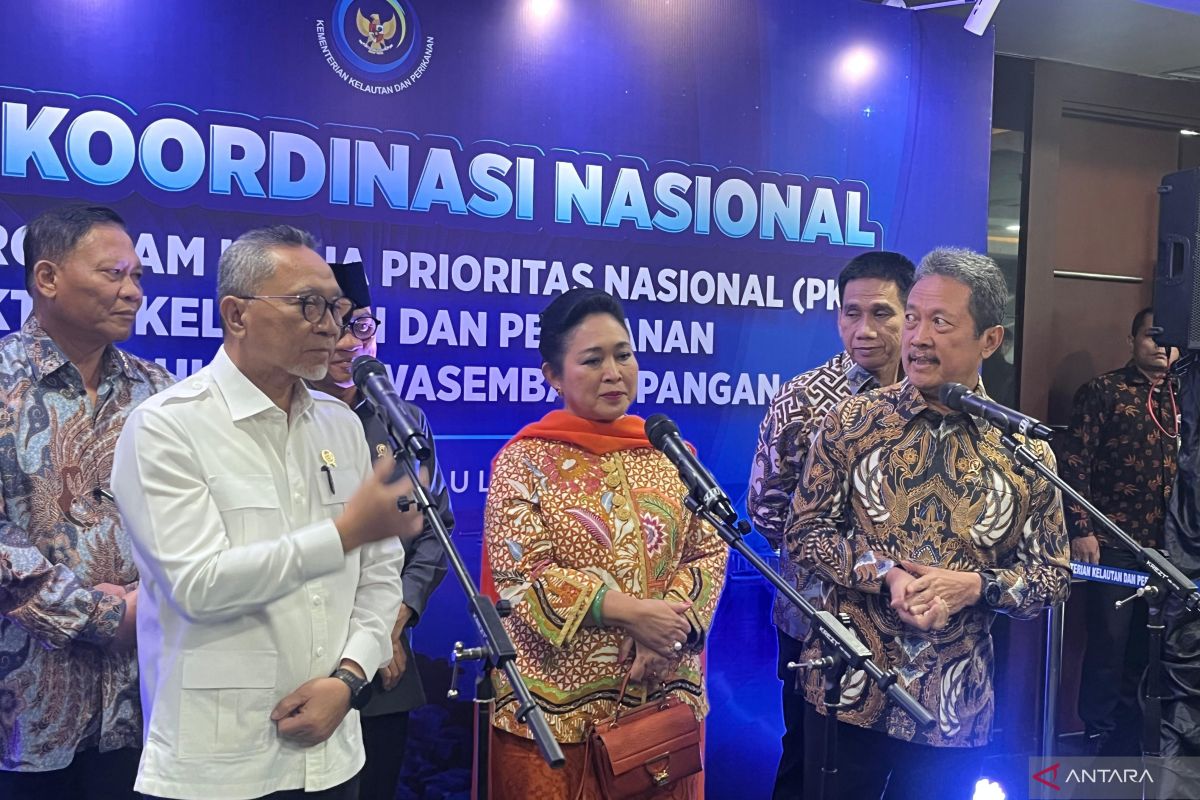
The Minister of Marine Affairs and Fisheries, Sakti Wahyu Trenggono, is confident that the ‘Kampung Nelayan Merah Putih’ (KNMP) programme can serve as a new engine for national economic growth, particularly in coastal regions.
He believes the programme is capable of transforming fishing villages into productive, modern, and competitive areas, while simultaneously supporting economic equality and poverty alleviation. Speaking at the National Coordination Meeting for National Priority Work Programmes of the Marine and Fisheries Sector 2-year 2026 in Jakarta on Thursday, Trenggono stated that the development of the marine and fisheries sector must begin in coastal villages as new economic centres that can also support national food security.
“The Kampung Nelayan Merah Putih programme is one of the strategies to transform fishing villages into productive and modern areas, serving as a new motor for economic growth in coastal regions, with a projected contribution to economic growth of 5.4 to 16.2 per cent,” said Trenggono.
He revealed that the implementation of KNMP began in 2023 through a pilot project in Kampung Samber-Binyeri, which has shown significant results. The programme successfully improved welfare, with the fishermen’s terms of trade rising by 113.2 per cent, fish sales increasing by 47 per cent, and catch production rising by up to 103 per cent. According to him, these improvements led to an increase in fishermen’s income by up to 78 per cent.
Furthermore, market access for fishery products has expanded to include Bitung, Jakarta, Semarang, and Surabaya, with a total distribution volume reaching 295 tonnes. In fact, most of the production has now entered export markets. “Previously, sales were only in local markets; now, almost 90 per cent is for export,” he noted.
Trenggono added that the development of Kampung Nelayan Merah Putih is carried out through three main stages: increasing productivity, increasing quality, and ensuring sustainability. In the sustainability stage, coastal communities are directed to diversify their businesses through the development of marine aquaculture, which is considered to have great potential.
He stated that the KNMP business model is designed so that fishermen do not only focus on fishing activities but also receive support through financing, operational facilities, and access to both domestic and export markets. Currently, there are 65 KNMPs undergoing operational transformation, and in parallel, the ministry plans to build 1,269 fishing villages across the country this year.
He also noted that the development of the marine and fisheries sector aligns with the President’s ‘Astacita’ vision, particularly in driving economic equality and poverty alleviation. Therefore, the ministry is implementing blue economy policies through several key programmes, including the expansion of marine conservation areas, quota-based measurable fishing, sustainable aquaculture development, coastal and small island supervision, and the management of marine plastic waste.
He emphasised that marine conservation areas are a vital foundation for the future sustainability of marine resources. In addition to the KNMP programme, the government is also encouraging the development of thematic inland fish aquaculture across 40,000 points in 500 areas. This step is considered strategic to increase national protein production without adding pressure to forest and land areas.
In the salt sector, the Ministry of Marine Affairs and Fisheries targets an increase in industrial-quality salt production through a salt self-sufficiency programme implemented via extensification and intensification strategies. The programme is expected to produce approximately 400,000 tonnes of salt per year with an NaCl content above 97 per cent to meet national industrial needs, which currently rely on imports of about 2.7 million tonnes per year.
Meanwhile, the government continues to develop integrated shrimp pond areas in Waingapu, East Sumba, as a modern shrimp aquaculture centre from upstream to downstream, and is revitalising approximately 14,090 hectares of shrimp ponds in North Java, integrated with mangrove rehabilitation. The government also plans to modernise 4,582 fishing vessel units to increase the competitiveness of the fishing sector and boost state revenue through foreign exchange, taxes, and non-tax state revenue (PNBP).
Source: jawawa.id (https://jawawa.id/newsitem/minister-trenggono-confident-fishermens-villages-will-become-engines-of-economic-growth-1782975320)
Originally published by Antara (Indonesian) (https://www.antaranews.com/berita/5631945/menteri-kp-yakin-kampung-nelayan-jadi-mesin-pacu-pertumbuhan-ekonomi), translated from Indonesian