
Minister Stresses Ecotheology-based Curriculum in Religious Education
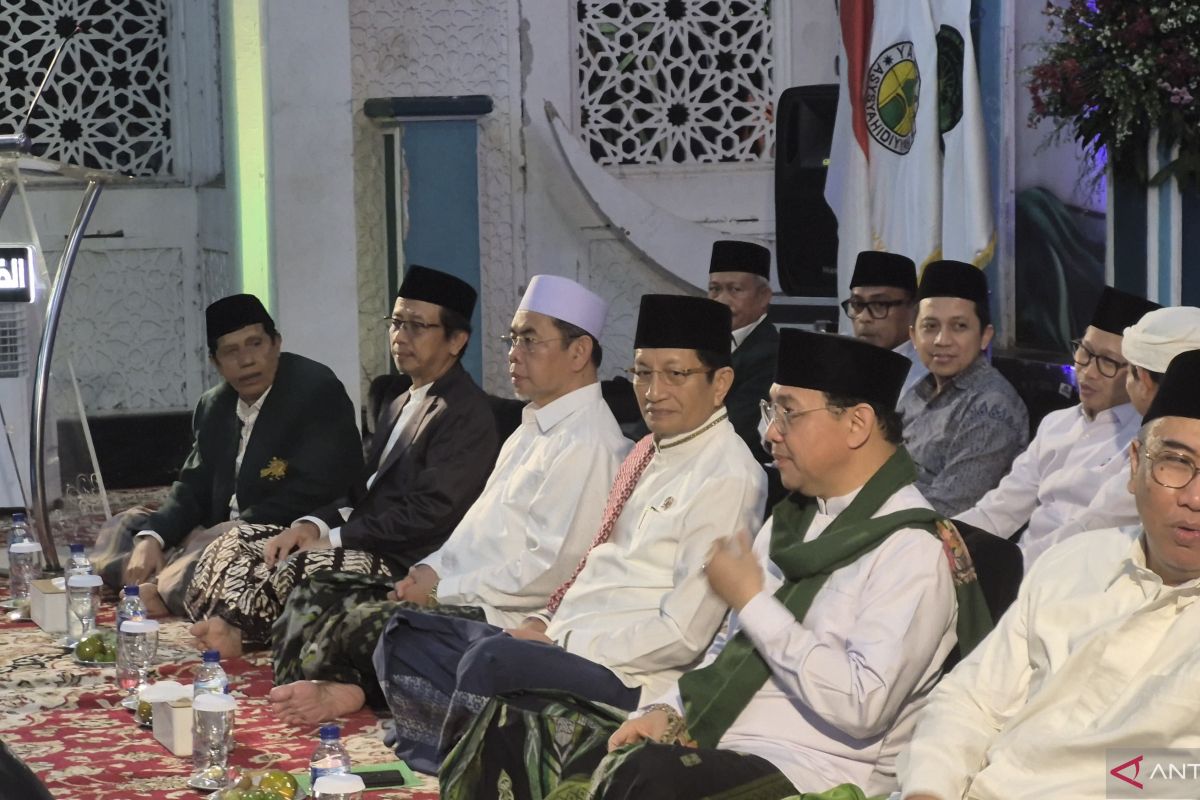
Bandung (ANTARA) - The Minister of Religious Affairs, Nasar/uddin Umar, has emphasised the importance of strengthening religious education curricula based on ecotheology, which highlights the holistic relationship between humans, nature, and God within a single value-based consciousness.
During his visit to Bandung, West Java, on Tuesday, Nasaruddin Umar explained that this spiritual concept can build a relationship of mutual love between fellow humans, the universe, and God as an inseparable unity.
“Ecotheology is the awareness that must emerge within every individual to love fellow humans, love the universe, and at the same time, for humans and nature to love their God. It is like a love triangle,” he stated while visiting the Al-Qur’an Al-Falah Cicalengka Islamic Boarding School.
He explained that such an approach is vital so that humans do not view nature merely as an object of exploitation, but rather as part of a balanced life system that must be preserved.
“Without love, nature will only be regarded as an object. Ultimately, what occurs is exploitation without considering the consequences,” he said.
He noted that environmental damage can have a wide-reaching impact on ecosystem balance, including the loss of biodiversity and the disruption of the natural life cycle.
“If forests are felled without control, ecosystems can be destroyed, animals disappear, and the balance of nature is disrupted,” he added.
In the context of religious education, he highlighted that ecotheology lessons are often not conveyed fully, causing the deeper meaning to be lost during the learning process.
He also emphasised the importance of continuity in religious education within pesantren (Islamic boarding schools), particularly from the Madrasah Tsanawiyah (Junior High) to the Madrasah Aliyah (Senior High) levels, to ensure understanding does not stop at the basic stage.
According to him, once material is studied at the Tsanawiyah level, it should be continued more deeply at the Aliyah level without repeating the same content, but rather developing analytical and advanced interpretive aspects.
“If necessary, do not repeat it in Aliyah, but rather continue it so that the deeper parts of the texts can be fully understood,” he said.
On this occasion, Nasaruddin Umar added that the ‘kitab kuning’ (classical Islamic texts) must also be understood in their entirety within pesantren, rather than stopping at the introductory stages.
“We see, for example, with hadith texts like Sahih Muslim, the beginning parts are usually studied, but the final parts are often left incomplete. Yet, the final sections contain a very profound spiritual dimension,” he said.
He asserted that strengthening the ecotheology-based curriculum and ensuring the continuity of pesantren learning is expected to produce a generation that possesses a more holistic understanding of religion alongside a strong ecological consciousness.