
Minister Shares Results of Digital Social Assistance Trials in 42 Cities and Bali
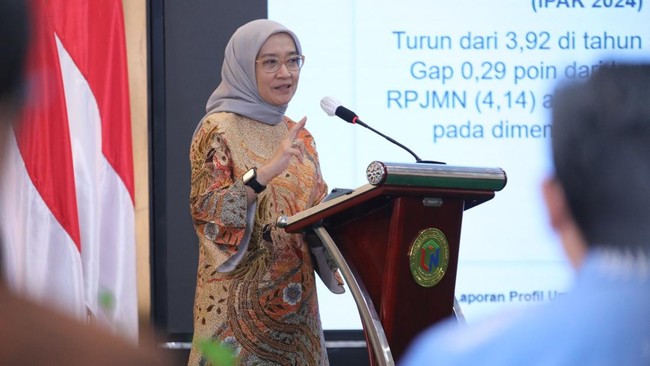
The Ministry of Administrative and Bureaucratic Reform (PANRB) has reported the results of piloting the digitalisation of social assistance in 42 districts and cities, with the addition of Batam City and the province of Bali. Minister Rini stated that the trial has provided important lessons regarding the acceleration of processes and strengthening of transparency in the distribution of social assistance. Therefore, the government must ensure that this digital transformation can continue systematically through regulatory strengthening, business process structuring, digital technology readiness, and data interoperability.
“The digital transformation of social assistance does not stop at innovation, but must become a robust and sustainable system. The trial has given us evidence, and now is the time to ensure its sustainability through solid policy, governance, and collaboration,” said Minister Rini during the Coordination Meeting of the Committee for the Acceleration of Government Digital Transformation (KPTDP) in Jakarta on Tuesday (30/6/2026).
She explained that there are several follow-up focus areas that need to be jointly overseen towards national operations. First, strengthening governance and institutions through reinforcing the social protection portal management organisation, clarifying cross-ministerial, agency, and regional roles, and strengthening the implementing institution for digital government as a GovTech strengthening strategy. Second, strengthening policy and regulation through revising a number of supporting rules, including accelerating the ratification of the Draft Presidential Regulation on Digital Government.
Additionally, the transformation is carried out by simplifying the business process for distributing social assistance from nine stages to three main stages, as well as strengthening data standardisation and interoperability, utilising Digital Public Infrastructure (DPI), and strengthening cyber security. The social protection portal also needs to be ensured to be technically ready to operate on a national scale.
In accelerating implementation in the regions, Rini also emphasised the importance of support from field actors so that the data collection process runs more effectively, including for vulnerable groups. “Local governments can optimise the role of agents in the field and, if necessary, involve civil servants (ASN) to help accelerate the process of filling in and updating data,” she added. This step is considered important to reduce technical barriers while ensuring that people in need can be reached in the social protection transformation process. She also reminded of the need for clear, consistent, and easily understood public communication.
“Public education must be strengthened so that people understand the stages of data collection, the official channels used, and ensure that the entire process is free of charge. That way, the risk of information misuse and potential fraud in the data collection process can be minimised,” said Rini.
Minister of Home Affairs Tito Karnavian expressed his support for the acceleration of government digital transformation, particularly in the aspect of digital-based social protection which is currently being expanded to various regions. “The Ministry of Home Affairs will continue to coordinate local governments so that the acceleration of government digital transformation can run optimally through cross-agency collaboration,” he said.
Chairman of the National Economic Council (DEN) and KPTDP, Luhut Binsar Pandjaitan, stated that the expansion of the pilot to 43 districts and cities is an important step towards the national implementation of digital social assistance transformation. “We are now piloting in 43 districts and cities. By the end of July, we will get a more complete picture to ensure a national launch in October,” he said. Luhut also stressed the importance of cross-ministerial and agency collaboration, strengthening data security, and utilising digital technology and artificial intelligence (AI) to support more targeted and accountable public services.
Going forward, Rini assured that the Ministry of PANRB, together with ministries, agencies, and local governments, will continue to oversee the transition from pilot results to national operations in a gradual, tiered, and continuous manner to realise social protection services that are more targeted, transparent, accountable, and of high quality.