
Minister says rice production and surplus maintained, ready to face El Nino
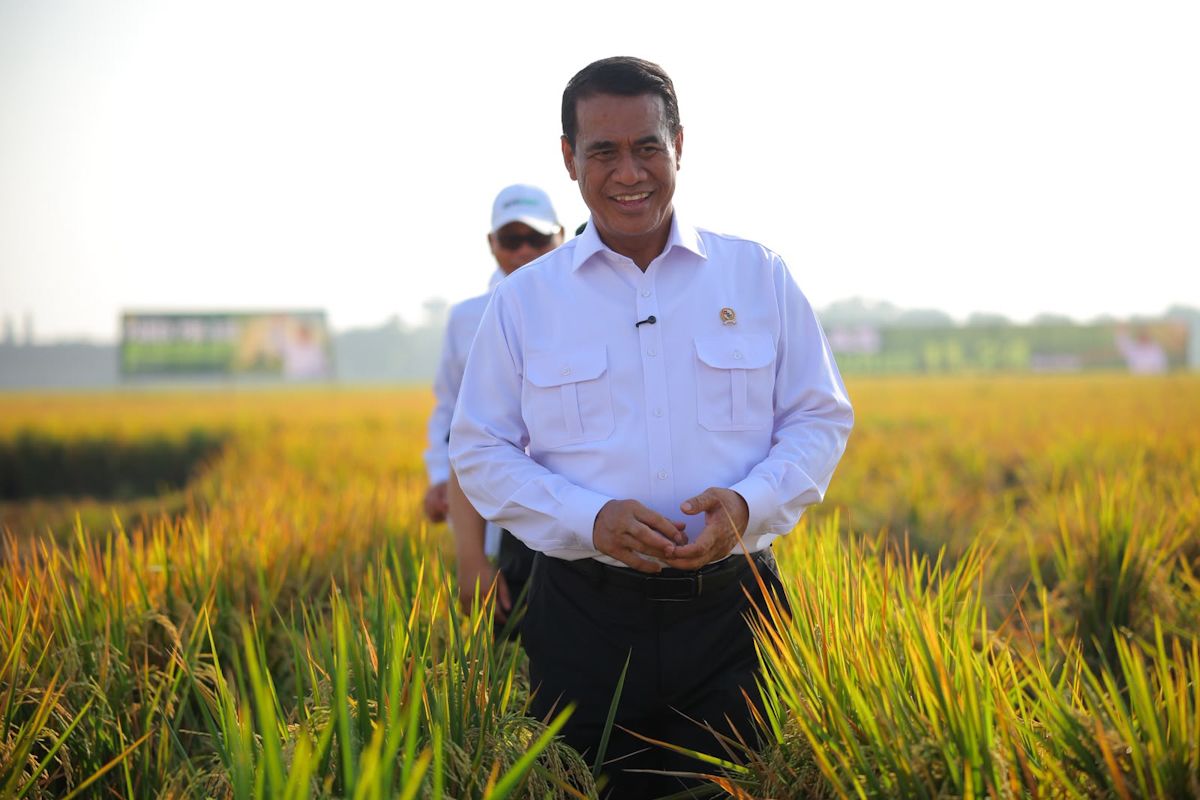
Jakarta (ANTARA) - Agriculture Minister Andi Amran Sulaiman has stated that national rice production and surplus remain maintained, so the government is optimistic it can face the potential impact of the El Nino phenomenon by safeguarding public food availability.
“We are optimistic that national rice production is safe even though Statistics Indonesia (BPS) projects a decline in rice production in January-October 2026,” the minister said when confirmed in Jakarta on Sunday.
According to him, the production decline projected by BPS needs to be viewed proportionally when compared with total national production.
BPS estimates national rice production for January-October 2026 will reach 31.41 million tonnes, down 0.08 percent compared with the same period in 2025, which reached around 31.44 million tonnes. Meanwhile, paddy production in the form of dry unhusked grain is projected to reach 54.52 million tonnes, also down 0.08 percent.
The minister assessed that this figure needs to be viewed proportionally against total national production. With a production base of around 34.7 million tonnes, a 0.08 percent decline is equivalent to only around 30,000 tonnes.
“Try multiplying 0.08 percent by 34.7 million tonnes of national rice production. That 0.08 percent is only 30,000 tonnes, very small compared with 34.7 million tonnes,” the minister explained.
Amran is optimistic that national production remains in a strong position because Indonesia has recorded a food surplus. He said Indonesia recorded a surplus of around 4 million tonnes last year and is again in a surplus position this year.
“Last year the surplus was 4 million tonnes, and this year as well, right? 30,000 tonnes are lost due to reduced production. Meanwhile we have had a 4 million tonne surplus twice, so how?” he said.
He stressed that the government continues to monitor production developments and does not take lightly the challenges faced by farmers. Moreover, current climate conditions are putting pressure on the agricultural sector.
However, various mitigation measures have been prepared by the government to keep production safe.
The Ministry of Agriculture continues to strengthen pump irrigation and irrigation systems, increase productivity, and encourage the use of seeds that are more resistant to drought.
“And it is natural for a decline to occur because of climate conditions, but with that decline it is extraordinary, this is the extreme El Nino Godzilla climate. That is why we are going down, installing pumps, we must not give up,” the minister stressed.
He said the government had made preparations well in advance to anticipate the impact of El Nino. Besides ensuring water availability through pump irrigation and irrigation systems, the government is also encouraging productivity improvements through cultivation technology.
“Now, God willing, we will mitigate the impact of El Nino. Why? Because we prepared well in advance. First, pump irrigation; second, irrigation; third, we are doubling production like this, from 5 tonnes of paddy per hectare to 10 tonnes, from 6 tonnes to 11 tonnes. Then there are drought-resistant seeds,” he explained.
These efforts are part of the government’s strategy to maintain food production amid climate challenges. The government is not only maintaining the harvested area but also encouraging productivity so that production per hectare continues to increase.
On the other hand, BPS has stressed that the October 2026 production figure it released is still a potential or projected figure, not a final figure. Actual production may still change depending on planting conditions and harvest developments up to October.
With the figure still being a projection, production developments until the end of the period will still be determined by planting conditions and actual harvests. The government is also continuing to strengthen mitigation on the ground to ensure climate challenges do not disrupt national food security.
Amran stressed that the government will continue to be present among farmers to maintain production. The various early interventions are expected to sustain productivity while ensuring that the public’s food needs remain secure.
“We must not let farmers walk alone; we must step in,” said Amran.