
Minister says Indonesia joins 50-in-5 campaign to strengthen digital public infrastructure
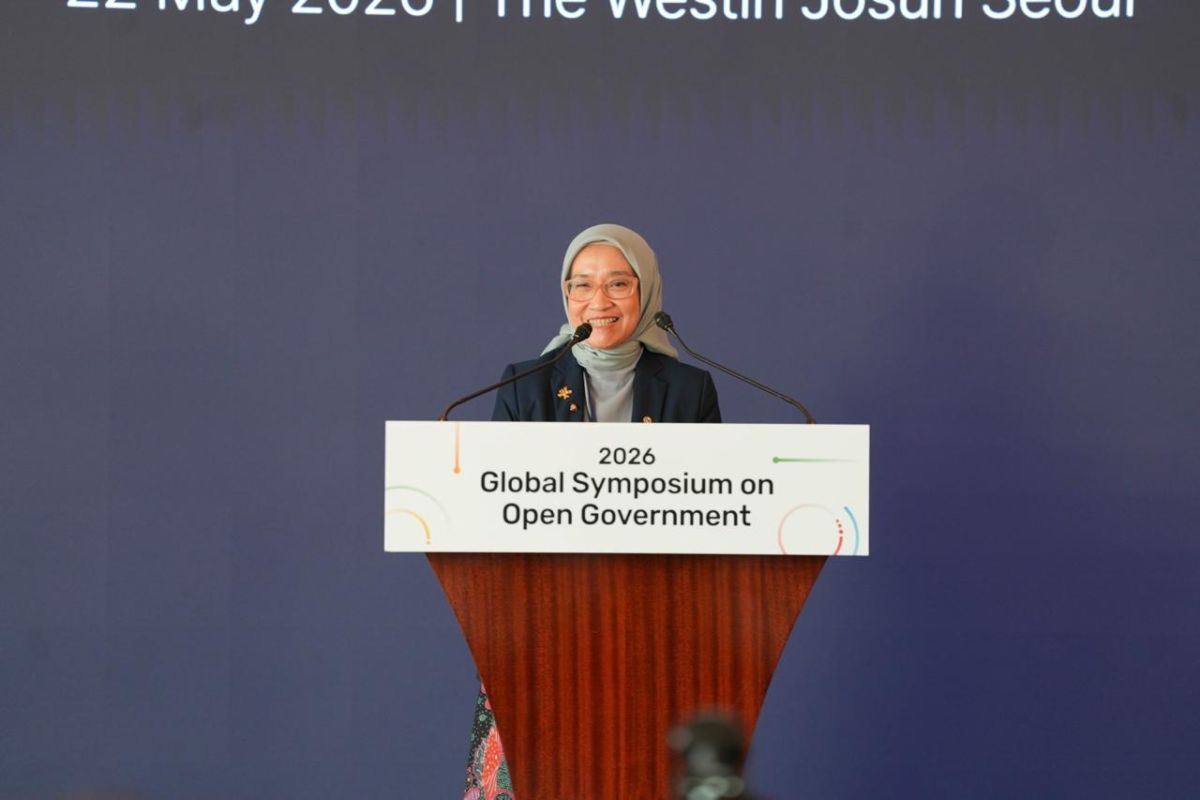
Minister of Public Administration and Bureaucratic Reform (PANRB) Rini Widyantini said the Indonesian government has officially joined the Global 50-in-5 campaign to accelerate the development of secure, inclusive, interoperable, and citizen-centric Digital Public Infrastructure (DPI).
‘While governments worldwide are increasingly digital, the critical question we must continually ask ourselves is whether citizens truly experience the benefits of these transformations in their daily lives,’ Rini stated in Jakarta on Friday.
She delivered the remarks during her speech at the OECD Global Symposium 2026 in Seoul, South Korea, recently.
Rini said that amid rapid digital transformation globally, Indonesia believes success is not measured by the number of applications built, but by the tangible benefits citizens experience in their daily lives.
The 50-in-5 campaign brings together governments and global partners to strengthen the foundations of digital public infrastructure, including digital identity, digital payments, secure data exchange systems, artificial intelligence applications, and integrated digital government service portals.
For Indonesia, joining the 50-in-5 campaign is not merely participating in a global movement but a commitment to ensuring digital transformation delivers tangible, equitable, and meaningful impacts for all citizens.
Rini, who also serves as First Vice Chair of the Government Digital Transformation Acceleration Committee (KPTDP), said citizens do not perceive government presence through technical jargon.
They experience it through real-world moments: when public services are more accessible when needed most, or when elderly citizens no longer struggle with cumbersome bureaucracy.
She cited an example of a rural mother not having to sacrifice her daily earnings just to handle family administrative documents.
‘For Indonesia, DPI is not just about connecting systems. It is about ensuring the government is more responsive, integrated, and present in citizens’ lives,’ she said.
As the world’s largest archipelago with over 280 million people, Indonesia views DPI as a crucial foundation to reduce service disparities, strengthen regional connectivity, and deliver more accessible, integrated, and responsive public services.
Indonesia’s DPI ecosystem is evolving through strategic components, including Digital Population Identity (IKD) as the national digital identity foundation, the Government Data and Digital Services Connector System (SPDLDP), and the implementation of One Indonesia Data (SDI) to drive data and service interoperability.
Additionally, data analytics and artificial intelligence are being utilised to support public services, interoperable digital payment systems via QRIS, BI-FAST, and the National Payment Gateway (GPN), along with the development of the integrated INAku service portal as a citizen-centric government access point with verifiable credentials.
Within this ecosystem, IKD serves as a digital identity used by citizens to access various identity-based services via smartphones.
Moving forward, IKD will be strengthened through facial recognition-based digital onboarding and liveness detection mechanisms, with an initial target of reaching 50 million users.
This enhancement aims to reduce repeated identity verification, improve public service efficiency, and support safer, more user-friendly, and citizen-centric digital services.
Interoperability
On interoperability, as of April 2026, the Government Service Connector System has linked 447 agencies. Meanwhile, QRIS has recorded over 10.33 billion transactions supported by more than 58 million users and 41 million merchants across Indonesia, predominantly micro, small, and medium enterprises (MSMEs).
Cross-border interoperability via QRIS has also been connected with Thailand, Malaysia, Singapore, Japan, and China.
Through digital identity integration, biometric verification, and secure data exchange systems, eligibility verification processes that previously took 75 to 200 days can now be completed in 1 minute to 6 hours.
Indonesia believes digital transformation cannot be achieved by the government alone. Through an Open Government approach, it continues to strengthen collaboration with civil society organisations, academia, the private sector, local governments, development partners, and citizens to ensure digital transformation is participatory, transparent, accountable, and citizen-centric.
Along this journey, Indonesia has partnered with international organisations including the World Bank, Asian Development Bank (ADB), United Nations Development Programme (UNDP), Gates Foundation, MicroSave Consulting (MSC), Prospera, OECD, Co-Develop, the Republic of Korea, and ASEAN nations.
As part of its strengthening commitment to the global DPI ecosystem, Indonesia is also preparing to host the Global DPI Summit 2027 in Bali.
Source: jawawa.id (https://jawawa.id/newsitem/minister-says-indonesia-joins-50-in-5-campaign-to-strengthen-digital-public-infrastructure-1780064090)
Originally published by Antara (Indonesian) (https://www.antaranews.com/berita/5587045/menpanrb-sebut-ri-gabung-kampanye-50-in-5-perkuat-layanan-digital), translated from Indonesian