
Minister Says Indonesia Is Emerging as a New Centre of Welcoming, Progressive Islamic Civilisation
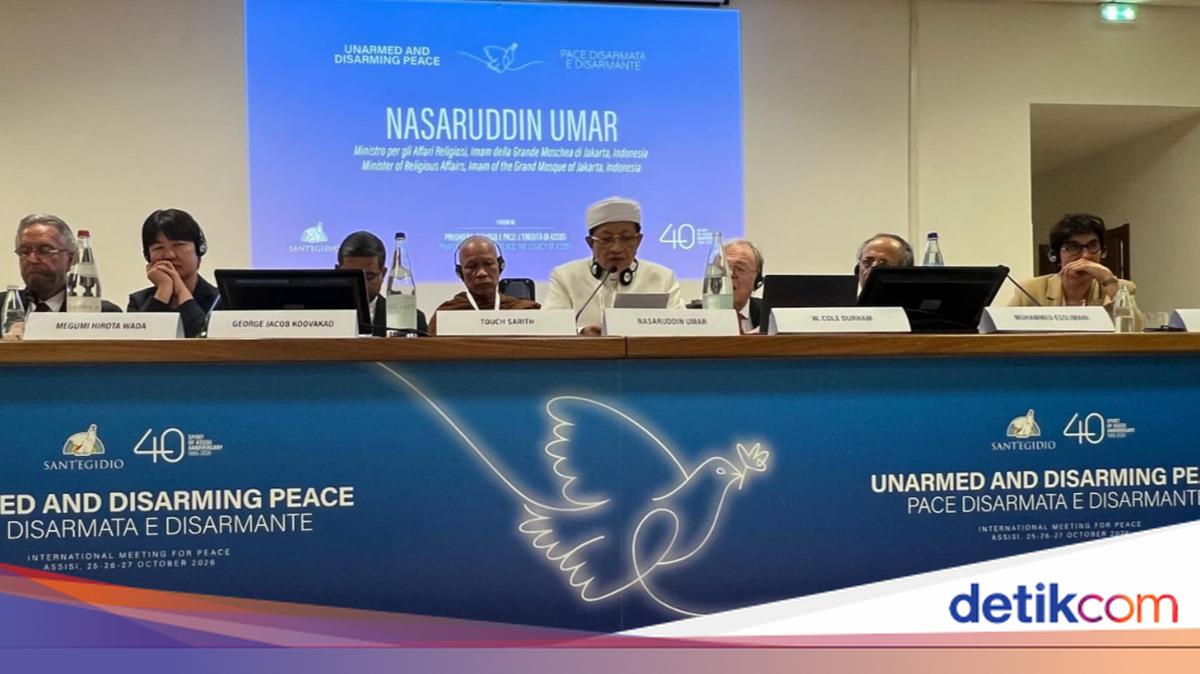
Religious Affairs Minister and Grand Imam of Istiqlal Mosque Nasaruddin Umar said Indonesia is emerging as a new centre of modern Islamic civilisation that is welcoming, progressive and inclusive. He made the remarks as keynote speaker at the “Forum 16 – Prayer, Dialogue and Peace: The Legacy of Assisi” at Casa Leonori in Assisi, Italy.
The forum was part of the Sant’Egidio International Meeting for Peace, titled “Unarmed and Disarming Peace”. Addressing religious leaders from around the world, Nasaruddin presented two key ideas — progressive pluralism and Nusantara ecotheology — as a new roadmap for global harmony.
On progressive pluralism, or “beyond tolerance”, Nasaruddin said genuine harmony across the Indonesian archipelago was not built on majority or minority egos, or merely on passive tolerance. It required sincere respect for differences and universal values, without forcing uniformity.
“What is the same should not be forced to differ, and what is different should not be forced to be the same,” he said in a written statement on Tuesday (27 October 2026).
On Nusantara ecotheology, or “beyond domination”, Nasaruddin said the global climate crisis was rooted in a theological outlook that was too masculine, favouring the domination and exploitation of nature as an object.
Drawing on an Islamic Sufi perspective, he urged the world to turn towards the divine feminine — noting that the Asma’ul Husna, or 99 names of God, are dominated by attributes of rahmah, or compassion — and to understand nature as tajalli, a manifestation of God’s beauty.
“Humanity must pursue exploration that nurtures, not exploitation that destroys,” he said.
As an example of ecotheology in practice in Indonesia, Nasaruddin described the management of Istiqlal Mosque in Jakarta. The mosque is the first place of worship in the world to receive final EDGE green-building certification from the International Finance Corporation (IFC).
“Through environmentally friendly refurbishment, including smart solar panels and efficient ablution-water management, Istiqlal has demonstrated energy savings of 23 per cent and water savings of up to 36 per cent. It is a tangible example of how spirituality can address the global challenge of climate change,” he said.
Nasaruddin also urged world leaders to make “the language of religion” a central instrument of international diplomacy, helping to resolve humanitarian crises and restore damaged ecosystems.
He said a spiritual approach was far more effective at disarming hostility than hard-line political manoeuvring, which often reached an impasse. As evidence, he presented Indonesia’s diversity and stability as a global model of pluralism successfully managed in everyday life.
Global delegates welcome Indonesia’s proposals
The proposals Nasaruddin presented at the international forum received a positive response from speakers and observers.
David Rosen, special adviser to the Abrahamic Family House in the United Arab Emirates, praised Nasaruddin’s emphasis on going beyond formalities. Rosen said the spirit of Assisi should be translated into concrete acts of fraternity at local level to curb extreme global polarisation.
Megumi Hirota Wada, a figure in Japan’s Rissho Kosei-kai Buddhist movement, endorsed the ecotheology pillar. She said protecting the planet was a shared spiritual responsibility, and that harmony between humanity and nature was key to genuine peace.
Cardinal George Jacob Koovakad, prefect of the Holy See’s Dicastery for Interreligious Dialogue, also expressed support. He said Indonesia’s model of harmony and the 2024 Istiqlal Declaration offered practical inspiration for how theological dialogue could lead to concrete joint humanitarian action.
Touch Sarith, president of Cambodia’s Dhammaraingsei Buddhist Association, highlighted the principle of progressive pluralism. He praised the Nusantara approach for rejecting the domination of minorities by majorities, describing it as a strong foundation for stability in Southeast Asia.
International law and religious-freedom expert Professor W. Cole Durham said Nasaruddin’s paper provided a strong theoretical and practical basis for developing legal and religious-freedom policies grounded in environmental protection, or eco-justice.
Civil society delegates and peace observers Mohammed Esslimani and Valerie Reginer said Nasaruddin’s call to use religious language as a formal instrument of international diplomacy was a crucial breakthrough in disarming psychological hostility in conflict zones. The praise, the article said, further strengthened Indonesia’s position as a pioneer of moderate Islam, or Wasatiyyah Islam.
Religious Affairs Ministerial Expert Staff member Adiyarto Sumardjono, who is also acting Director General of Catholic Community Guidance, accompanied Nasaruddin in Italy. The minister’s itinerary was due to continue in the Vatican, where he was scheduled to meet the Holy See’s foreign minister to discuss strengthening the strategic partnership and exploring religious-studies cooperation with the Pontificio Istituto di Studi Arabi e d’Islamistica (PISAI).
Source: jawawa.id (https://jawawa.id/newsitem/minister-says-indonesia-is-emerging-as-a-new-centre-of-welcoming-progressive-islamic-civilisation-1793112730)
Originally published by detikcom (https://news.detik.com/berita/d-8726990/menang-sebut-ri-jadi-episentrum-baru-peradaban-islam-yang-ramah-progresif), translated from Indonesian