
Minister Says Agriculture Can Be a Path to Alleviating Poverty in Alor
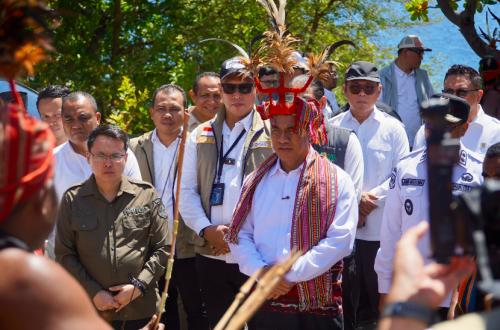
Agriculture Minister Andi Amran Sulaiman has stated that the agricultural sector can serve as a pathway to overcoming poverty in Alor Regency, East Nusa Tenggara. The government is preparing short-term and long-term agricultural development to increase community incomes while strengthening regional food security.
Amran observed that Alor possesses significant agricultural potential, supported by agro-climatic conditions suitable for a number of commodities. Coconut, cashew, and cocoa will be developed as long-term crops, while rice and maize are being prepared to deliver quicker results for the community.
“The potential is substantial. Why? Because it is supported by the agricultural sector here,” said the Minister during a working visit to Alor, East Nusa Tenggara, on Saturday (8/8/2026).
Amran is targeting the development of productive crops across at least 10,000 hectares in Alor. Assuming one hectare is allocated to one family, the programme could potentially reach around 10,000 families.
He calculated that if each family consists of four people, the development of 10,000 hectares could benefit approximately 40,000 people. That figure, he said, could serve as one of the foundations for reducing poverty in Alor.
“We are targeting a minimum of 10,000 hectares of crops here. If it is 10,000, with one hectare per family, that equates to 10,000 families,” said Amran.
The Minister acknowledged that crops such as cocoa and cashew require time before they yield produce. For this reason, the government is not only developing plantation crops but is also promoting rice and maize so that communities can obtain results in a shorter timeframe.
“So our programme is clear: there is a short-term component and a long-term component. We are implementing both here,” said the figure from South Sulawesi.
According to Amran, rice can be harvested in around three to four months. Meanwhile, cocoa and cashew are projected to become long-term sources of income because they can continue producing for decades once they begin bearing fruit.
To accelerate the programme, the government is providing seedlings, agricultural machinery and equipment, as well as pumps for land with water sources. The Minister confirmed that the costs of seedlings and planting under the government’s priority programme are borne by the state.
The strengthening of the agricultural sector is proceeding in tandem with government interventions to ensure the food needs of the people of Alor are met. This step came into focus after a student from Alor, Adriano Padama, raised the issue of high rice prices and low local production to Amran during a dialogue at Diponegoro University in Semarang.
Adriano stated that rice demand in Alor reaches approximately 24,000 to 27,000 tonnes per year. However, local production is only able to meet around 10 percent of that need, leaving the region dependent on external supply.
“The problem, Sir, is that our rice requirement is around 24,000 to 27,000 tonnes per year, while our capacity is only 10 percent, so rice prices often rise and become expensive, Sir,” said Adriano.
The archipelagic geography also drives up rice distribution costs. Adriano noted that rice prices in urban areas range from Rp 13,000 to Rp 15,000 per kilogram, while in the interior they reach Rp 17,000 to Rp 18,000 per kilogram.
Prices can even surge to Rp 25,000 to Rp 30,000 per kilogram when rain disrupts inter-island distribution. Responding to these conditions, Amran has asked the State Logistics Agency (Bulog) to immediately distribute rice under the Food Supply and Price Stabilisation programme to Alor.