
Minister Raja Juli Warns of El Niño Effects Bringing Disaster to Indonesia During Dry Season
Jakarta, CNBC Indonesia - Forestry Minister Raja Juli Antoni has warned of the dangerous effects of the El Niño climate phenomenon if it strikes Indonesia during this year’s dry season, particularly the potential increase in forest and land fires (karhutla).
For this reason, he stated, the Meteorology, Climatology, and Geophysics Agency (BMKG) plays a crucial role in protecting Indonesia’s forests through various karhutla prevention efforts. This is supported by scientific knowledge that forms the basis of every policy, making it accountable in a scientific or evidence-based manner.
“This year’s karhutla incidents have the potential to increase in line with the occurrence of El Niño,” said Raja Juli in a statement on the official BMKG website, quoted on Thursday (23/4/2026).
“Therefore, interventions through OMC (Weather Modification Operations) and data accuracy will be key in determining whether karhutla can be suppressed. This includes law enforcement and public discipline in not burning land,” he added.
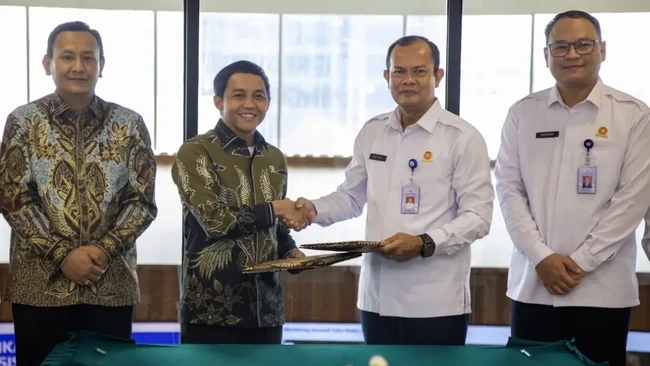
To this end, he revealed, the Ministry of Forestry (Kemenhut) and BMKG have officially strengthened their strategic cooperation through the signing of a Memorandum of Understanding (MoU) at the BMKG office in Jakarta on Wednesday (22/4/2026). Citing the official Kemenhut website, the MoU signing was conducted by Forestry Minister Raja Juli Antoni and BMKG Head Teuku Faisal Fathani, witnessed by Deputy Forestry Minister Rohmat Marzuki, as well as senior officials from Kemenhut and BMKG.
“Collectively, our nation is a learning nation. Karhutla data continues to decline. However, this year’s challenge is greater due to the El Niño threat. Our interventions, such as data accuracy and OMC, will be very determining,” he said.
“One of the main strategies agreed upon is the optimisation of Weather Modification Operations. Currently, these operations are underway in Riau and West Kalimantan as an early detection step,” Raja Juli added.
Therefore, he continued, with strengthened coordination between central agencies, local governments, TNI, Polri, and community participation in preventing forest and land fires, the government is optimistic that the impacts of karhutla in 2026 can be minimised.
“Prevention is far better than cure. Preventing karhutla is far better than extinguishing fires. We continue to monitor groundwater levels, especially in peatlands. If it drops below 40 cm, we immediately conduct OMC for re-wetting or re-moistening to maintain groundwater reserves,” he said.
BMKG Head Teuku Faisal added similar sentiments. He emphasised that preventive measures need to be strengthened to control and reduce the risk of forest fires.
“BMKG’s task is to support the Ministry of Forestry in controlling forest fires, land fires, and drought,” he stated.
“We are striving to be more prepared this year for mitigation. We are not only working curatively when fires are already burning, but strengthening preventive aspects through data integration to predict vulnerable points,” Faisal said.
Faisal revealed that as of 21 April 2026, the number of hotspots in Indonesia reached 1,777, with Riau and West Kalimantan having the most.
“This figure is higher than in previous years, so forest fire risks must be a collective concern,” Faisal said.
When Will El Niño Strike Indonesia?
According to Faisal, Indonesia is predicted to experience a drier dry season due to El Niño.
“According to BMKG data, parts of Indonesia are currently entering the dry season. Meanwhile, in the second semester of 2026, a weak to moderate El Niño phenomenon has a 70-90 percent chance of occurring,” Faisal said.
“The potential for forest and land fires greatly depends on data accuracy and the optimisation of preventive efforts, one of which is through atmospheric interventions in weather modification operations,” he added.
“Currently, OMC is being conducted in Riau and West Kalimantan with the aim of increasing peatland groundwater levels. Thus, when rainfall decreases, the land will be resistant to fires,” Faisal explained.
On another occasion, Faisal had warned that although the intensity of El Niño is predicted not to be as strong as in 2015, 2019, and 2023, its impacts still need to be anticipated, especially as it coincides with the dry season period.
“The dry season and El Niño are two separate phenomena. What we are concerned about is when during the dry season, the El Niño phase is active. This is the condition that occurred in 2015, 2019, 2023, and is predicted to start in 2026. BMKG will continue to monitor so that future predictions are more accurate,” he stressed.
BMKG, he said, is also coordinating with stakeholders in Jambi and South Sumatra for the implementation of land re-wetting through OMC as an anticipation of increasing hotspots.
“Re-wetting the land is key to maintaining the fire resistance level of peatlands,” he said.
Environment Ministry Forms Task Force to Strengthen Early Response
Separately, the Ministry of Environment and Forestry/Badan Pengendalian Lingkungan Hidup (KLHK/BPLH) has formed a Task Force for Land Fire Control in 2026.
“This step is part of the national strategy in facing the increased risk of karhutla in line with projections of the dry season and potential El Niño this year,” said Environment Minister/Head of BPLH Hanif Faisol Nurofiq in an official statement.
“The approach to controlling karhutla must focus on structured and integrated prevention. We must act quickly, structured, and without compromise because this concerns public safety, the environment, and the nation’s future,” he emphasised during the 2026 Karhutla Control Alert Roll Call.
It was explained that there has been a significant increase in karhutla incidents in early 2026, with the number of hotspots reaching 3,609, or three times higher than the same period last year.
The area burned up to February 2026 was also recorded to have increased sharply, reaching more than 32,000 hectares, with Sumatra and Kalimantan as the most affected regions.