
Minister: Presidential Regulation on Red and White Village Cooperative Governance to Cover Operations and Financing
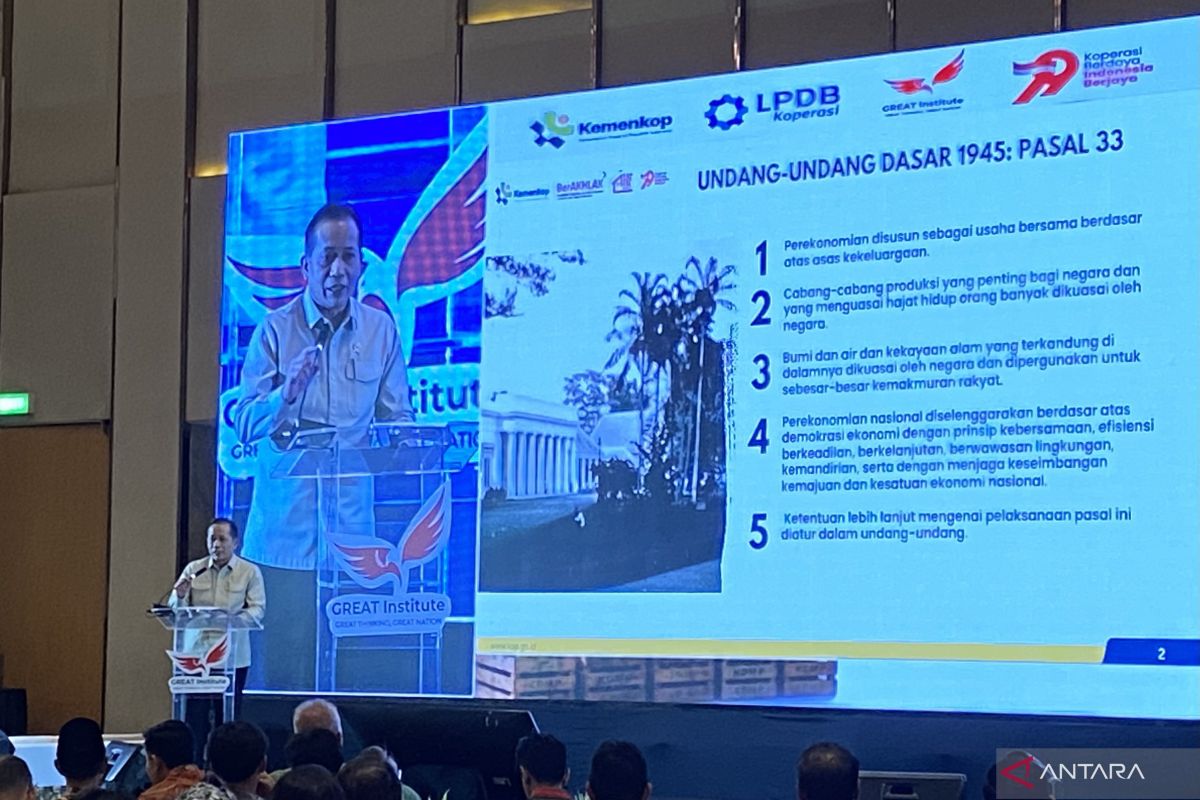
Jakarta (ANTARA) - Cooperatives Minister Ferry Juliantono said the government is finalising a Presidential Regulation (Perpres) on the governance of the Merah Putih Village/Urban Village Cooperatives (KDKMP), which will govern operations, financing, and the cooperatives’ assignment to distribute subsidised goods.
“Because we are currently training and educating village/urban village cooperative managers who, at the beginning of August, will be placed and deployed across all the completed physical buildings — warehouses, outlets, and equipment — of the Merah Putih village cooperatives. Then we will begin operations,” Ferry said at the Great Institute seminar in Jakarta on Tuesday.
Ferry said the drafting of the presidential regulation is being carried out alongside preparations for the operational launch of the Merah Putih Village/Urban Village Cooperatives. The government is currently training cooperative managers who will be stationed at cooperatives whose physical buildings have been completed.
According to the Ministry of Cooperatives, the draft regulation will govern the cooperatives’ institutional formation, physical construction in the form of warehouses, outlets, and supporting facilities, asset management, licensing, and financing.
In addition, the regulation will cover the operationalisation of the cooperatives, including human resource recruitment, manager placement, business development, capitalisation, and coordination of implementation with relevant ministries and agencies.
The draft regulation also assigns the cooperatives as distributors of subsidised goods, including 3-kilogram LPG, cooking oil, and subsidised fertiliser.
The regulation also provides for strengthening programme synergy with state-owned enterprises (BUMN), regionally owned enterprises (BUMD), and Village-Owned Enterprises (BUMDes).
Under the draft, PT Agrinas Pangan Nusantara will also be assigned to support the operationalisation of the cooperatives for two years, accompanied by guidance from the Ministry of Cooperatives.
After that period ends, the cooperatives will be managed independently.
The presidential regulation will also govern the financing mechanism, the exit strategy after the two-year period, oversight, control, evaluation, reporting, and transitional provisions.
Ferry said the government targets the cooperatives’ operations to begin after the regulation is issued and the cooperative managers start being placed in early August.
He added that physical construction of the cooperatives is ongoing. Based on the latest data, he said around 19,000 warehouse, outlet, and supporting facility buildings have been 100 per cent completed, with the number targeted to rise to around 35,000 units by the end of August 2026.
Previously, the government issued Presidential Instruction Number 9 of 2025 on the Acceleration of the Establishment of Merah Putih Village/Urban Village Cooperatives, which serves as the legal basis for forming cooperative legal entities in villages and urban villages.
The government subsequently issued Presidential Instruction Number 17 of 2025, which governs the acceleration of physical construction of warehouses, outlets, and supporting facilities for the cooperatives.
Ferry added that the government is also preparing the placement of cooperative managers from early August so that cooperatives that are physically ready can begin operating as soon as the presidential regulation on operations is issued.
A total of 29,830 prospective managers of the Merah Putih Village/Urban Village Cooperatives are currently undergoing managerial training and competency certification in preparation for placement at cooperatives across various regions.
The training runs from 17 to 29 July 2026, with the closing ceremony on 31 July 2026. The programme is being conducted at 15 training commands, 61 education units, and 451 classes throughout Indonesia.
The training curriculum comprises 90 lesson hours, consisting of 12 modules, 42 subjects, and 10 competency units, focusing on cooperative management and financial administration.
All participants will also take the KDKMP manager competency certification, which has been accredited by the National Professional Certification Agency (BNSP).