
Minister PPPA: Synergy Needed to Build Safe Ecosystem for Children
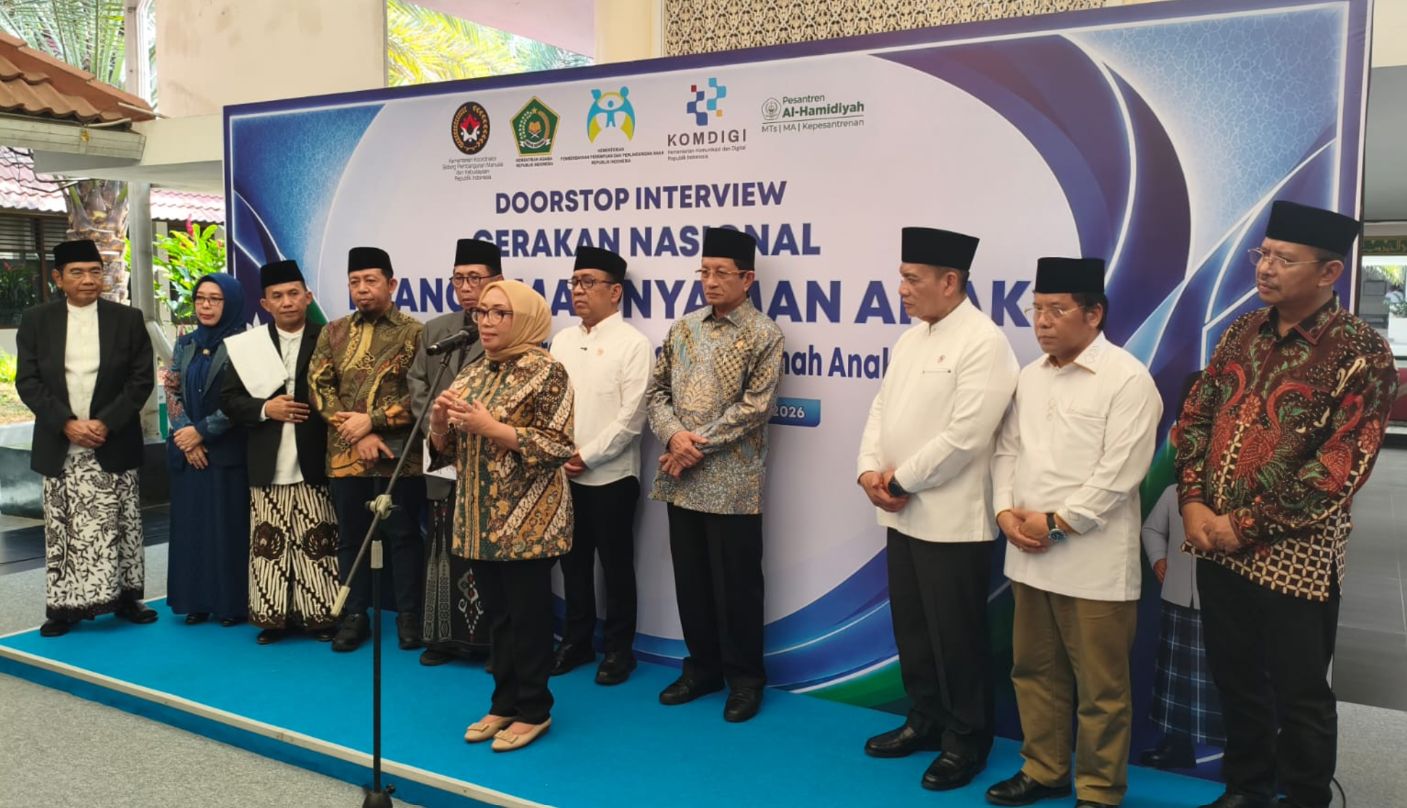
Minister of Women’s Empowerment and Child Protection (PPPA) Arifatul Choiri Fauzi has stressed that the National Movement for Safe and Comfortable Spaces for Children is part of strengthening national policy to protect children from all forms of violence, whether within the family, educational settings, public spaces, or the digital realm.
According to Arifatul, child protection cannot be carried out partially but requires synergy across ministries and agencies so that each policy complements the others in building a safe ecosystem for children’s growth and development. “We express our appreciation to the Coordinating Minister for Human Development and Culture who has coordinated various ministries and agencies so that child protection efforts can run in an integrated manner according to their respective duties and authorities,” she said at the launch of the National Movement for Safe and Comfortable Spaces for Children for Child-Friendly Islamic Boarding Schools and Madrasas at Pesantren Al-Hamidiyah, Depok, Sunday (12/7/2026).
Arifatul explained that the movement is an implementation of various government policies that have been issued, including Presidential Regulation Number 87 on the Roadmap for Child Protection in the Digital Realm, the Child-Friendly Madrasa programme developed by the Ministry of Religious Affairs, and Minister of Primary and Secondary Education Regulation Number 6 of 2026 concerning safe and comfortable school culture. She said the alignment of these various regulations forms an important foundation for building a more comprehensive and sustainable child protection system.
She expressed hope that the National Movement for Safe and Comfortable Spaces for Children would not be seen as a ceremonial activity or a short-term programme, but rather as a collective movement to build awareness among all elements of the nation. “What we want to build is not just a programme, but a collective awareness so that all Indonesian children truly feel safe and comfortable, wherever they are,” Arifatul asserted. She added that the success of child protection depends heavily on collaboration between the government, educational institutions, families, communities, and the business sector in creating an environment free from violence and optimally supporting children’s growth and development. Through this cross-sector synergy, the government hopes that every Indonesian child’s right to a sense of security, protection, and a healthy environment can be realised in daily life.