
Minister Officiates Greater Bandung BRT Construction, Targets 2027 Operation
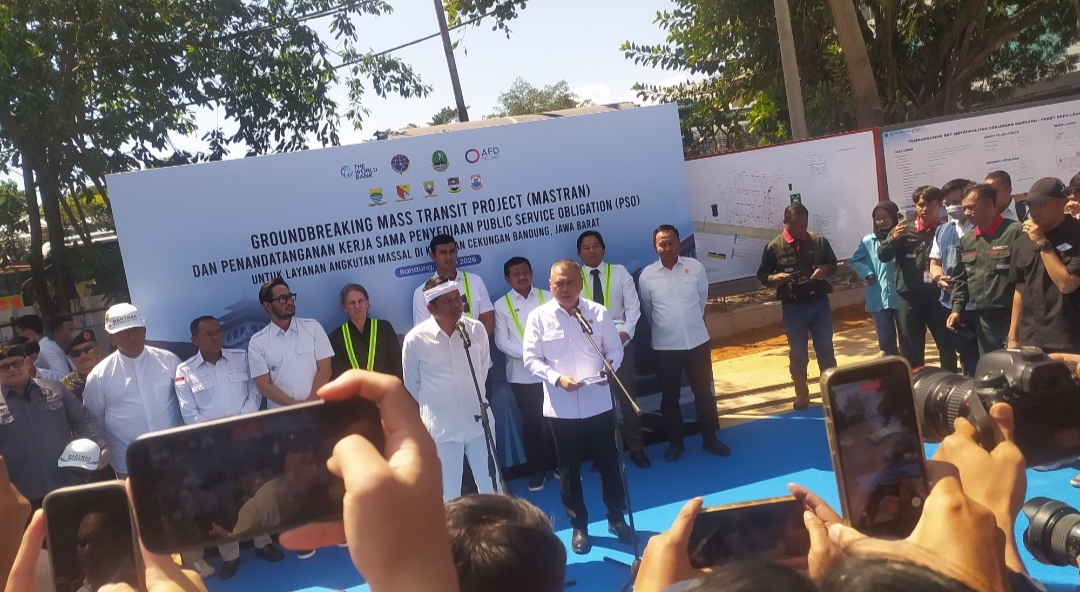
Transportation Minister Dudy Purwagandhi has officiated the start of construction for the Greater Bandung Bus Rapid Transit (BRT) infrastructure. The BRT will be part of the Indonesia Mass Transit Project (Mastrans) in the Greater Bandung area. The first stone was laid on Wednesday (22/7) at the Leuwi Panjang Terminal in Bandung City, attended by the Governor of West Java and regional heads.
Dudy explained that the presence of the BRT is a solution to the worsening traffic congestion in Greater Bandung, which not only wastes time but also impacts productivity and the quality of life of residents. "The solution we need is not just to increase road capacity, but more importantly, to provide a reliable, integrated public transport system that becomes the primary choice for the community in their daily activities," he said.
He explained that the BRT infrastructure development is crucial to realising a modern, comfortable, safe, punctual, and affordable public transport service in the agglomeration area. Through the Mastrans project, the central government is synergising with the West Java Provincial Government and district/city governments in Greater Bandung to deliver interconnected mass transportation. Dudy added that the BRT will become the backbone, integrated directly with rail services, urban transport, and other modes of transport. This is expected to facilitate efficient and sustainable mobility for residents from their point of departure to their final destination.
In addition to the start of physical construction, a cooperation agreement for the provision of a public service obligation (PSO) subsidy was also signed. Dudy stated that the PSO commitment is vital to ensure the continuity of service operations with tariffs that are affordable for the public. "Good infrastructure must be accompanied by quality and sustainable services. I also emphasise that the entire implementation of this programme must adhere to the principles of timeliness, quality, and appropriate targeting," he said.
He also expressed appreciation to the West Java Provincial Government, regional heads in Greater Bandung, and international institutions such as the World Bank and the Asian Development Bank (ADB) for their financing support, technical assistance, and partnership. "We hope the presence of this integrated public transport system will not only move people from one place to another, but also reduce congestion, create a cleaner environment, and give people more time to spend with their families," he said.
The BRT infrastructure development in Greater Bandung includes 6 BRT depots, 719 on-corridor bus stops, 34 off-corridor bus stops, 21 kilometres of dedicated BRT lanes, and an integrated Metropolitan Intelligent Transportation System (ITS). The project is jointly financed by the government and the World Bank. The overall Mastrans programme financing totals US$264 million (Rp3.8 trillion), consisting of a US$224 million loan from the World Bank, a US$40 million loan from the AIIB, and supporting funding from the Indonesian government. The investment value for the BRT infrastructure in Greater Bandung specifically reaches approximately Rp1.3 trillion, allocated for the construction of lanes and bus stops on the main corridor, phase 1 and phase 2 off-corridor bus stops, BRT depots, ITS, and various other supporting enhancements.
Regarding the construction stages and service targets, ongoing works include the construction of phase 1 off-corridor bus stops, Cicaheum Depot, Leuwi Panjang Depot, and the main corridor BRT lanes and bus stops. Future works will include phase 2 off-corridor bus stops, bus stops at Tegallega, Alun-alun Bandung, Hall Station, Kiara Artha Park, Ciburuy Depot, Padalarang Depot, Soreang Depot, Majalaya Depot, and the procurement of ITS to support the Metropolitan BRT operations. Through this infrastructure development and the implementation of ITS, the Greater Bandung BRT service is targeted to operate with a maximum headway of 7 minutes during peak hours and 15 minutes during off-peak hours, allowing the public to enjoy a more reliable, fast, and comfortable public transport service. These service standards are expected to be a key attraction for increasing public transport usage while reducing congestion and emissions in the Greater Bandung area.