
Minister of Social Affairs Gus Ipul Calls on Local Governments to Update DTSEN Data in Kupang
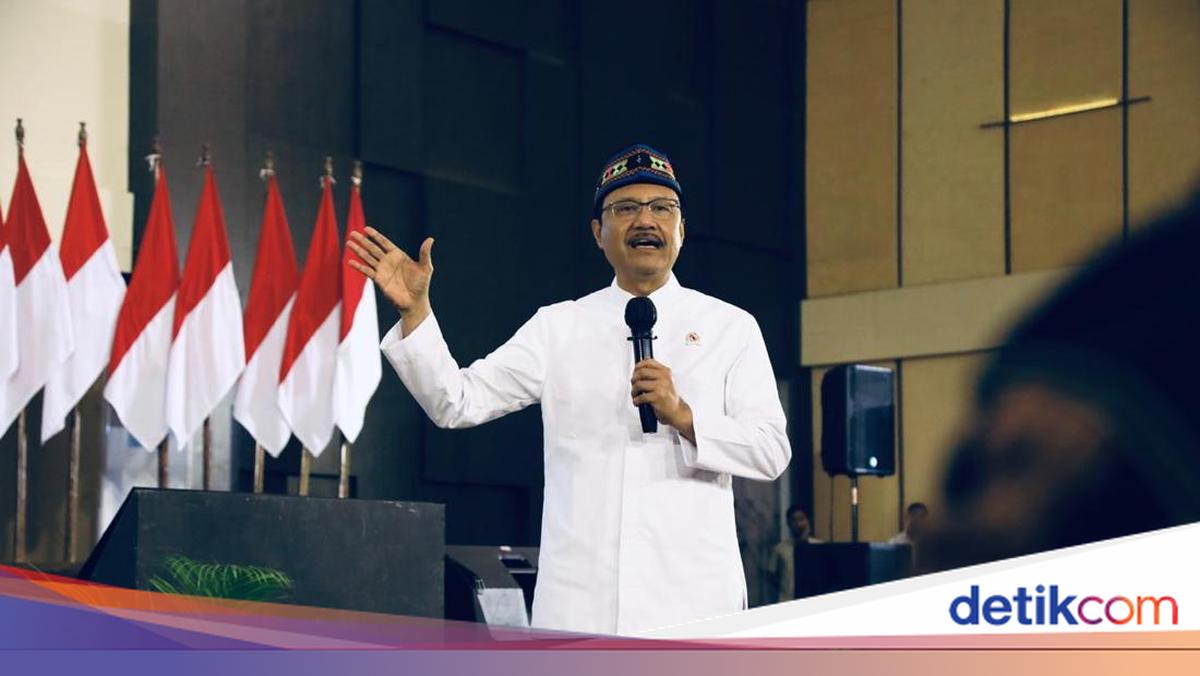
Minister of Social Affairs Saifullah Yusuf, known as Gus Ipul, revealed data from the National Economic Council (DEN) 2025 indicating that approximately 45% of Family Hope Program (PKH) recipients are misaligned with intended targets. This finding has prompted the government to update the National Social Economic Single Data (DTSEN) to ensure social assistance reaches the correct beneficiaries.
Gus Ipul made the statement during the Presidential Priority Program Collaboration Event for Building Human Resources Towards Economic Independence, held in conjunction with the National Elderly Day (HLUN) 2026 under the theme ‘Resilient Elderly, Growing Indonesia’ at the Eltari Hall of the East Nusa Tenggara (NTT) Provincial Government Office in Kupang on Sunday, May 31, 2026.
Gus Ipul said President Prabowo Subianto, after his inauguration, urged all government officials to courageously acknowledge the current state of data as a basis for improvement.
‘I am most moved by President Prabowo’s call for us, especially me, to begin this work by presenting honest data. We must acknowledge the data as it is, be truthful and transparent, and then proceed to make improvements,’ he said.
He explained that evaluations revealed some social assistance and subsidies are still not fully targeted correctly.
‘The data shows that part of the social assistance and subsidies are misdirected. Some are correctly targeted, but others are not. One example is the Family Hope Program,’ he explained.
According to Gus Ipul, around 45% of PKH recipients are no longer eligible. However, this is not due to PKH facilitators, but because they work based on available data.
‘Until now, they only receive data and then proceed to assist. So it’s not the PKH facilitators choosing beneficiaries, but the data comes from higher authorities. The result is that some are misdirected,’ Gus Ipul said.
Therefore, President Prabowo has tasked the Central Statistics Agency (BPS) to manage DTSEN, while ministries, agencies, local governments, and social facilitators assist in updating data on the ground.
Gus Ipul stated that data correction is crucial to ensure poor families receive assistance accurately.
Gus Ipul stressed that DTSEN’s success depends on data quality collected at village and sub-district levels. He said village data operators play a strategic role in accurately recording community conditions.
‘The key is the village data operators. Without data coming from the ground, issues in Village A in Kupang cannot be identified from Jakarta,’ he said.
He added that data collection must start at the RT, RW, village, and sub-district consultation levels before being entered into DTSEN by village data operators.
Gus Ipul said data quality at village level would determine the quality of government policies at national level.
‘So Governor, our fate depends on them. If they input the data correctly, we can proceed. If it’s wrong from the start, we’ll face difficulties. Our fate hinges on them,’ he said.
During the event, Gus Ipul pledged joint commitment with the NTT Provincial Government and all regency/municipal authorities to improve social data quality.
In line with Gus Ipul, Statistics Indonesia (BPS) Chief Amalia Adininggar Widyasanti said DTSEN updates are ongoing to ensure social assistance is targeted correctly. Reconciliation with Dukcapil is conducted every three months.
‘We collaborate with the Social Affairs Minister and his team, updating data through ground checks assisted by PKH facilitators. We also work with local governments for local updates, and several ministries support us,’ Amalia said.
She noted that from Q2 2025, DTSEN updates have been used as a basis for social assistance distribution.
‘The latest DTSEN version as of April 2026 includes 289 million individuals with single National Identity Numbers (NIK). From this, we can form family units based on family cards, resulting in 95.3 million unique, non-duplicate, and non-empty family cards in DTSEN,’ Amalia explained.
Amalia stated that DTSEN data shows 627,404 elderly in NTT. Of these, 118,711 (18.92%) live alone, with 59.31% receiving health insurance premium assistance (PBI). Among the 379,592 elderly in the bottom 40% income bracket, 91.11% have health insurance via PBI.
At the event, East Nusa Tenggara Governor Emanuel Melkiades Laka Lena highlighted DTSEN’s crucial role in policies for poor communities.
‘DTSEN is vital to ensure all those in need receive assistance properly,’ he said.
He also stated that the NTT Provincial Government is committed to continuously updating DTSEN to ensure all poor citizens are registered and receive targeted social assistance.
To support DTSEN updates, the Ministry of Social Affairs has established formal and participatory data update channels. In the formal channel, citizens can report to RT/RW for data updates via SIKS-NG operators at village, sub-district, or social affairs offices.
Proposals are discussed in village or sub-district consultations, followed by ground checks or verification by PKH facilitators and social affairs departments, then confirmed by local leaders.
For the participatory channel, citizens can submit objections or suggestions via the Cek Bansos app and PKH facilitators.