
Minister of Religious Affairs: Religious Diplomacy is a New Approach to Creating Global Peace
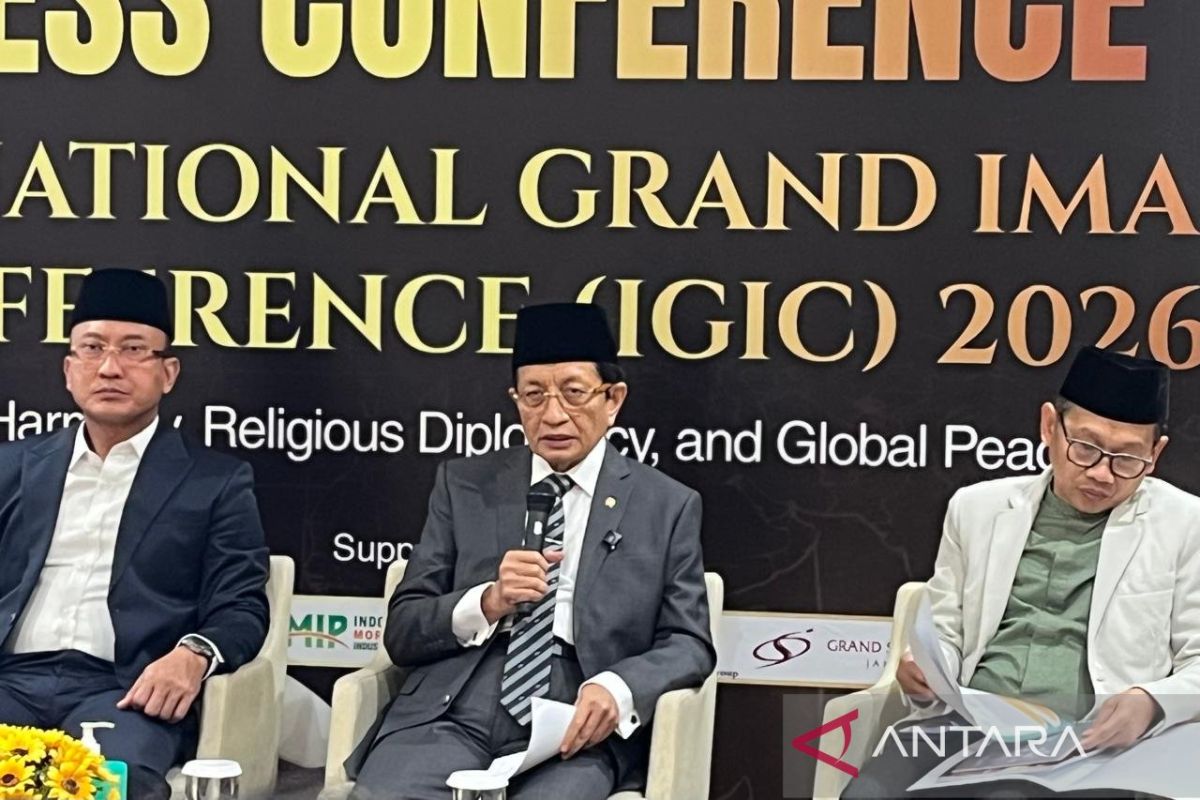
Jakarta (ANTARA) - Minister of Religious Affairs Nasaruddin Umar stated that the approach of religious diplomacy can serve as a new method for building global peace by prioritising humanitarian values.
“We know that the diplomacy we have developed so far is very formal and too legal-formalistic, which ultimately often leads to deadlocks. Therefore, we are attempting to use a spiritual diplomacy approach because we are very certain that humanity is only one; there is no other,” Nasar จง said at Istiqlal Mosque, Jakarta, on Wednesday.
The Minister’s statement was made during a press conference regarding preparations for the International Grand Imam Conference (IGIC), scheduled to take place from 25–28 September 2026.
The IGIC will be held across three locations: Istiqlal Mosque, Hotel Bidakara, and Hotel Sahid. Approximately 500 participants are expected, including 47 mosque imams from 39 different countries.
Nasaruddin Umar noted that the organisation of the IGIC serves as a form of soft diplomacy. He believes the religious diplomacy approach needs to be developed by using humanitarian values as a common ground.
He explained that this principle implies all humans share the same humanity, regardless of nationality, ethnicity, gender, religion, or belief.
Religious values can serve as an instrument to bring different groups together because, fundamentally, religions carry universal messages regarding peace and the rejection of violence.
“If we want to be honest, it is actually easier to find common ground in religion than to seek its differences,” said the Grand Imam of Istiqlal Mosque.
He added that all religions reject violence and instead encourage the creation of a peaceful life. Therefore, these messages need to be developed as a force to strengthen human relationships.
“We will emphasise religion as a centripetal force—a force for unification—rather than a centrifugal force, which is a force for division,” said Nasaruddin.
According to him, mosques hold a strategic position in the development of religious diplomacy because, in addition to being places of worship, mosques can also serve as meeting spaces to discuss humanitarian issues.
“A mosque, like any other place of worship, is a meeting point between the servant and God. Therefore, the mosque is also a meeting point to discuss fundamental humanitarian issues,” he said.
Nasaruddin stated that this concept will be presented at the 2026 IGIC, which carries the theme “Mosque Harmony, Religious Diplomacy, and Global Peace.”
The expected outputs of the conference will be the “Jakarta Understanding” and the “International Grand Imams Forum.” Both outputs are intended to serve as guidelines for imams worldwide in implementing the results of the discussions within their respective spheres.
Source: jawawa.id (https://jawawa.id/newsitem/minister-of-religious-affairs-religious-diplomacy-is-a-new-approach-to-creating-global-peace-1790158423)
Originally published by Antara (Indonesian) (https://www.antaranews.com/berita/5754668/menag-diplomasi-keagamaan-pendekatan-baru-ciptakan-perdamaian-global), translated from Indonesian