
Minister of Public Works Reveals Food Self-Sufficiency Strategy: Wet Rice Fields All Year Round
The Ministry of Public Works (PU) is prioritising the construction of dams and irrigation networks to support national food self-sufficiency targets. The move aims to ensure that water supply to agricultural land is maintained throughout the year, thereby increasing farmer productivity.
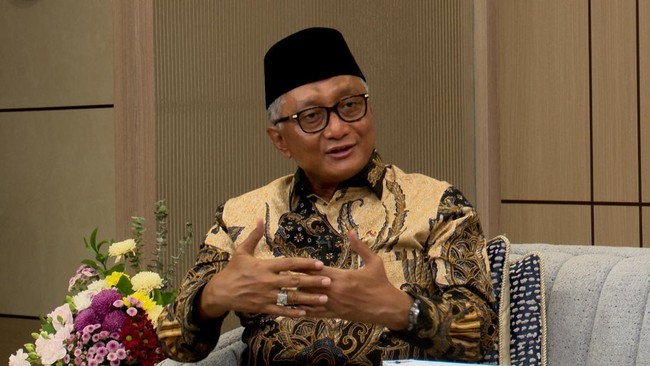
Minister of Public Works Dody Hanggodo stated that water availability is the most fundamental factor in achieving food security. He argued that increasing agricultural production requires not only fertiliser and seeds but also a well-functioning irrigation system.
“If we look at it, if we want strong food security or food self-sufficiency, the water supply must be certain first. After all, rice needs water. That is why our focus is on ensuring that paddy fields no longer depend on rainwater, but receive water supply from the dams and reservoirs we build,” Dody said during CNBC Indonesia’s Economic Update on Friday (2/7/2026).
He acknowledged that while farmers most frequently complain about issues related to fertiliser and seeds, limited water supply is also a cause of low agricultural productivity in several regions.
“If there is fertiliser, seeds, and labour, but no water, it becomes a problem. Our task at the Ministry of Public Works is to ensure that water in storage facilities can truly flow to the paddy fields for all 12 months. We hope farmers can harvest up to three times a year. There are many challenges, but once irrigation is improved, average productivity increases from one harvest to one and a half or even two harvests a year,” he explained.
However, most agricultural land depends on irrigation networks that fall under the authority of regional governments. For years, many regional irrigation channels have not been repaired due to budget limitations and the division of authority. The government is accelerating the repair of regional irrigation networks through the Presidential Instruction (Inpres) on Irrigation.
“The President saw the problem there. That is why he issued the Inpres on Irrigation so that we can work together with regional heads to fix provincial and district irrigation. These regional irrigation networks are far more extensive than the national ones and have been almost untouched. That is what we are now pursuing in 2026 and 2027 so that water can flow more optimally to the people’s paddy fields,” he revealed.
Dody added that irrigation improvement is a crucial part of maintaining sustainable food self-sufficiency. The government wants to ensure that successful food production is not just a short-term achievement but can be sustained in the following years.
“Alhamdulillah, in 2025 we were able to achieve food self-sufficiency. But our task is still enormous. Therefore, regional irrigation must continue to be improved so that the water supply gets better and the food self-sufficiency target can be maintained in line with the President’s directives,” Dody concluded.