
Minister of Public Administration and Bureaucratic Reform Highlights Importance of Digital Transformation in Removing Barriers at OECD Global Symposium
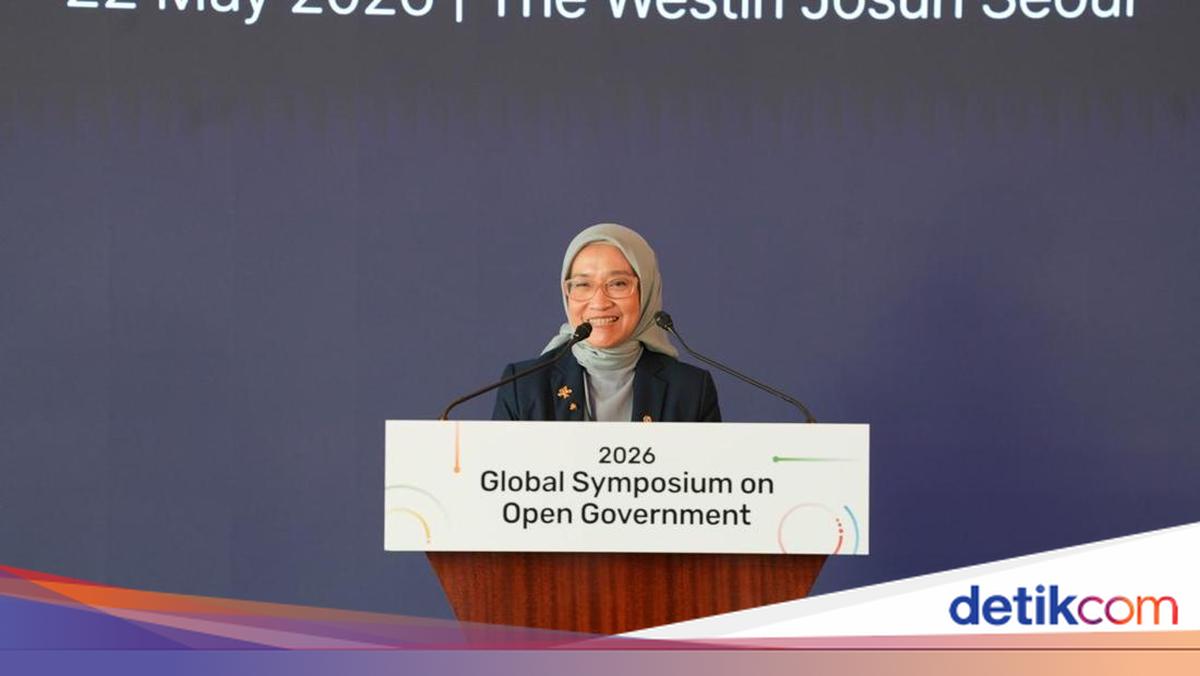
Rini, Minister of Public Administration and Bureaucratic Reform, stated that the Indonesian government believes the future of digital governance must be rooted in trust. She made the remarks during her keynote speech at the Organisation for Economic Co-operation and Development (OECD) Global Symposium in Seoul, South Korea, on Friday (22 May 2026).
“It is not merely digital trust in technical security, but a firm belief that the government truly understands the realities faced by the public,” Rini said in a written statement on Monday (25 May 2026).
She added that the Indonesian government deeply understands these challenges. Currently, Indonesia is home to one of the world’s largest digital populations, with over 229 million internet users.
“As an archipelagic nation spanning over 17,000 islands and home to more than 280 million people, we understand that geographical distances can lead to social inequality,” she said.
“For ordinary citizens, transformation is never felt through technical terms. They experience the government’s role through more personal moments.”
She cited examples such as public services running smoothly during crises, elderly citizens no longer struggling with bureaucracy, young job seekers instantly accessing opportunities due to interconnected databases, and rural mothers no longer sacrificing daily earnings to travel and handle basic administrative documents for their families.
“These are the moments when government becomes accessible, humane, and present for millions. Public services are not abstract systems; they determine whether things are made easier or harder, and whether citizens feel included or entirely forgotten,” she explained.
“To achieve this, the Indonesian government has strengthened Digital Public Infrastructure (DPI) through robust digital identities, integrated digital payment systems, secure data exchange, efficient services, and responsible artificial intelligence (AI) deployment. Indonesia is also developing INAku, an integrated portal designed to streamline public services into a single connected process.”
“More importantly, we ensure these supporting systems deliver tangible and immediate impacts for ordinary citizens,” Rini added.
“Furthermore, Rini stated that the Indonesian government is also accelerating the implementation of the national digital identity framework known as Digital Population Identity (IKD), and cross-agency data-driven services under the Government Service Linkage System (SPLP). IKD has connected millions of users to essential public services, while SPLP serves as the national interoperability infrastructure.”
“Beyond citizen-focused portals, Indonesia strategically leverages GovTech. The Indonesian government views GovTech not merely as a collection of digital platforms, but as an institutional driver for whole-of-government transformation. GovTech bridges the gap between policy design and implementation, ensures institutional interoperability, and accelerates citizen-centric service delivery.”
“Ultimately, digital transformation is not just about public convenience. It is about building a transparent, accountable, and inherently trustworthy nation,” she concluded.