
Minister of Primary and Secondary Education Urges Educational Institutions to Expand Access to Learning and Skills
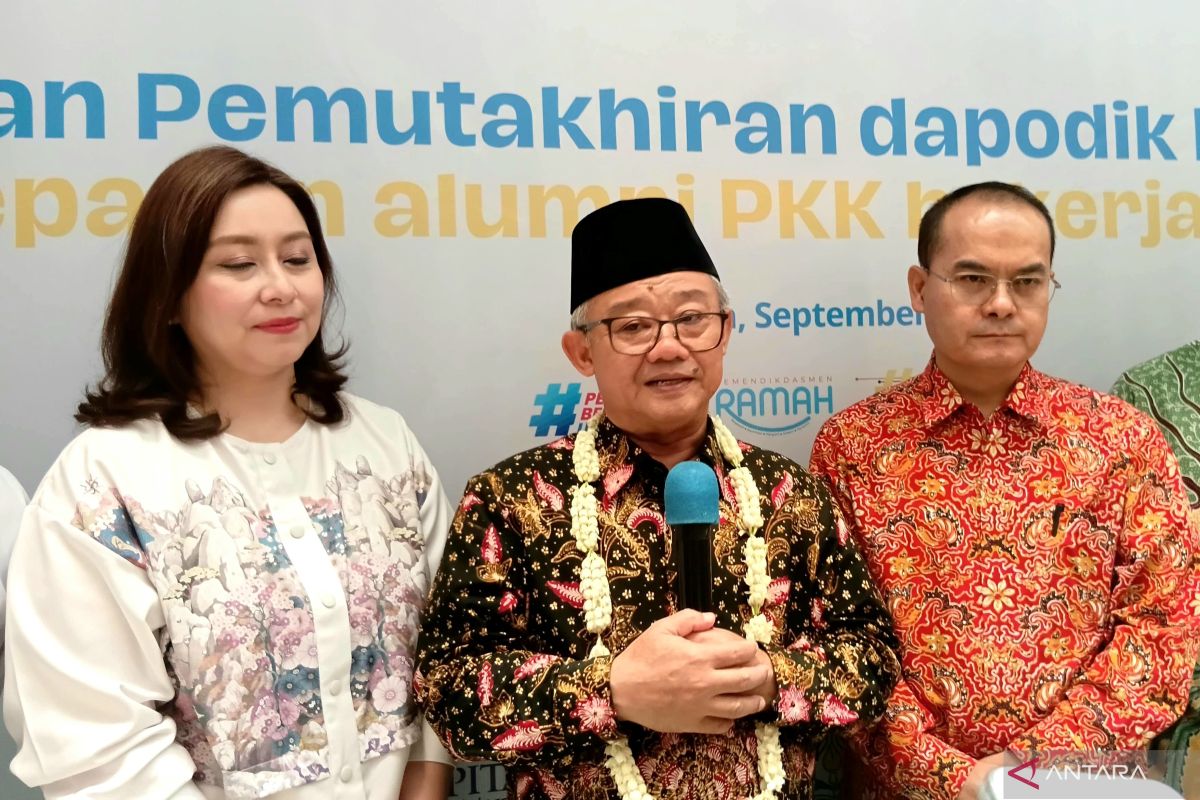
There is no need to create a dichotomy between formal, informal, and non-formal education.
Jakarta (ANTARA) - The Minister of Primary and Secondary Education, Abdul Mu’ti, has invited formal, informal, and non-formal educational institutions to synergise in order to expand opportunities for the public to acquire learning and skills.
He emphasised the importance of building a synergistic educational ecosystem, which includes the involvement of course and training institutions.
“I am calling for the need to build a synergistic ecosystem between formal and non-formal educational institutions. For instance, when discussing courses, they have an important connection with Vocational High Schools (SMK), and even with non-SMK educational institutions. Therefore, we do not need to create a dichotomy between formal, informal, and non-formal education,” said Minister Abdul Mu’ti during the launch of the Dapodik Update for Course Institutions for Governance Strengthening towards Integrated Data Collection in Central Jakarta on Thursday.
Furthermore, the Minister stated that course institutions play a vital role in relation to education in Vocational High Schools (SMK) and other educational bodies, particularly in providing skills that the public can utilise to enter the workforce.
According to him, participating in courses or training should not be viewed as an educational choice only for those with below-average abilities. Rather, such choices are more closely related to opportunity, time availability, and public access to education.
He cited as an example that individuals who do not have the opportunity to pursue formal education due to economic limitations can attend courses to acquire skills.
These skills, he noted, can later be used to generate income, which serves as a foundation to continue education through equivalency programmes.
The Minister reaffirmed that certificates from equivalency programmes hold the same status as formal education certificates at the equivalent level.
“They gain skills, and from those skills, they generate income. From that income, they can then attend school. They may not be able to attend formal school due to time constraints, but they can attend school through equivalency programmes,” said the Minister.
He provided the example of national athletes who must spend most of their time in training centres and participating in various tournaments.
“If they had to attend formal school, it would certainly be impossible, as most of their time is spent in training centres and competing in various tournaments,” added the Minister.
According to Mu’ti, the education system needs to provide space for these various options so that the public can continue to receive an education while developing skills according to their specific conditions and needs.
Thus, synergy between formal, informal, and non-formal education is essential to ensure that economic limitations, time, or access do not become barriers for the public to improve their competence and pursue further education.
Source: jawawa.id (https://jawawa.id/newsitem/minister-of-primary-and-secondary-education-urges-educational-institutions-to-expand-access-to-learning-and-1789632328)
Originally published by Antara (Indonesian) (https://www.antaranews.com/berita/5745333/mendikdasmen-ajak-lembaga-pendidikan-perluas-akses-belajar-ketrampilan), translated from Indonesian