
Minister of Primary and Secondary Education Encourages OPSI 2026 to Foster Scientific Culture Among Students
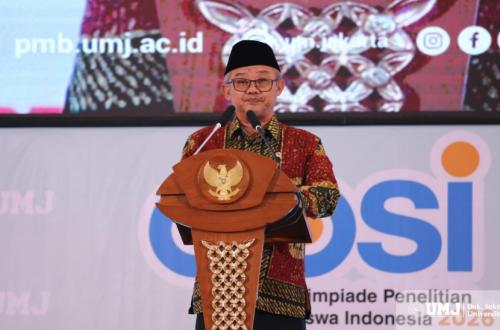
The Minister of Primary and Secondary Education of the Republic of Indonesia, Prof. Dr. Abdul Mu’ti, M.Ed., has encouraged the 2026 National Student Research Olympiad (OPSI) to become a space for building a scientific and research culture among students. This was stated during the opening of the 2026 National OPSI held at the K.H. Ahmad Azhar Basyir Auditorium, Cendekia Building, Universitas Muhammadiyah Jakarta (UMJ), on Friday (25/09/2026).
Mu’ti believes that research should not merely end with achievements in a competition. According to him, research activities need to foster a love for science and encourage participants to produce solutions to various problems.
“What I oversee is how we make OPSI one of the arenas to build a scientific and research culture among our students and pupils,” said Mu’ti.
Furthermore, Mu’ti highlighted technological developments that provide both ease and challenges in the learning process. He reminded that the use of technology, including artificial intelligence (AI), must be accompanied by the ability to continue thinking independently and not become dependent on technology.
Consequently, Mu’ti encouraged the strengthening of the Science, Technology, Engineering, and Mathematics (STEM) field, developed into STEAM. This concept encompasses science, technology, engineering, art, mathematics, and sport. Mu’ti also explained the function of science in supporting the process of understanding and resolving issues.
“Science has four functions: description, narration, explanation, and prescription. Therefore, science does not only describe a problem, but also explains it and provides a direction for its resolution,” he added.
In addition to technology, Mu’ti highlighted climate change and global warming, which impact agriculture and food security. He emphasised the importance of research and behavioural changes accompanied by environmental awareness.
“To build that awareness, we are introducing the 4R concept, namely reduce, reuse, recycle, and reproduce. There is also the STEP 5X, consisting of easy, cheap, fun, mindful, and meaningful, to build a culture of science and research from an early age,” he explained.
On the other hand, Mu’ti emphasised the importance of science and technology in developing the potential of natural resources. He cited tuna and cassava as resources that can be developed through research to possess economic value and contribute to prosperity.
“The OPSI we are organising must not stop at the aspect of winning championships alone. We must build a culture of researching, a culture of loving science, and subsequently design an attitude where this correlates with welfare and prosperity,” he said.
Furthermore, Mu’ti linked the educational process to the concept of ‘deep learning’, which includes mindful, meaningful, and joyful learning. This concept provides space for students to develop reasoning skills, creativity, and curiosity.
Mu’ti stated that the OPSI participants have become part of a young generation possessing research capabilities. He encouraged them to continue learning from the process they undergo, including when facing failure, so that research can continue to evolve and produce solutions.
The 2026 National OPSI is a research competition for students that brings together pupils from various regions to present their research results and ideas. The event is taking place from 24–30 September 2026, involving 125 finalist teams from 24 provinces and one team from the Indonesian School in Malaysia.
Source: jawawa.id (https://jawawa.id/newsitem/minister-of-primary-and-secondary-education-encourages-opsi-2026-to-foster-scientific-culture-among-students-1790430761)
Originally published by Republika (https://news.republika.co.id/berita/tlz3cs490/mendikdasmen-dorong-opsi-2026-bangun-budaya-ilmiah-pelajar), translated from Indonesian