
Minister of Primary and Secondary Education Announces Expansion of School Revitalisation Target by 6,000 Schools
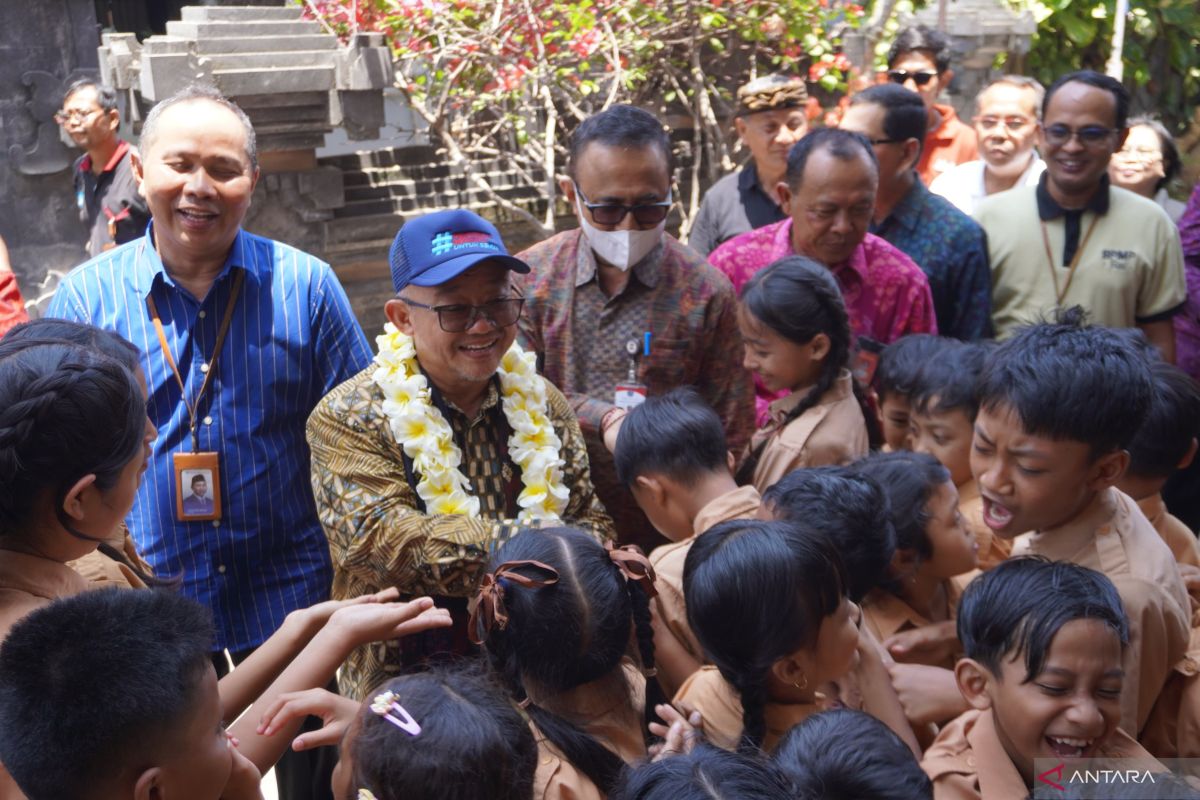
Denpasar (ANTARA) - The Minister of Primary and Secondary Education, Abdul Mu’ti, stated that the target for the educational unit revitalisation programme this year has increased by 6,000 schools following recent reports.
“We have received reports that there is an addition of 6,000 schools this year, and there may still be further increases, meaning the figure of 71,744 schools receiving aid could grow,” he said during a visit to SDN 15 Dangin Puri in Denpasar, Bali, on Friday.
The Minister noted that this addition to the number of schools will push the total number of beneficiaries beyond the initial plan of 71,744 schools nationwide for 2026.
“For 2026, we have planned for 71,744 educational units, and based on our calculations, because the system is self-managed, there is a possibility of an increase due to budget use efficiency,” he added.
This surge in recipients means the cumulative number of schools revitalised over the past two years has jumped drastically, exceeding 90,000 buildings.
“If we add the 16,167 schools from 2025, we can revitalise more than 90,000 schools this year,” he continued.
Regarding the amount of revitalisation assistance, the Ministry of Primary and Secondary Education does not impose a maximum funding limit per school, as the amount is based purely on the level of damage and actual needs on the ground.
He cited the budget allocation for the revitalisation of TK Indraprasta in Bali, which exceeded Rp1,000,000,000 due to the larger volume of physical construction required.
“As seen with the kindergarten, the assistance is larger than it is here (at SDN 15 Dangin Puri); the kindergarten received over Rp1,000,000,000 because there was more work to be done,” said Abdul Mu’ti.
The distribution of both the additional quota and the funding amounts remains strictly mapped based on priority scales for urgent educational infrastructure needs. The government’s primary focus this year is on frontier, outermost, and least developed (3T) regions, disaster-affected areas, and learning facilities with severe damage.
Meanwhile, schools outside these priority categories still have the opportunity to receive revitalisation through official application mechanisms from local governments. The process of identifying schools for the additional quota is conducted through a tiered proposal system from education offices up to the updates of the national primary education database (Dapodik).
“Other schools can certainly be assisted based on priorities submitted by local governments. Some proposals are submitted via local education offices, while others are based on the Dapodik data we possess,” the Minister explained.
The government also stated it is prepared to provide emergency affirmative pathways for schools that suddenly suffer disasters or heavy damage, even if they were not included in the initial proposals. Furthermore, public oversight through direct community reports and media coverage serves as a vital instrument in determining locations for rapid revitalisation.
“Some cases are brought to our attention by the public and the media, and once they go viral, we immediately appoint a team to conduct verification and validation. We will provide immediate attention to schools that urgently need assistance,” he added.
With this increase in quota, the Ministry is optimistic that the ambitious target of completing national educational infrastructure can be achieved on time by the end of this decade.
“As the President stated that by 2027, approximately 100,000 educational units will be constructed, by the end of 2028, we will have repaired all schools in Indonesia, certainly according to priority, especially those that are heavily damaged,” he concluded.
Source: jawawa.id (https://jawawa.id/newsitem/minister-of-primary-and-secondary-education-announces-expansion-of-school-revitalisation-target-by-6-000-1790924514)
Originally published by Antara (Indonesian) (https://www.antaranews.com/berita/5768188/mendikdasmen-sebut-sasaran-revitalisasi-bertambah-6-ribu-sekolah), translated from Indonesian