
Minister of PAN-RB: BSSN Graduates to Serve as Cyber Defence Fortress
The rapid development of government digitalisation is triggering increasingly complex new challenges. Amidst massive data integration and the widespread use of Artificial Intelligence (AI), cyber threats are no longer merely technical issues but have shifted to become a part of national resilience.
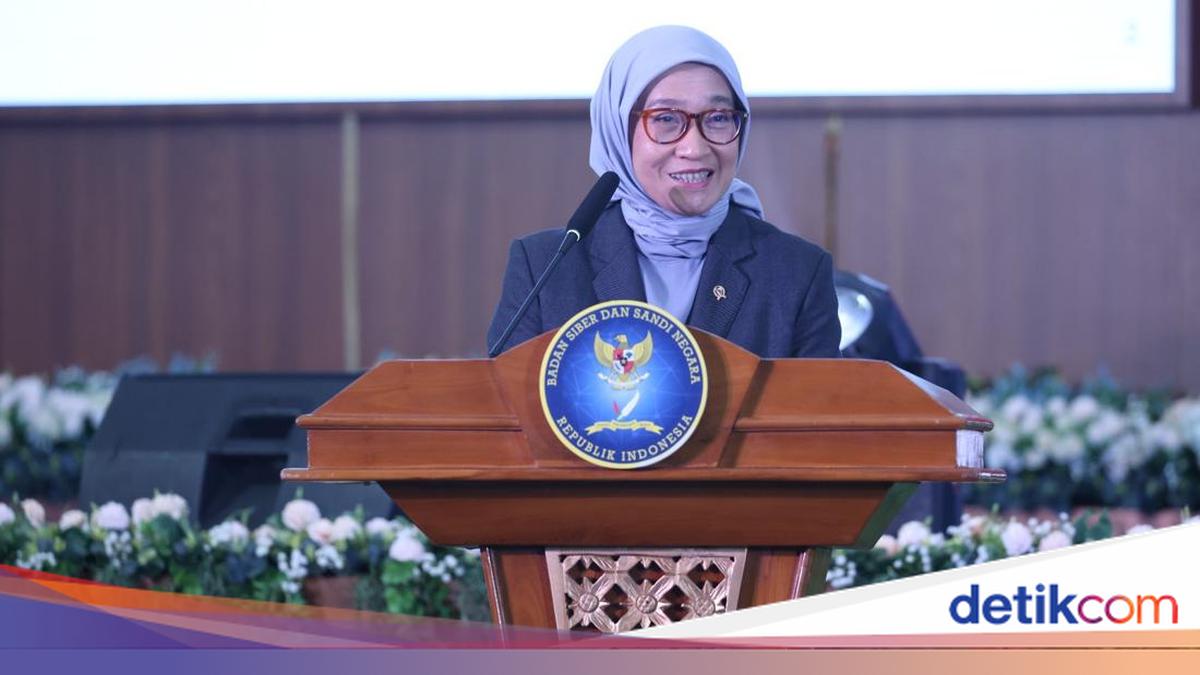
This was stated by the Minister of Administrative and Bureaucratic Reform (PANRB), Rini Widyantini, during her keynote speech at the Scientific Oratory for the Graduation of Applied Bachelor Students of the National Cyber and Crypto Polytechnic (Poltek SSN) Academic Year 2026 at the BSSN Office, Depok, on 22 September 2026.
“The digitalisation of bureaucracy and public services is an inevitability. However, as more community and government activities move into the digital space, the risks and threats faced also increase. This is where the crucial role of BSSN graduates comes in, acting as a cyber defence fortress to protect data, critical infrastructure, and state secrets,” said Rini Widyantini in a written statement on Wednesday (23/9/2026).
Rini explained that the intensity of cyberattacks continues to rise, characterised by the prevalence of ransomware variants, zero-day security vulnerabilities, and the potential for massive economic losses. However, the government’s primary focus is currently on protecting strategic sectors that are main targets for attacks, such as energy, transport, finance, health, and public service infrastructure.
“When public services depend on digital systems, cyber resilience becomes a part of national resilience. The impact of cyberattacks no longer stops at technology, but is felt directly by the community and disrupts the continuity of government services,” she said.
Rini added that the development of AI also makes this landscape increasingly complex. AI can help improve detection and defence capabilities; however, the same technology can also be utilised to strengthen the capabilities of attackers.
“Therefore, cyber security can no longer be viewed merely as a technical issue. When public services depend on digital systems, cyber resilience also becomes a part of national resilience,” she added.
Rini also stated that in the implementation of digital government, there are seven crucial, interrelated aspects that require attention. First, interconnected systemic risks; second, the double-edged sword of AI; third, data as both an asset and a primary target; fourth, the application of ‘security by design’ and ‘privacy by default’; fifth, cyber security as a part of governance; sixth, the human factor remains the key; and seventh, the risk of third-party dependency.
“With these increasingly complex challenges, cyber security is now the main foundation in building public trust. The success of the government’s digital transformation is measured not only by how sophisticated the applications created are, but by how secure the digital ecosystem is in protecting the data of the people and the state,” she revealed.
Rini explained that the government is currently entering the era of human-machine collaboration, where administrative and routine tasks are beginning to be transferred to automation systems, algorithms, and AI.
This shift does not diminish the role of humans but rather raises the standard of Civil Servant (ASN) competence to a higher level. The role of ASN is now focused on high-value-added work, such as in-depth analysis, strategic decision-making, communication, collaboration, and complex problem-solving. Therefore, mastery of data, digital systems, and AI is now an indispensable necessity.
“You will not merely be users of technology. You will be the ones ensuring that this technology can be used safely. When AI is used, you must understand both its benefits and its risks. As more data is exchanged, you must understand how that data is protected,” she asserted.
In her motivational scientific oration, Rini emphasised that digital authority is a great mandate that demands high responsibility. Graduates and new digital talents were reminded that the knowledge and exclusive access they possess must be balanced with strong values of integrity.
According to her, to face future complexities, Indonesia requires integrated digital talent that encompasses three main pillars: head, hand, and heart.
“The first pillar is head (competence). Digital practitioners are required to think strategically based on science and data. The second pillar, hand (execution), emphasises that scientific knowledge is only truly useful when successfully translated into real action,” she explained.
“The third pillar, and the most crucial, is heart (character). Given that the systems, data, and information managed are vital to the state, the enhancement of capability and access must be accompanied by great responsibility,” she continued.
Rini also advised the graduates, as the frontline of digital transformation, to master technology, understand risks, uphold their mandate, continue to adapt, and deliver an impact to society.
“Use the knowledge you possess to provide benefits. Use your expertise to protect the nation. And use every authority entrusted to you with full responsibility,” she concluded.
Source: jawawa.id (https://jawawa.id/newsitem/minister-of-pan-rb-bssn-graduates-to-serve-as-cyber-defence-fortress-1790154174)
Originally published by detikcom (https://news.detik.com/berita/d-8675607/menpan-rb-lulusan-bssn-hadir-sebagai-benteng-pertahanan-siber), translated from Indonesian