
Minister of Marine Affairs: Seaweed is a Vital Component of Food Security Solutions
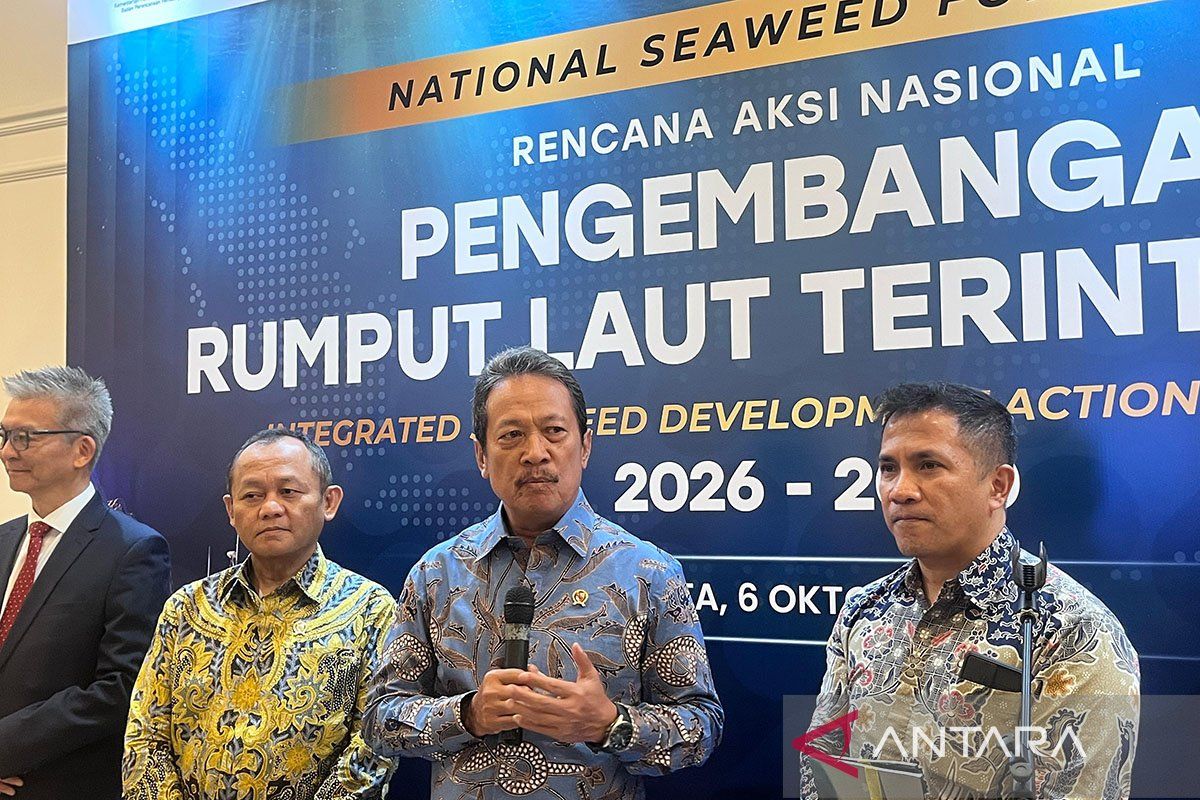
Jakarta (ANTARA) - The Minister of Marine Affairs and Fisheries, Sakti Wahyu Trenggono, stated that seaweed is a vital part of the food security solution, as it can be cultivated without increasing pressure on terrestrial land.
“Blue food is a crucial part of the food security solution, including seaweed, which can be cultivated without adding pressure to land resources,” he said during the National Seaweed Forum 2026 in Jakarta on Tuesday.
On this occasion, he highlighted the challenges of increasingly limited land and rising food requirements. The global population is projected to increase from 8.23 billion in 2025 to 9.66 billion by 2050, increasing global food needs by 50-60 per cent and demand for meat and fish protein by up to 67 per cent, including a fish requirement of 179 million tonnes, a 66 per cent increase.
As for Indonesia’s population, it is expected to rise from 285.7 million in 2025 to 320.7 million by 2050, meaning protein requirements will reach 7.62 million tonnes per year, equivalent to 35 million tonnes of fresh fish.
Terrestrial-based food systems are also becoming increasingly constrained, with the rate of paddy field conversion exceeding 100,000 hectares (ha) per year, which is projected to leave only 5.1 million ha of paddy fields by 2045.
Therefore, Trenggono considers seaweed to be an alternative or solution for meeting food needs. It is noted that seaweed production in 2025 reached 11.6 million tonnes, an increase of 18.27 per cent, with an average production for the 2020-2025 period of approximately 9.86 million tonnes per year. This is considered a strength that should serve as a solid foundation for increasing high-value-added seaweed productivity.
From a trade perspective, Indonesia’s seaweed exports in 202 and reached 242,000 tonnes with a value of 315 million USD, with China being one of the main markets. Nearly 70 per cent of this is dominated by dried seaweed, meaning the opportunity for downstreaming remains very large.
“Seaweed contributes about 42 per cent of total fisheries production, involving over 200,000 farmers and supporting the livelihoods of more than 1 million Indonesians. Besides its economic value, it offers environmental benefits through carbon and nutrient absorption, as well as improving water quality,” the Minister stated.
Furthermore, he noted that Indonesia possesses 1,006 seaweed species, but only six species have been cultivated by the community. Commercial production is dominated by Kappaphycus alvarezii and Kappaphycus striatus (red seaweed producing carrageenan) at approximately 62.58 per cent, Eucheuma denticulatum (a red algae species) at 20.78 per cent, and Gracilaria (a red algae species producing agar) at 16.62 per cent.
In the global market, the largest production comes from Saccharina (brown algae) grown in cold or subtropical waters at around 10 million tonnes, followed by Eucheuma (red seaweed) at 9.2 million tonnes, and Gracilaria at 3.5 million tonnes.
Indonesia is positioned strategically as the second-largest seaweed producer in the world, as well as a major producer and exporter of Eucheuma and Gracilaria.
Trenggono continued, noting that this strength has not yet been fully translated into downstreaming power, considering that most of Indonesia’s seaweed is still exported as raw material in the form of dried seaweed.
In other words, only a portion has been processed into primary derivative products such as carrageenan, agar, and alginate, while development towards secondary derivatives and high-value-added products for pharmaceuticals, cosmetics, and industrial formulations has not yet been realised.
Other challenges facing seaweed development include cultivation and seed quality, pricing and market issues, logistics and financing, as well as governance and environmental concerns. The impact is that quality and production are inconsistent, prices do not reflect quality, and the income of farmers and industrial supply remain unstable.
“This is what I believe will be the task of the Ministry of Marine Affairs and Fisheries to rectify,” he said.
Addressing these issues, the Ministry has prepared a five-pillar integrated action plan for seaweed development to be handled from upstream to downstream. This includes improving production quality, developing industry, adding value, and enhancing market access and exports; developing data, innovation, intermediation, technology, collaboration, and networking; increasing support for financing and investment; and strengthening the seaweed ecosystem and governance (regulation and institutions).
“The level of transformation must shift from chasing volume towards productivity, value addition, and competitiveness. In doing so, the potential of the seaweed market can truly be translated into a strong industry and prosperity for coastal communities,” said Trenggono.
Source: jawawa.id (https://jawawa.id/newsitem/minister-of-marine-affairs-seaweed-is-a-vital-component-of-food-security-solutions-1791302577)
Originally published by Antara (Indonesian) (https://www.antaranews.com/berita/5774310/menteri-kp-rumput-laut-jadi-bagian-penting-solusi-pangan), translated from Indonesian