
Minister of Industry Reshuffled: Convection Entrepreneurs Issue Requests to New Minister
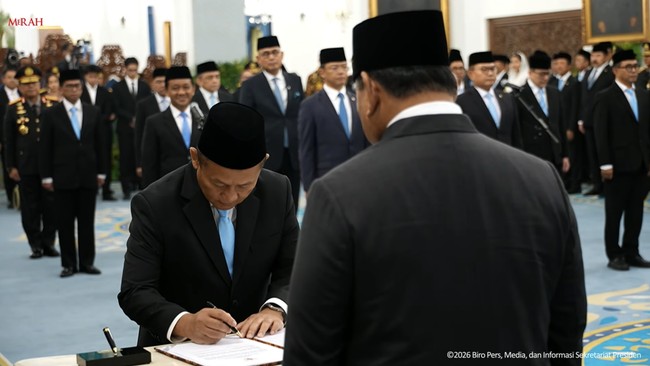
President Prabowo Subianto officially inaugurated M Sarmuji, Secretary General of the Golkar Party, as the Minister of Industry at the State Palace on Thursday (1/10/2026). Prabowo appointed Sarmuji to replace Agus Gumiwang Kartasasmita.
This change has drawn significant attention from small and medium industry (SMI) players, particularly within the convection sector, which serves as a vital pillar for employment absorption. The Association of Convection Entrepreneurs (IPKB) hopes that the leadership change at the Ministry of Industry will be accompanied by policies that are more closely aligned with the real-world challenges faced by business owners.
“Congratulations and success on the appointment of Mr Sarmuji as the Minister of Industry of the Republic of Indonesia. We, the large family of the convection SMI, hope this new leadership can pay even greater attention to small business owners, ranging from production centres to home-based enterprises,” said IPKB Chairman Nandi Herdiaman to CNBC Indonesia on Thursday (1/10/26).
Nandi also expressed appreciation for several programmes implemented during the era of Agus Gumiwang Kartasasmita, including New Industrial Entrepreneurs (WUB), Mentor Hub and Smart Sentra, halal certification facilitation, and efforts to protect the domestic market from import pressures. He noted that successful programmes should be maintained and expanded using approaches better suited to the character of SMIs.
“Our hope is not to build new buildings, but for the ministry to understand the SMIs located in the narrow alleys. We want greater attention directed towards the downstream sector, as the convection SMI is highly labour-intensive. Support could be directed towards affordable raw material shops in SMI centres or subsidies for sewing machines,” Nandi stated.
According to data provided by IPKB, the number of convection SMIs reaches 4.45 million units, representing approximately 99.79% of the total industry in Indonesia, based on 2024 BPS data. This sector also employs 13.06 million workers, according to Sakernas data from February 2026. Due to this massive scale, IPKB is requesting that the government implement differentiated regulations based on the size and character of the business.
“Do not treat large factories and SMIs the same. Working systems, business premises, and administrative capabilities differ. Small SMIs and contract manufacturing businesses require tiered regulations so that rules do not make it harder for them to survive,” said Nandi.
Beyond regulatory issues, IPKB is calling on the government to strengthen protection for the domestic market. Convection players believe that the textile and textile products (TPT) industry will not develop optimally if the domestic market remains under pressure from illegal products and very cheap imports.
“We want TPT to be king in its own country first. Before chasing US$12 billion in exports, the domestic market must be saved, including by eradicating illegal second-hand clothing and regulating imported fabric by weight. The utilisation of SMIs, which is only 30%-40%, is not solely due to a lack of demand, but because the market is being seized by illegal goods,” he added.
IPKB is also encouraging the government to revitalise old industrial centres such as Majalaya, Kopo, Cibaduyut, Laweyan, and Pekalongan. Furthermore, the need to improve workforce skills must be adjusted to the production patterns of SMIs, rather than strictly following the manufacturing systems of large factories.
“IPKB is ready to act as a mentor for SMIs in the field. The government cannot reach every business owner in the narrow alleys, whereas we have the network to assist with NIB facilitation, cluster-based halal certification, and BPJS membership for daily workers. Our hope is simple: protect the workers by protecting their workplace, which is the SMI,” Nandi concluded.