
Minister of Basic and Secondary Education Ensures West Papua Education Does Not Lag Behind
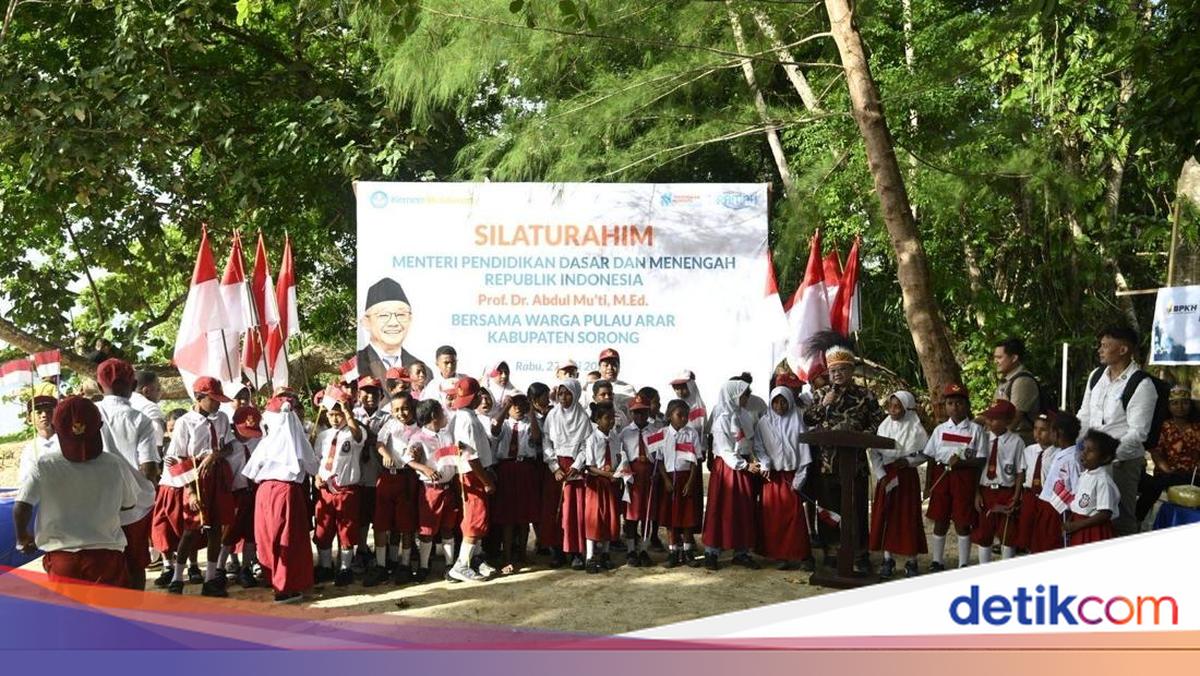
Minister of Basic and Secondary Education Abdul Mu’ti has assured that the government continues to strive to provide education access for all Indonesian children, including those in remote areas such as Pulau Arar in West Papua. He emphasised that no child should lose educational opportunities due to economic hardship, intellectual ability, physical limitations, or remoteness.
“No Indonesian child should be deprived of education due to economic difficulties, intellectual capacity, physical constraints, or living in remote areas like Pulau Arar. This is a mandate we are fulfilling to the best of our ability,” Abdul Mu’ti stated in a written statement on Thursday, 28 May 2026.
The comments were made during his visit to Pulau Arar, Sorong Regency, West Papua, on Wednesday, 27 May.
To this end, the Ministry of Basic and Secondary Education has prioritised schools affected by disasters, those in 3T (frontier, outermost, and most disadvantaged) regions, and schools with severe structural damage for the 2026 Revitalisation of Educational Institutions programme. Alongside school infrastructure construction, the government is implementing policies to expand education access in remote areas.
He explained that five education service models are being strengthened: distance learning (PJJ), one-roof schools, community-based open schools, equivalence education, and courses and training.
“These models are designed to adapt education services to geographical conditions and community needs,” he said.
“We share the same enthusiasm to advance education across the nation. Let us collectively foster this spirit so our children can grow into Indonesia’s golden generation by 2045,” he added.
Meanwhile, Adolof Kambuaya, Head of the West Papua Province Education and Culture Office, stated that the Minister’s visit to Pulau Arar was a significant moment for the local community.
“This is the first time a minister has reached Pulau Arar,” Kambuaya said.
He explained that West Papua has approximately 160,000 students, over 1,200 schools, and around 10,000 teachers spread across more than 900 villages. Therefore, achieving equitable education services in the region requires joint support and commitment from both central and local governments.
The impact of government education programmes is directly felt by students in Pulau Arar. Meske Salomina Sosir, a student at SMA Unimuda Pulau Arar, said she had studied for years in dilapidated and inadequate school buildings.
However, through the revitalisation programme, the school’s condition has completely transformed with renovated and rebuilt classrooms.
Meske noted that previously many students were reluctant to attend school due to uncomfortable facilities. Now, with classrooms repaired, students are returning to active learning.
“The construction was completed a month ago. The classrooms are already in use, and learning is possible. We are overjoyed. Every morning, even before the teachers arrive, we students are the first to come,” she said.
She also expressed gratitude for the government’s attention to education in Pulau Arar.
“Thank you to President Prabowo Subianto and Minister Abdul Mu’ti. May the support provided to SMA Unimuda Pulau Arar help our students learn and thrive,” Meske added.
Additionally, other beneficiaries of the revitalisation include SD Inpres 27 in Sorong Regency, which received assistance for toilet construction, a school health unit (UKS), and teacher housing. During the visit, Abdul Mu’ti was enthusiastically greeted by teachers and students before inspecting the newly built facilities ready for use.
Abdul Mu’ti then officially inaugurated the revitalised facilities as part of efforts to provide better educational infrastructure and support teaching and learning in remote Papua.