
Minister of Basic and Secondary Education Ensures School Revitalisation Programme Continues in 2026
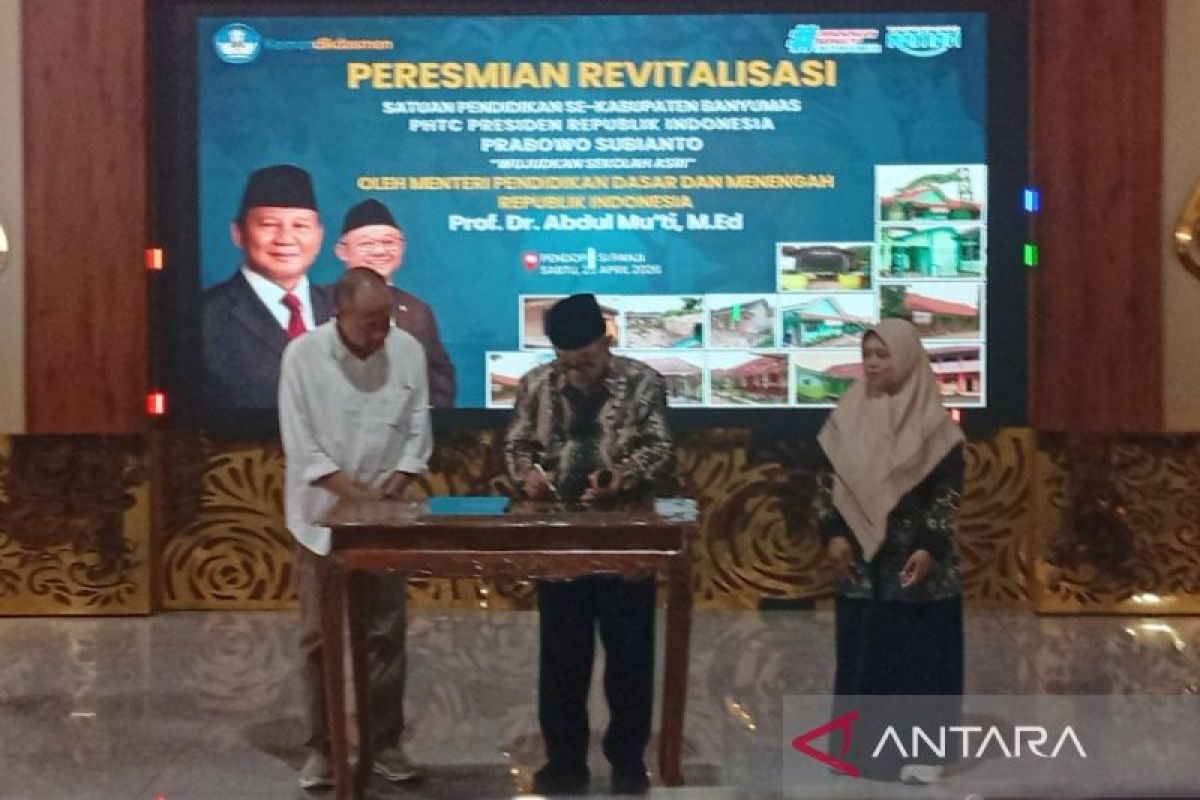
Purwokerto (ANTARA) - Minister of Basic and Secondary Education (Mendikdasmen) Abdul Mu’ti has assured that the revitalisation and digitalisation programme for educational units will continue in 2026 to enhance the quality of learning evenly across Indonesia.
“Congratulations to the schools receiving revitalisation assistance and interactive digital panels in 2025. We entrust that all facilities are utilised properly to improve education quality,” he said during the inauguration of educational unit revitalisation across Banyumas Regency at Pendopo Si Panji, Purwokerto, Banyumas, Central Java, on Saturday.
He stated that the programme is part of the government’s priorities in realising quality education for all, while supporting improvements in learning quality through technology utilisation.
According to him, the government has allocated a Rp14 trillion budget for revitalisation in 2026, covering 11,744 educational units throughout Indonesia.
Additionally, the government is proposing additional funding to expand the revitalisation programme to 60,000 educational units.
To support digitalisation, the government also plans to increase interactive flat panel (IFP) devices in 2026 to two or three units per educational unit, up from previous allocations.
An Interactive Flat Panel (IFP) is a large, high-resolution (4K) touchscreen that functions as a digital whiteboard, projector, and all-in-one computer. This device allows users to write, collaborate, and share screens wirelessly, often used in modern classrooms and interactive meetings.
Furthermore, the number of recipients of the Indonesia Pintar Programme (PIP) will be increased to around 19.6 million students from primary to high school levels.
For the first time, PIP assistance will be provided to around 888,000 kindergarten students.
The government is also raising incentives for honorary teachers from Rp300,000 to Rp400,000 per month, disbursed directly to recipients as part of efforts to improve educator welfare.
Mendikdasmen emphasised that these various policies demonstrate the government’s commitment to strengthening education services, while refuting notions of education budget cuts.
Further, he stressed the importance of fostering a safe, healthy, clean, and comfortable school culture through a humanistic and participatory approach.
He also highlighted the negative impacts of excessive digital technology use on children, such as decreased concentration and increased risks of mental health disorders.
Therefore, the government is encouraging restrictions on social media use for children under 16 years old and strengthening digital literacy in educational environments.
According to him, improving education quality is not only achieved through providing facilities and infrastructure but also through character building and implementing deep learning.
“We are currently awaiting approval from the Ministry of Finance regarding the proposed additional spending budget to expand the revitalisation coverage,” he said.
Hundreds of proposals
In a separate opportunity, Acting Head of the Banyumas Regency Education Office (Dindik) Amrin Ma’ruf said that his side has proposed 140 educational units through the regular scheme based on basic education data (Dapodik).
Additionally, Banyumas has received revitalisation allocations for 12 disaster-affected educational units, some of which have entered the cooperation agreement stage and will begin construction this year.
He said the total need for repairs in Banyumas reaches around 165 educational units in moderate to severe condition, particularly at primary and junior secondary levels.
On the other hand, he said, all educational units in Banyumas have received digital device assistance in the form of IFPs.
“All schools, both public and private from kindergarten to junior secondary, have received IFPs, one unit each complete with supporting learning devices,” he said.
Amrin detailed that the number of IFP recipients includes 806 primary schools and 169 junior secondary schools in Banyumas, all of which have been distributed to support digital-based learning transformation.