
Minister of Basic and Secondary Education Affirms Education Objectives at Hardiknas 2026
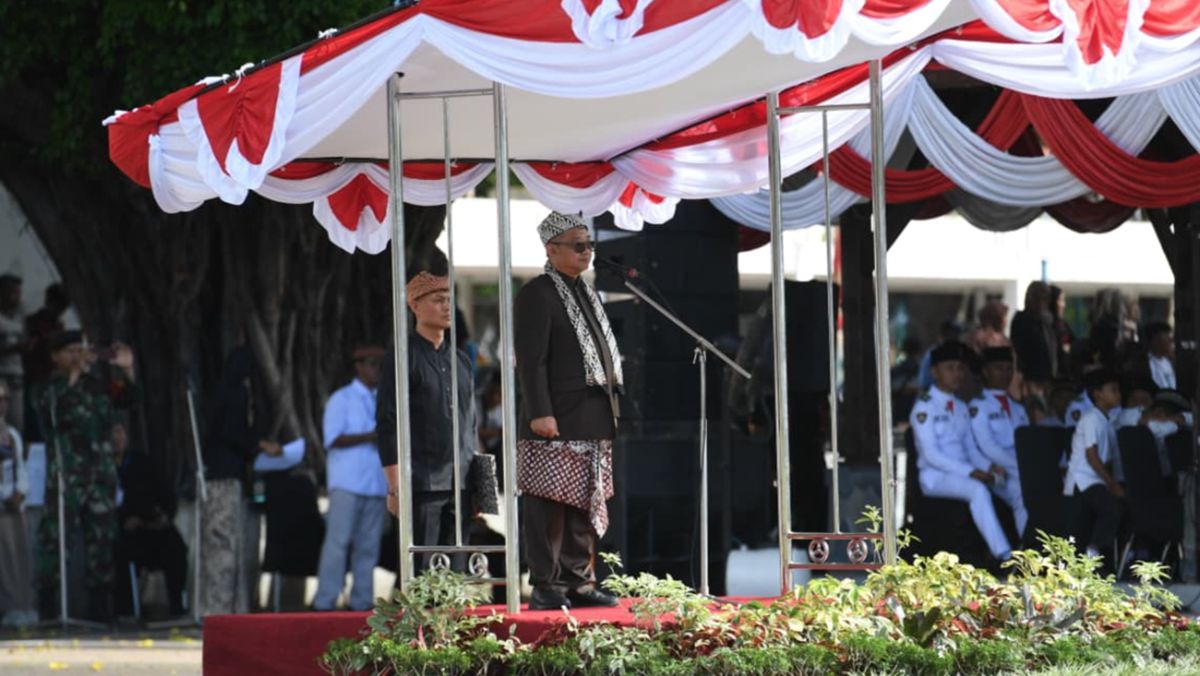
The Ministry of Basic and Secondary Education (Kemendikdasmen) held a ceremony to commemorate National Education Day (Hardiknas) 2026 in Banyuwangi, East Java, on Saturday (2/5). The ceremony was led directly by the Minister of Basic and Secondary Education (Mendikdasmen) Abdul Mu’ti, who attended wearing traditional Banyuwangi attire. This year’s Hardiknas theme, “Strengthening Universal Participation to Realise Quality Education for All,” serves as a crucial moment to reaffirm collective commitment to advancing national education. On this occasion, Mendikdasmen extended congratulations on National Education Day 2026 to all education stakeholders in Indonesia. “Alhamdulillah, today we jointly commemorate National Education Day 2026. We celebrate it in the life of the Indonesian nation and state that is united, safe, and peaceful,” he stated. Mendikdasmen affirmed that education, in essence, is a process of enlightening life, building character, and advancing the nation’s civilisation. “Education is a process of developing human potential to become individuals who are faithful and pious to the Almighty God, of noble character, intelligent, skilled, independent, physically and spiritually healthy, honest, responsible, democratic, and possess other superior traits,” said Abdul Mu’ti. To achieve these objectives, Kemendikdasmen is promoting the implementation of the Deep Learning approach as a priority programme. This approach positions learning as a meaningful experience centred on the holistic development of students’ potential. “A popular adage states: if you wish to advance the nation, improve education. If you wish to improve education, start from within the classroom. Deep Learning is the effort intended to achieve the ideal of national education,” he explained. To support this implementation, Kemendikdasmen has established several strategic policies. The Revitalisation of Educational Units and Learning Digitalisation programmes, as part of President Prabowo Subianto’s Presidential Quick-Win Results Programme (PHTC), have delivered tangible impacts on the education sector. In 2025, the revitalisation programme reached 16,167 educational units. Meanwhile, the Learning Digitalisation programme through the provision of Interactive Flat Panels (IFP) has been utilised in more than 288,000 educational units. Additionally, Kemendikdasmen continues to promote the fulfilment of qualifications, enhancement of competencies, and improvement of teacher welfare as the primary keys to quality learning. Character building is strengthened through the creation of safe and comfortable school environments and cultures, in line with the President’s directives on ASRI culture (Safe, Healthy, Clean, and Beautiful), so that schools can become a second home for all students. On the other hand, improving learning quality is reinforced through strengthening literacy, numeracy, STEM (Science, Technology, Engineering, Mathematics), and Academic Ability Tests (TKA). These efforts are accompanied by expanding access to more accessible, affordable, and flexible education services through various schemes such as one-roof schools, distance education, learning communities, and open schools. In recent months, Kemendikdasmen has laid the foundation for national education through various regulations and ecosystem strengthening that integrate four education centres: schools, families, communities, and media. These efforts underscore that education development cannot be done in isolation but requires support and collaboration from various parties. Concluding his address, Mendikdasmen called on all elements of the nation to continue strengthening cooperation in advancing education. “Let us strengthen collaboration to realise quality education for all towards an intelligent, advanced, and dignified Indonesia,” he urged. The 2026 Hardiknas commemoration was also enlivened by the “Kuntulan Ewon” arts performance involving 1,100 students, comprising 600 musicians and 500 dancers from various education levels. This performance symbolises the spirit of collaboration and diversity in the education world. This year’s Hardiknas commemoration is not merely a ceremony but also a reinforcement of the direction of national education policies. Through the achievements attained and collaborations continuously strengthened, the government is committed to delivering more meaningful learning for every student in Indonesia.