
Minister Natalius Pigai Attends Bali–Timor-Leste Business Forum 2026 to Strengthen Economic Ties
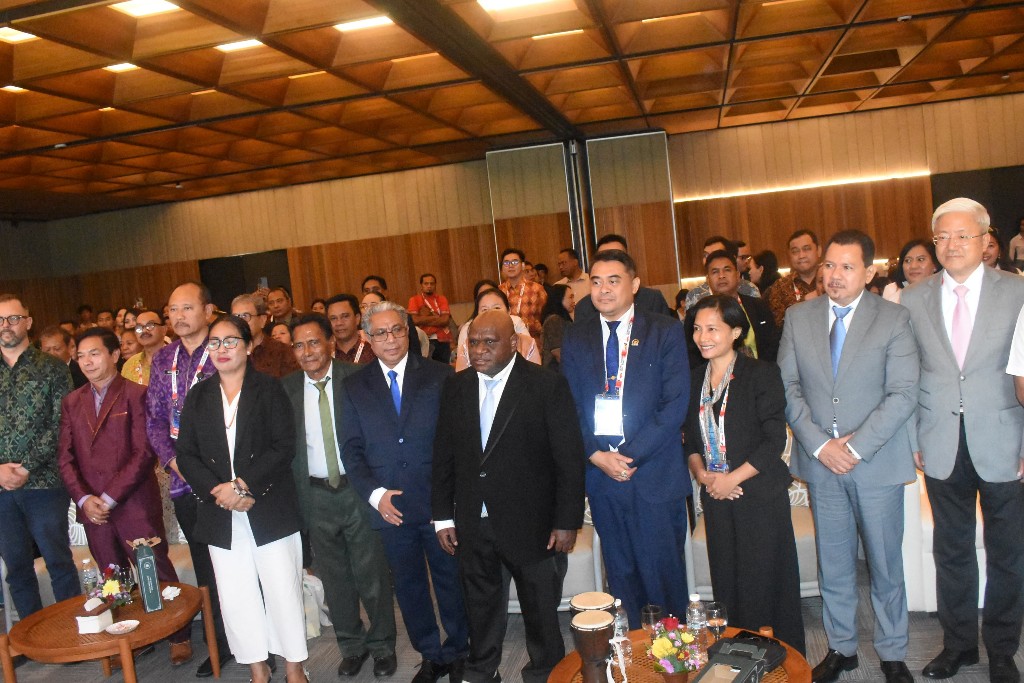
Denpasar - The Minister for Human Rights of the Republic of Indonesia, Natali andus Pigai, attended and delivered a keynote address at the Bali–Timor-Leste Business Forum 2026, held at the Awan Auditorium 3, Tsinghua Southeast Asia Centre, Serangan, Denpasar, Bali, on Friday (2/10/2026).
Under the theme “Strengthening Indonesia–Timor-Leste Economic Partnership through Sustainable Investment, Trade, Innovation, and Financial Collaboration”, the forum served as a meeting platform for governments, the business community, investors, academics, SMEs, and various stakeholders from both Indonesia and Timor-Leste.
In his address, the Minister for Human Rights emphasised the importance of maintaining good relations between Indonesia and Timor-Leste as neighbouring nations. According to Pigai, the relationship between the two countries must continue to be built on the foundations of friendship, brotherhood, care, and mutual assistance, not only for economic interests but also to build sincere and mutually supportive ties.
“Because we are neighbours, our priority is to maintain sincere friendship, brotherhood, and compassion,” said Pigai, accompanied by the Bali Regional Coordinator, Anak Agung Gede Ngurah Dalem.
Pigai also stressed that economic development must proceed alongside the responsible management of national resources. He noted that the utilisation of resources must consider sustainability, environmental protection, and the impact on local communities.
In the context of Indonesia-Timor-Leste relations, he observed that Bali has the potential to be part of broader cooperative development, including through the strengthening of economic, financial, and tourism activities.
Furthermore, Pigai highlighted the importance of implementing Business and Human Rights principles within investment and business activities. He argued that economic growth must be accompanied by respect for and the protection of human rights, including the protection of workers’ rights and the prevention of negative impacts from business activities on the environment and society.
“Business and Human Rights must be a priority for business actors so that economic activities do not only generate profit but also provide protection for the rights of affected parties,” said Pigai.
He revealed that he has submitted a proposal to the President of the Republic of Indonesia regarding a draft Presidential Regulation on Business and Human Rights.
According to him, strengthening the Business and Human Rights agenda is a vital part of building a conducive business ecosystem while ensuring that economic activities proceed with respect for community rights.
Meanwhile, Senator of the DPD/MPR RI for Bali Province, Dr. Shri I Gusti Ngurah Arya Wedakarna M. Wedasteraputra Suyasa III, stated in his remarks the importance of seizing various cooperation opportunities between Indonesia and Timor-Leste.
Arya Wedakarna assessed that the forum serves as a strategic space to bring various stakeholders together and build a commitment to strengthening the relationship between the two nations.
He believed the forum could serve as a means to open wider cooperation opportunities, particularly in facing various international dynamics and opportunities for both Indonesia and Timor-Leste.
Similarly, the Minister of Trade and Industry of Timor-Leste, Marcos da Cruz, also emphasised the importance of utilising the opportunities arising from the cooperative relationship between Indonesia and Timor-Leste.
In his speech, Marcos da Cruz stressed the importance of strengthening the existing ties and cooperation between the two countries, specifically in opening opportunities for trade, investment, and economic partnership.
He viewed the forum as an important space for the governments and business actors of both nations to meet, exchange ideas, and identify various cooperation opportunities that can be developed.
The Bali–Timor-Leste Business Forum 2026 continued with panel discussions addressing three main pillars: the Blue Economy, Green Economy, and Gold Economy. Issues discussed included strategic partnerships, bilateral trade, investment, marine and fisheries economy, maritime connectivity, sustainable tourism, environmental protection, agriculture, education, financial cooperation, and the strengthening of private sector partnerships.
Through this forum, Indonesia and Timor-Leste are expected to continue strengthening bilateral relations and opening spaces for cooperation that benefit the governments, the business world, and the people of both nations.