
Minister Mu'ti States First Day of Junior High Academic Ability Test Runs Credibly and Smoothly
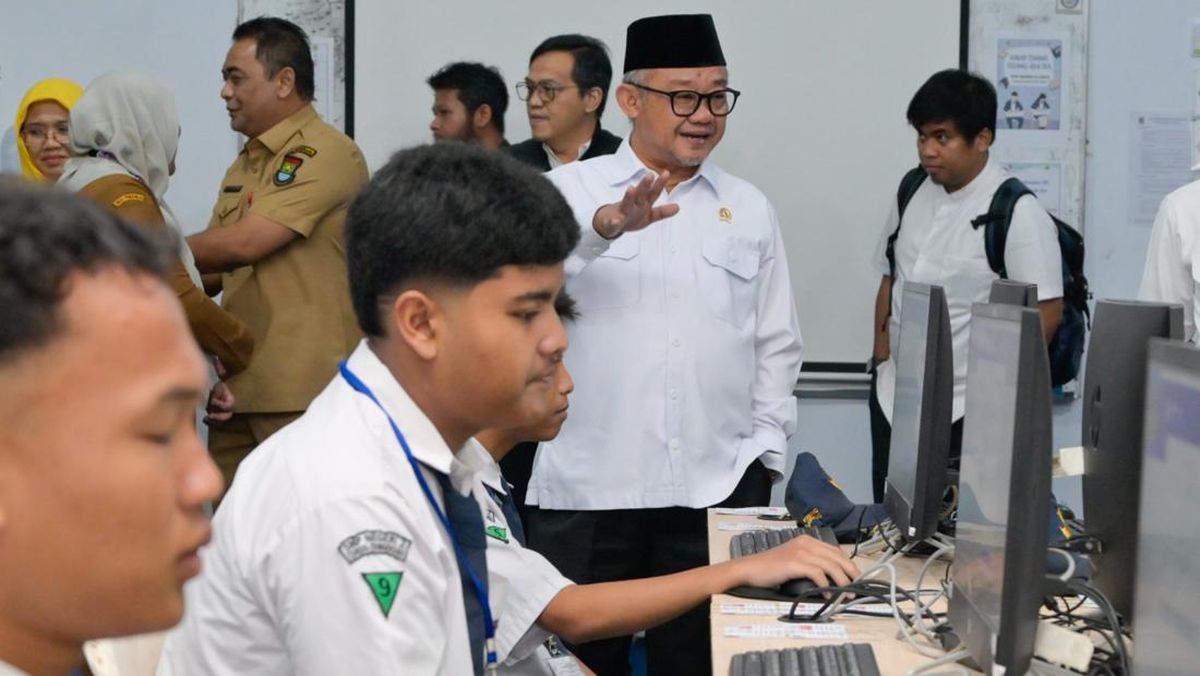
Minister of Basic and Secondary Education (Mendikdasmen), Abdul Mu’ti, assured that the implementation of the Academic Ability Test (TKA) for the junior high school level on Monday (6/4) ran smoothly and credibly, protected by anti-cheating systems from the outset.
Mu’ti conveyed this during his inspection of the first day of the TKA at SMP Negeri 2 Curug, Tangerang Regency, Banten. During the visit, the Minister of Basic and Secondary Education stated that overall, the readiness for the TKA implementation in schools had proceeded in accordance with the established regulations. The technical arrangements, from classrooms to the execution mechanisms, were deemed well-prepared.
“The classroom readiness and technical arrangements are in line with the regulations. We hope the TKA implementation can run smoothly,” said Minister Mu’ti in an official statement.
The Minister of Basic and Secondary Education also explained that the TKA is not a determinant of student graduation. Graduation determination remains the authority of each educational unit. The TKA serves as an instrument to measure students’ academic abilities, particularly in literacy and numeracy aspects, supplemented by character and learning environment surveys.
Mu’ti added that the TKA results will complement student achievement assessments that have previously included report card grades and non-academic accomplishments.
“Through the TKA, we aim to obtain a more comprehensive profile of students’ abilities, both academically and in terms of character. This data will later serve as one of the references in the new student admission process through domicile, achievement, or affirmative pathways,” said Mu’ti.
On that occasion, the Minister of Basic and Secondary Education also reminded the importance of integrity in the TKA implementation through the slogan ‘Honest and Joyful’. He urged students to take the test honestly and with enthusiasm, without treating the TKA as a burden.
“Work on it honestly and joyfully, because this is part of the process, not the end. Additionally, we also urge supervisors to carry out their duties professionally, without unnecessary documentation such as making videos or updating statuses during the implementation,” said Minister Mu’ti.
To ensure credible implementation, the Ministry of Basic and Secondary Education has prepared various anti-cheating systems. Technical protections have been designed from the start to ensure the assessment process runs transparently and accountably.
Nationally, the first day of TKA implementation reached around 98 percent of the target participants. Meanwhile, about 2 percent of students did not participate in the TKA for various reasons, such as psychological readiness or parental considerations. At SMP Negeri 2 Curug, which was visited, participation reached 100 percent.
The Minister of Basic and Secondary Education explained that the TKA is designed as a ‘five in one’ system capable of producing five types of educational data simultaneously, covering academic abilities, literacy skills, numeracy, character, and learning environment conditions.
He also assured that the TKA implementation in underdeveloped, frontier, and outermost regions (3T) has been anticipated with flexible schemes. The questions are not entirely online-based, allowing schools with device limitations to still conduct the assessment, including through facility-sharing schemes with other schools.
For educational units affected by disasters, such as schools currently experiencing fires and floods, the government has prepared follow-up exam mechanisms based on computers to ensure all participants still receive their rights.
“Schools have prepared the implementation as best as possible. With the existing system, we are optimistic that the TKA implementation can provide valid and accurate data as a basis for formulating future education policies,” said the Minister of Basic and Secondary Education.