
Minister: Molinas Launch a Moment to Accelerate Indonesian Industrial Independence
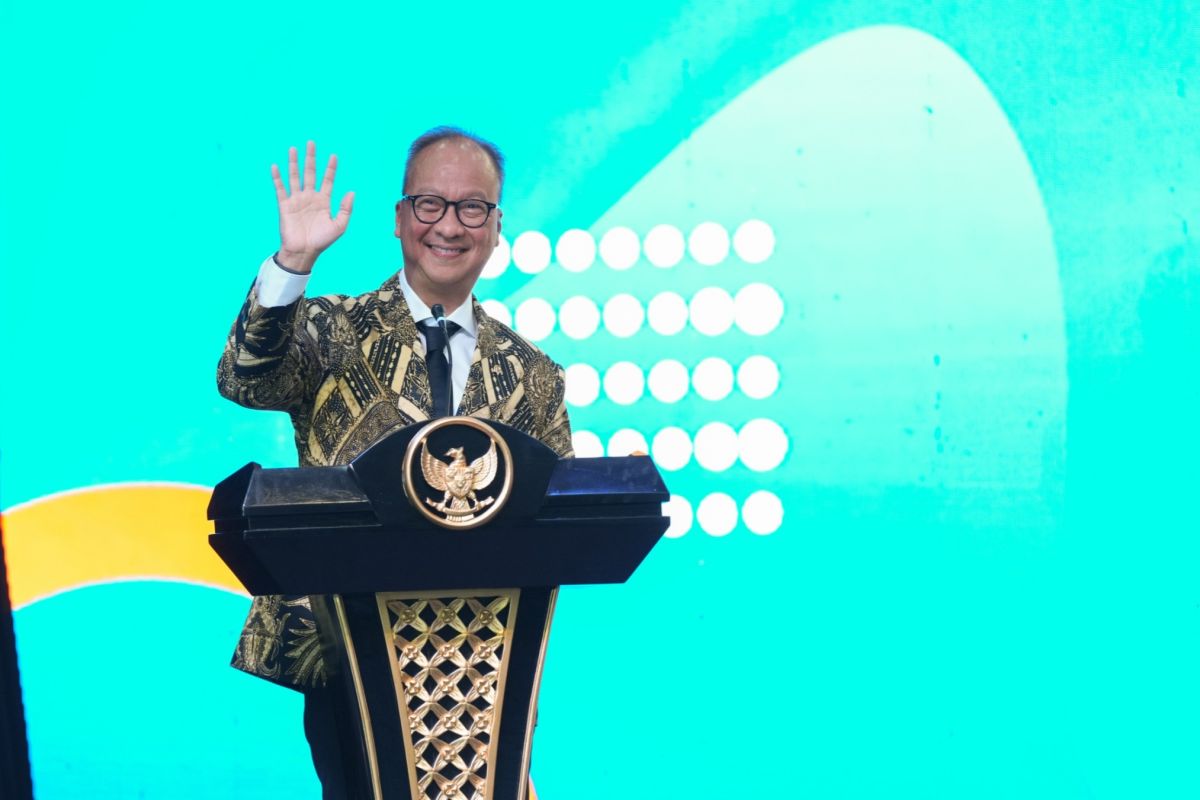
Industry Minister Agus Gumiwang Kartasasmita believes the launch of the National Electric Motorcycle (Molinas) by President Prabowo Subianto is a momentum to accelerate Indonesia’s industrial independence through technological mastery and deepening of the industrial structure.
“We must make Molinas a momentum to build an increasingly strong national electric vehicle ecosystem from upstream to downstream. Indonesia must not only become a market for electric vehicles, but must become a production base and a centre for electric vehicle technology development with global competitiveness,” the minister said in a statement confirmed in Jakarta on Friday.
The launch of Molinas and its supporting ecosystem was carried out by President Prabowo Subianto at the ALVA production facility in Cikarang, Bekasi Regency, West Java, on Thursday (13/8/2026).
The minister said Indonesia has a strong foundation for building an integrated electric vehicle industry.
Currently, there are 69 companies in the two- and three-wheeled battery-based electric vehicle (KBLBB) industry with a total production capacity of 2.511 million units per year and an investment value of around Rp1.2 trillion.
In addition, there are 14 four-wheeled electric vehicle companies with a production capacity of 409,860 units per year, as well as 10 electric commercial vehicle companies with a capacity of 7,500 units per year.
Total investment in the national electric vehicle assembly industry is recorded at around Rp30.468 trillion.
“The large production capacity shows that Indonesia actually has a very adequate manufacturing foundation. Our next challenge is to ensure the market grows sustainably, production capacity utilisation increases, and at the same time the industrial structure deepens through the use of domestically made components,” Agus said.
He said the development of the national electric vehicle ecosystem is also reflected in the increase in the number of users. Based on data processed by the Ministry of Industry, the total electric vehicle population in Indonesia has reached 468,231 units as of around April 2026.
Of that number, two-wheeled electric vehicles are the largest group with 242,909 units, followed by four-wheeled passenger electric vehicles with 223,100 units.
The national KBLBB population recorded significant growth with a compound annual growth rate (CAGR) of more than 150 percent during the 2020-2025 period.
This growth was mainly driven by two- and four-wheeled vehicles.
The minister assessed that the increase in the electric vehicle population shows growing public acceptance.
However, demand growth must be accompanied by strengthening production capacity and the domestic supply chain.
“We want every increase in electric vehicle use to provide the greatest possible multiplier effect for the national economy. This means that the more electric vehicles are used by the public, the greater the components produced in Indonesia, the investment that comes in, the technology we master, and the industrial activity that grows domestically,” he said.
In addition, the electric motorcycle market performance also shows the important role of government policy in shaping demand. Electric motorcycle sales increased from 17,198 units in 2022 to 62,409 units in 2023 and reached 77,078 units in 2024, while in 2025, sales were recorded at 55,059 units.
He said the two-wheeled KBLBB purchase assistance programme in 2023 and 2024 involved 22 industries and 70 vehicle types.
The distribution of assistance reached 11,532 units in 2023 and increased to 62,541 units in 2024, so cumulatively 74,073 units have received purchase assistance.
“This experience shows that market stimulus has a very significant impact on the growth of the two-wheeled electric vehicle industry. Therefore, demand and supply development policies must go hand in hand so that the industry has market certainty while being encouraged to continue investing and deepening its structure,” the minister explained.
Furthermore, his ministry continues to ensure that the electric vehicle transformation provides added value for the national industry through increasing the domestic component level (TKDN).
As of 22 July 2026, there are 48 companies with a total of 213 KBLBB products that have TKDN certificates.
Specifically for two- and three-wheeled KBLBB, there are 31 companies with 98 TKDN-certified products.
The TKDN achievement for two- and three-wheeled electric vehicles is in the range of 27.00-74.27 percent, with an average of 47.5 percent.
Meanwhile, the highest TKDN value for four-wheeled electric vehicles has reached 80.01 percent.
He said the government has set stages for increasing the KBLBB TKDN.
Until 2026, the minimum TKDN target is 40 percent, then it increases to a minimum of 60 percent in the 2027-2029 period, and from 2030 it is targeted to reach a minimum of 80 percent.
“The launch of Molinas is proof that Indonesia has the ability to move from being merely a technology user to a nation capable of developing and producing its own technology. The spirit of Indonesia Incorporated conveyed by the President must be translated into real work to build a national industry that is independent, sovereign, and globally competitive,” the minister said.