
Minister: Mandaya Awards 2026 Marks a Paradigm Shift in Development
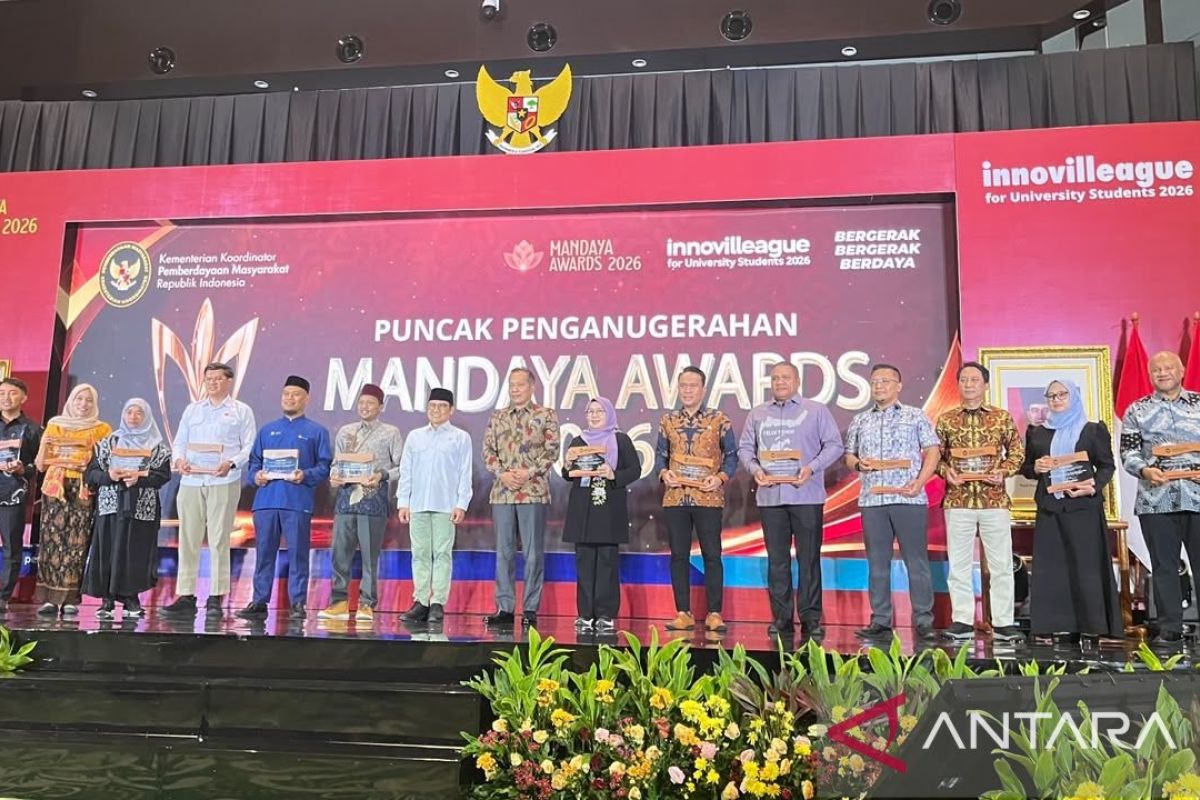
Jakarta (ANTARA) – Co-ordinating Minister for Community Empowerment Muhaimin Iskandar said the Mandaya Awards 2026 marked a turning point in the shift from aid towards sustainable empowerment, building communities’ self-reliance so that poverty can be eradicated.
The Indonesian Philanthropy Association (PFI) received a Mandaya Award 2026 for its Multi-Stakeholder Forum (MSF) Poverty Alleviation programme. Muhaimin said the MSF had successfully shifted social programmes away from charitable and fragmented initiatives towards structured, measurable collective impact focused on the self-reliance of rural communities.
“The measure of development success is not just the amount of social assistance, but the increase in people’s self-reliance and dignity, as well as their ability to become the main actors in sustainable development,” said the minister, widely known as Cak Imin, in Jakarta on Tuesday.
The Mandaya Awards target six groups of recipients, including local governments, villages, businesses, universities, Islamic boarding schools and community organisers. The awards are expected to encourage cross-sector collaboration and create a sustainable empowerment ecosystem to speed up the eradication of extreme poverty in Indonesia.
Together, the groups form a partnership network of more than 700 member institutions and cross-sector partners across Indonesia.
Using a Collective Impact approach, the MSF promotes a shift from short-term charitable aid to transformative empowerment efforts that sustainably and equitably build the capacity, access and economic institutions of rural communities.
Indonesian Philanthropy Association board chair Rizal Algamar echoed those remarks, saying the prestigious award belonged to the entire MSF ecosystem.
“The MSF is here to ensure that every rupiah of assistance delivers the greatest possible collective impact for the community,” Rizal said.
He said sustainable village development could not rely solely on physical assistance. The MSF therefore emphasises the integration of three key pillars in every intervention: Perspective, People and Policy.
To ensure long-term sustainability, the MSF uses an innovative blended-finance scheme and graduation model.
Before reaching its poverty-reduction target in 2031, the MSF plans to extend its interventions to more than 100 villages by 2030. The programme also aims to help households achieve self-reliance, increase villages’ per-capita income, strengthen village-owned enterprises (BUMDes), and integrate villages into an inclusive and sustainable development ecosystem.
Looking ahead, PFI and the entire MSF network are committed to expanding the impact of their collaboration. With a curated pipeline of villages and a network of more than 700 partners, the MSF is opening up opportunities for wide-scale replication.