
Minister Imipas reviews assimilation and education facilities at Warungkiara Prison
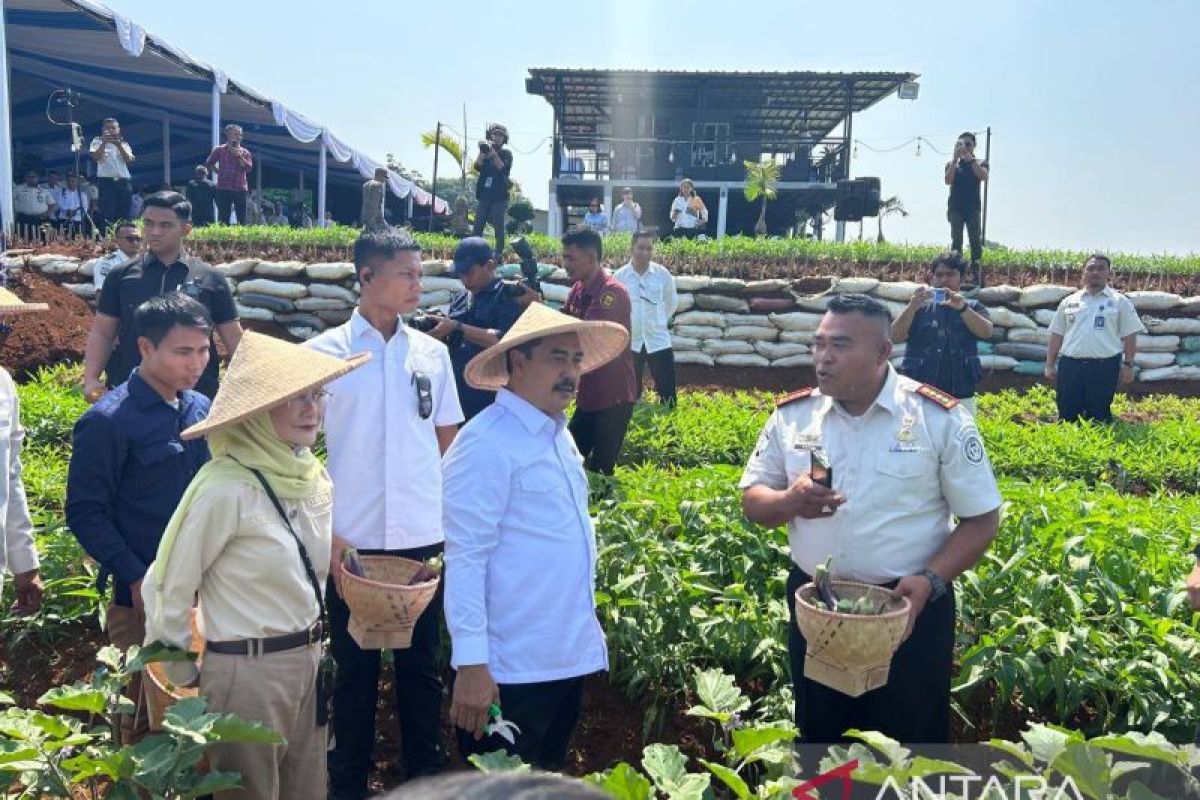
Sukabumi — The Minister of Immigration and Correctional Services, Agus Andrianto, inspected the assimilation and education facilities at the Warungkiara Class IIA Prison, Sukabumi Regency, West Java, on Wednesday.
The assimilation and education facilities at Warungkiara Prison serve as a centre for independence training based on agriculture, livestock, and fisheries for inmates. These facilities act as a pilot programme for food security in the Sukabumi region.
Accompanying the working visit were members of Commission XIII of the Indonesian House of Representatives (DPR RI) Dewi Asmara, the Director General of Correctional Services Mashudi, the Regent of Sukabuli Asep Japar, the Acting Head of the West Java Correctional Regional Office Kusnali, and representatives from the Sukabumi Regency regional leadership.
During the visit, Minister Agus and the accompanying guests took the opportunity to harvest agricultural produce from the prison, including purple and green eggplants.
Agus also spoke with inmates involved in these productive training programmes, offering encouragement to remain optimistic about their lives both during and after their incarceration.
The retired police general stated that the efforts undertaken by Warungkiara Class IIA Prison are intended to support the 15 action programmes of the Ministry of Immigration and Correctional Services and the broader transformation of the correctional system.
“I personally wish to express my gratitude for their performance. Firstly, they are supporting the government’s food security programmes, even though currently, the produce is being used to meet the needs within prisons and detention centres within the community,” said Agus.
He expressed hope that the food self-sufficiency programme at Warungkiara Prison would eventually contribute to the community through the economic activities conducted there.
“My hope is that once profits are generated, they can contribute in the form of social assistance to the community, whether through providing basic food supplies or supporting infrastructure repairs, such as the house renovation project conducted earlier. This is a positive effort because the correctional system exists within the community; therefore, it must do good for the people,” Agus added.
Meanwhile, the Acting Head of the West Java Correctional Regional Office, Kusnali, stated that Warungkiara Class IIA Prison is optimising its ‘SAE Berkah Mandiri’ assimilation and education facility across 3.5 hectares. The facility develops various productive sectors, including agriculture, horticulture, poultry, sheep farming, cattle farming, freshwater fisheries, and integrated environmental management and food security.
Through the optimisation of SAE Berkah Mandiri, he noted, the department aims to provide training that is not only security-oriented but also capable of generating economic value, supporting national food security, enhancing the quality of rehabilitation, and fostering a productive and independent community.
“These activities are part of supporting social reintegration and building a positive image of the correctional system within society,” said Kusnali.
Separately, the Head of Warungkiara Prison, Kurnia Panji Pamekas, stated that the food security area covers a total of 7 hectares. This includes approximately 1 hectare for livestock and fattening located within the residential block, 2 hectares of active productive agricultural land, and 3.5 hectares dedicated to agricultural development and food security.
The area also includes supporting infrastructure such as poultry houses, sheep pens, freshwater fish ponds, storage warehouses, farm roads, irrigation channels, and other supporting facilities.
“This area serves as a productive training facility that provides job skills to inmates while simultaneously producing various economically valuable agricultural, livestock, and fishery commodities,” said Kurnia.