
Minister Iftitah: Transmigration's Contribution Far Greater Than Just Moving People
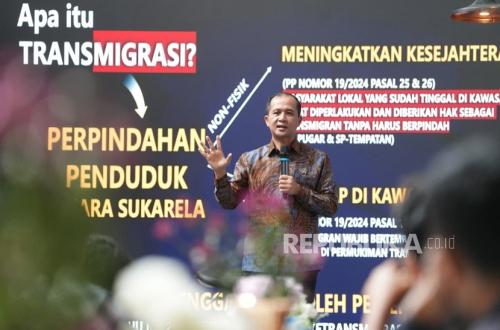
Behind the birth of thousands of villages, hundreds of districts, and several new provinces in Indonesia lies the long trail of the transmigration programme. According to Minister of Transmigration M. Iftitah Sulaiman Suryanagara, transmigration areas have now developed into 1,567 definitive villages, 466 sub-district capitals, 116 district capitals, and 3 provincial capitals, making it one of the important foundations of regional development in Indonesia.
“All this time, people have known transmigration only as a programme to move people. In fact, its contribution is far greater. Transmigration has given birth to more than 1,500 definitive villages, 466 sub-district capitals, 116 district capitals, and even three provincial capitals in Indonesia,” said Minister Iftitah during a Media Gathering of the Ministry of Transmigration in Jakarta, Friday (26/6/2026).
The three provinces are North Kalimantan, West Sulawesi, and South Papua, which grew from transmigration areas. Since it was first implemented, the transmigration programme has also facilitated the relocation of approximately 9.1 million people, who then became the driving force behind the birth of settlements, economic centres, and new governance in various regions of Indonesia.
“Transmigration has opened up new areas which then developed into centres of economic growth as well as centres of government. This shows that transmigration has a strategic role in building Indonesia,” he said.
According to Minister Iftitah, these achievements serve as a foundation for transforming transmigration policy to make it more relevant to future development challenges. If the orientation was previously population distribution, the government’s focus has now shifted to creating new economic growth centres capable of attracting investment, opening job opportunities, and improving community welfare.
“If the focus used to be population distribution, now our focus is creating economic growth. The measure of success is no longer how many people are moved, but how many people can be made prosperous,” he stressed.
He explained that the development of transmigration areas is now carried out in an integrated manner by combining settlements, industrial zones, modern agriculture, education, health services, and investment so that the economic benefits grow sustainably. “If transmigration used to open new areas, today our task is to make those areas new engines of economic growth. That is where investment grows, jobs are created, and community welfare increases. That is the new face of Indonesian transmigration,” said Minister Iftitah.