
Minister Iftitah: Land Once for 75 Families Now Set to Create Jobs for 20,000
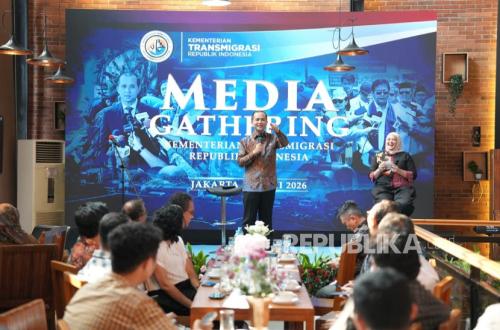
The transmigration paradigm is undergoing a major transformation. Where transmigration land was once primarily used for distribution to a number of household heads, the same areas are now being directed to become centres of economic growth capable of creating jobs for tens of thousands of people.
Minister of Transmigration M. Iftitah Sulaiman Suryanagara cited the development of the Rempang-Galang area in the Riau Islands as an example. He said approximately 150 hectares of transmigration land, which previously was only sufficient for around 75 families, is now projected to become a shipyard industrial estate with the potential to open up job opportunities for up to 20,000 people.
“Previously, 150 hectares were divided into plots for about 75 families. Now, the same land can become an industrial area that opens up employment opportunities for up to 20,000 people. The impact is certainly far greater for the community,” Minister Iftitah said during a Transmigration Ministry media gathering in Jakarta on Friday (26/6).
He stressed that this transformation does not mean ignoring community rights, but rather optimising the use of transmigration areas to provide much broader economic benefits. “If in the past the orientation of transmigration was to divide land, now our orientation is how that land can create prosperity for far more people through investment, industrialisation, and job creation,” he said.
According to Minister Iftitah, the initial phase of the Rempang-Galang area development alone is expected to absorb around 1,000 to 3,000 construction workers before the industrial estate becomes fully operational. He added that the transformation of transmigration is also changing the way the government develops areas.
He said the focus is no longer solely on providing houses or land, but on building an economic ecosystem integrated with industry, education, health services, infrastructure, and investment so that the benefits are sustainable. “Today’s transmigration is no longer just about land ownership, but about how the area can deliver jobs, investment, education, health services, and sustainable economic activity,” he said.
Therefore, the development of transmigration areas will continue to prioritise collaboration between the government, the business sector, and the community so that each area grows as a new centre of economic growth. “We want people to come not just to get a house or land, but also to obtain job opportunities and a better future. That is the new direction of transmigration transformation,” Minister Iftitah asserted.
Through this transformation, the Ministry of Transmigration is optimistic that transmigration areas will develop into new economic growth centres that attract investment, create jobs, strengthen regional economies, and accelerate equitable development across various regions of Indonesia.