
Minister: IDR 2 Trillion Not Mill Profit, but Theft of People's Rights
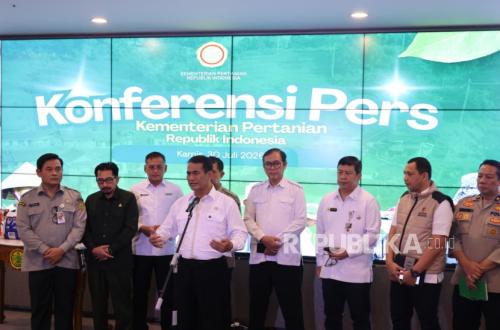
Agriculture Minister Andi Amran Sulaiman has responded to the viral issue of rice mills earning IDR 2 trillion per month during the harvest season, a figure previously cited by President Prabowo Subianto. The Minister assessed that the President was very polite in conveying this matter, whereas it is a true fact that harms farmers. This situation actually occurs within a single corporate group with many business units under it or through contract manufacturing schemes. According to the Minister, this is very detrimental to the public because it deceives consumers.
Minister Amran presented the results of an in-depth analysis of the national rice trading system titled ‘Rice Mafia Emergency’. The analysis showed losses reaching IDR 98 trillion due to the circulation of premium rice that does not meet quality standards, plus potential consumer losses of up to IDR 71.9 trillion per year from the circulation of non-compliant fortified rice. ‘These trillions of rupiah are not reasonable business profits. This is robbing the people’s rights,’ Minister Amran stressed in a statement on Thursday (30/7/2026).
The 2025 Food Security Budget was recorded at IDR 144.6 trillion, channelled through ministries and agencies (IDR 59.42 trillion), State-Owned Enterprises (IDR 63.00 trillion), Regional Transfers (IDR 22.17 trillion), and financing (IDR 0.05 trillion). From these subsidies, national paddy production was valued at IDR 537 trillion with rice production of 34.69 million tonnes, referencing a Highest Retail Price of IDR 13.5 million per tonne and an average price according to the Ministry of Trade of IDR 15.5 million per tonne. However, the distribution of profits is unequal. Farmers only receive household income of IDR 1.87 million from an allocation of IDR 215 trillion.
Rice milling entrepreneurs or RMUs actually receive the largest portion, amounting to IDR 259 trillion, with specific findings that one corporate group reaped unreasonable profits of up to IDR 2 trillion per month from quality fraud practices. Minister Amran explained the analysis results of government rice subsidies. The rice supply chain is dominated by large entrepreneurs or conglomerates. Conglomerates utilise government subsidies for commercial activities up to 40 per cent, and take maximum profits by raising prices above the Highest Retail Price.
Field findings some time ago showed that much premium rice does not comply with the Indonesian National Standard, with a violation rate reaching 85.56 per cent. As much as 39.75 per cent of the total premium rice in circulation, equivalent to 12.2 million tonnes, is estimated to violate standards or constitute consumer fraud, with total losses reaching IDR 98 trillion. The National Police Food Task Force recorded that throughout the 2024 to 2025 period, it handled 93 food mafia cases with a total of 77 suspects, comprising 46 rice cases, 27 fertiliser cases, 16 cooking oil cases, and 4 internal employee cases. Additionally, 2,231 fertiliser retailer and distributor permits have been revoked.
Specifically for rice criminal cases, throughout 2025 there were 30 cases with 36 suspects. Entering 2026, enforcement continued with 2 cases and 6 suspects. A recap from the National Police Food Task Force as of 30 July 2026 mentioned different figures, namely 38 cases with 39 suspects for 2025, with 21 cases already at P-21 stage and in trial proceedings, while 2 cases with 1 suspect for 2026.
From the total national paddy production absorption of 65 million tonnes per year, large-scale mills with a capacity of 20 tonnes per hour, numbering 1,056 units, control 40 per cent of the paddy supply or 25 million tonnes per year. Small-scale mills with a capacity of 0.5 tonnes per hour, although far more numerous at 161,401 units, also absorb 40 per cent or 25 million tonnes per year. Meanwhile, medium-scale mills, 7,332 units, absorb 20 per cent or 15 million tonnes per year. This pattern confirms that large mills, despite having far fewer units, are able to control a paddy supply equivalent to all the small mills numbering hundreds of thousands of units. In the current staple food trade supply chain, rice flows from farmers through collectors, distributors, sub-distributors, wholesalers, to retailers before reaching the final consumer. This long chain generates middleman profits of IDR 313.08 trillion.
Therefore, the government is promoting an alternative scheme through Village or Sub-district Cooperatives (Koperasi Desa/Kelurahan Merah Putih), which shortens the distribution chain directly from farmers to final consumers. This scheme has the potential to generate a fairer margin for farmers and consumers amounting to IDR 50 trillion.
Fortified rice is regulated under two standards, namely SNI 9314:2024 for fortificant rice kernels and SNI 9372:2025 for fortified rice. Every 100 grams of fortified rice must contain a minimum of 0.25 milligrams of vitamin B1, 0.25 to 0.38 milligrams of folic acid, 1.0 to 1.5 micrograms of vitamin B12, 3.50 to 5.25 milligrams of iron, and 3.0 to 4.5 milligrams of zinc, with a mixing ratio of fortificant kernels to milled rice of at least 1 per cent. Results of supervision by the National Food Agency in DKI Jakarta in June 2026 on 15 brands of fortified rice found that only 3 brands met the requirements, while 12 other brands were declared non-compliant, with selling prices ranging from IDR 17,580 to IDR 42,500 per kilogram. The Highest Retail Price for premium rice is IDR 14,900 per kilogram, while the average price of non-compliant fortified rice reached IDR 22,665 per kilogram, a difference of IDR 7,765 per kilogram. Assuming 30 per cent of national premium rice consumption of 30.9 million tonnes shifts to fortification, or equivalent to 9.2 million tonnes per year, potential consumer losses are estimated to reach IDR 71.9 trillion per year. Following up on these findings, Minister Amran revealed that on Friday his office will announce the names of non-compliant fortified rice producers and revoke their business permits. A study by the Indonesian Fortification Coalition shows the estimated additional production cost for fortified rice is only around IDR 700 to IDR 1,000.
Source: jawawa.id (https://jawawa.id/newsitem/minister-idr-2-trillion-not-mill-profit-but-theft-of-peoples-rights-1785383509)
Originally published by Republika (https://ekonomi.republika.co.id/berita/tiyvmf472/mentan-tegaskan-rp-2-triliun-bukan-untung-penggilingan-tapi-merampas-hak-rakyat), translated from Indonesian