
Minister Hopes School Holiday Transport Stimulus Boosts Economic Growth
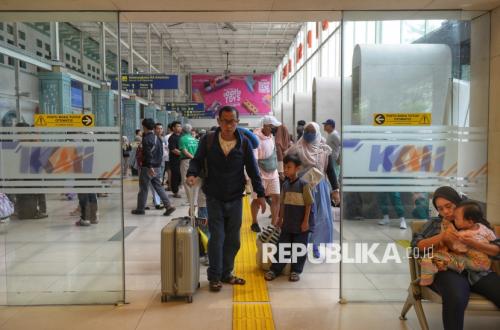
Transport Minister Dudy Purwagandhi stated that various stimulus measures in the transport sector during the 2026 school holiday period are intended to ease the public’s travel costs while simultaneously boosting economic growth through increased mobility. According to Dudy, the government, through the Ministry of Transportation, has designed a number of incentives valid for specific periods during the holiday season. “The transport stimulus covers all modes of transport, including land, sea, air, and rail,” Dudy said during a media briefing on current strategic issues in the transport sector in Jakarta, Friday (26/6/2026). For ferry transport, Dudy said the exemption of port service fees is valid from 20 June to 5 July 2026. This programme is estimated to benefit around 160,000 passengers and 377,000 vehicles crossing major routes such as Merak–Bakauheni, Ketapang–Gilimanuk, Padangbai–Lembar, Kayangan–Pototano, Sape–Labuan Bajo, Kuala Tungkal–Tanjung Uban, and Ajibata–Ambarita. “For the sea transport sector, a 30 percent discount on the base fare for passenger ships operated by PT Pelayaran Nasional Indonesia (Pelni) is being provided,” Dudy said. He explained that the discount is valid during the school holiday period, from 20 June to 15 August 2026, with an estimated 693,000 passengers benefiting. The price reduction applies to all economy class passengers on all subsidised passenger ship routes (public service obligation/PSO). Meanwhile, in the aviation sector, Dudy continued, the government is providing an incentive in the form of a 100 percent exemption from Value Added Tax (PPN) on the base ticket fare, valid from 24 June to 5 July 2026. Dudy said the government is also offering a 30 percent discount on economy class train tickets for the period of 27 June to 5 July 2026. “This programme is expected to be utilised by around 1.043 million passengers,” Dudy added. Dudy expressed hope that the public will fully utilise all these stimulus measures. He is optimistic that the incentives will have a positive impact on the national economy. “With high public mobility, we expect good economic growth during the holiday period,” he continued. On the same occasion, Dudy also explained the development of airfare tariff policy. He stated that the government has not yet implemented changes to the upper limit tariff (TBA) and is still using the fuel surcharge adjustment mechanism. “Currently, regarding ticket prices and the upper limit tariff, discussions are still ongoing. What is currently in effect is the fuel surcharge adjustment,” he said. According to Dudy, this step was chosen as it is considered the most appropriate way to accommodate the recent rise in avtur prices. He noted that this has received a positive response from the national aviation industry. “The airlines consider that the fuel surcharge adjustment can address the increase in avtur prices,” Dudy revealed. Nevertheless, he continued, the government has drafted a new formulation for the upper limit tariff. Dudy said this policy will be implemented once fuel prices stabilise again. “Perhaps in due course, when fuel prices have returned to stability, we will implement the TBA with the new formula,” he added. Dudy noted that the evaluation is not merely about changing the tariff formula but also reviewing various flight cost components last compiled in 2019 to align with current industry conditions. Dudy is optimistic that the new upper and lower limit tariffs can be enforced once global avtur prices and geopolitical conditions become more stable. “We are seeing that world fuel prices have started to decline. If global geopolitical conditions also improve, we will implement the latest upper and lower limit tariffs,” Dudy said.